


A Tyrannosaurus's 'temperature was taken' 66 million years later. Here's what was discovered
The teeth of one of history's most famous predators preserved information about how warm its body was. New data helps to resolve a long-standing debate about dinosaur physiology and understand how tyrannosaurs could live even in cold climates.
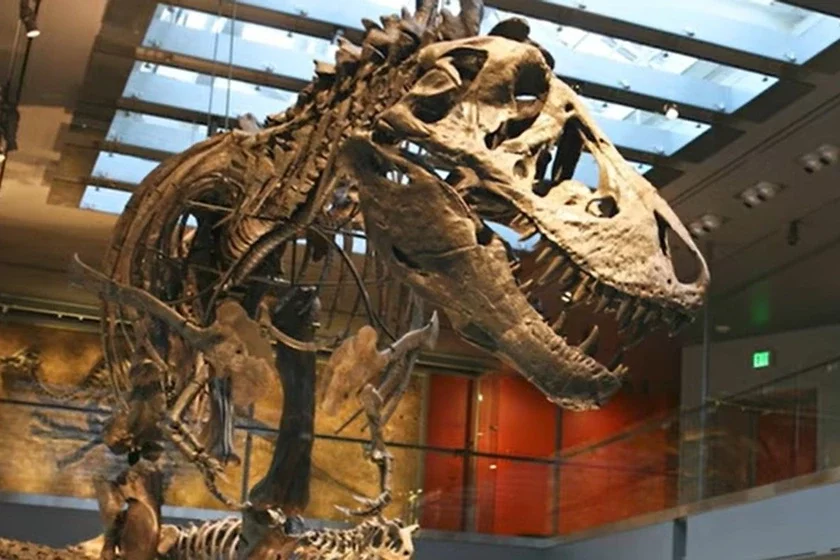
For a long time, dinosaurs were imagined to be similar to modern reptiles, and it was assumed that their body temperature depended on the environment. But over the last decades, more and more evidence has emerged that at least some of them could generate their own heat and maintain a high body temperature.
This was indicated by the kinship of dinosaurs with modern birds, the growth rate of their bones, as well as discoveries in high latitudes where winters were cold. However, this evidence was mostly indirect. Furthermore, dinosaurs were a very diverse group, so it cannot be assumed that all of them had the same metabolism.
Now scientists have obtained more direct data about Tyrannosaurus rex (Tyrannosaurus rex). They studied the teeth of an individual nicknamed Thomas, whose remains are preserved at the Natural History Museum of Los Angeles County.
Tooth instead of thermometer
As IFLScience writes, the chemical composition of tooth enamel allowed scientists to determine the temperature at which it formed.
The secret lies in the bonds between heavy isotopes of carbon and oxygen: at lower temperatures, such bonds form more frequently. By measuring their proportion in tooth enamel, scientists can determine the temperature at which the tooth grew.
Enamel is particularly well-suited for such analysis. Bones are constantly remodelled throughout life, while the crystalline structure of enamel is very strong, making it more resistant to chemical changes under environmental influence.
There is, however, a downside: the fossil itself has to be damaged for the analysis.
36.3 degrees
Analysis showed that Thomas's teeth formed at a temperature of about 36.3°C, plus or minus two degrees. This is very close to human body temperature.
But a high temperature did not yet mean that the tyrannosaurus generated heat itself. It could have been related to the warm climate in which the animal lived.
To test this, scientists studied the teeth of crocodiles from the same Hell Creek Formation in Montana, where Thomas died. Their temperature turned out to be around 30°C.
Thomas and these crocodiles might not have lived at exactly the same time, but the temperature difference still indicates that Tyrannosaurus rex was an endotherm, meaning it generated its own heat.
What this changes in our understanding of the tyrannosaurus
The ability to maintain a high body temperature requires a lot of energy, and therefore more food. But it could also give the predator advantages. A warm-blooded Tyrannosaurus rex could pursue prey longer.
New results also help to understand how tyrannosaurs could live in cold regions. Remains of representatives of this group have been found in Alaska, where even in the time of dinosaurs, winters were cold. The ability to generate their own heat could have helped them endure such conditions.
This could also have played a role in the dispersal of Tyrannosaurus rex ancestors. According to one of the study's authors, Robert Eagle, high body temperature and endothermy could have facilitated their movement between Asia and North America via the Bering Strait region.
Now researchers want to apply their method to other ancient animals. They hope to find out at what stage of evolution the ancestors of modern birds acquired the ability to maintain a high body temperature.
-
U.S. authorities want to test an invisible "heat ray" at the border that makes people feel like they are burning
-
Nobel laureate expects human-level artificial intelligence to emerge in two to three years. What will smart technology be capable of?
-
Critical vulnerabilities found in PHP. 70 percent of websites at risk
Now reading


"About 70% of Russian visitors turned out to be vatniks." An ex-guide from the WWII museum, detained by his own tour group, is now popular in Warsaw — we spoke with him

"About 70% of Russian visitors turned out to be vatniks." An ex-guide from the WWII museum, detained by his own tour group, is now popular in Warsaw — we spoke with him


Tsikhanouski ironizes about his wife: Lukashenka helps and cares for her, even when there was a threat to children, all information was passed to Poland


Comments