


Russia and North Korea have almost completed the first road bridge between the countries
Thanks to the new bridge between Russia and North Korea, direct road traffic will be possible for the first time. Officially, it is intended to develop trade and tourism, but researchers believe that in reality, the new crossing could simplify military logistics and make cargo transportation less noticeable for satellite surveillance.
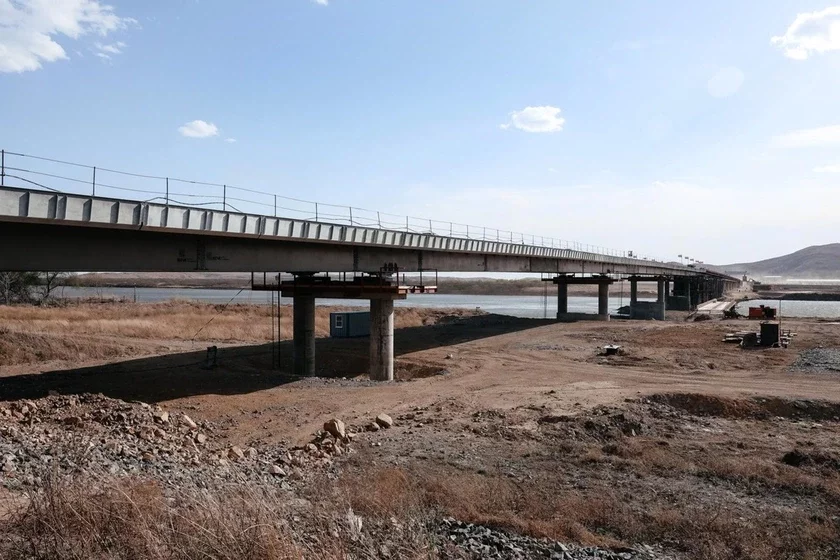
The bridge over the Tumen River (Tumangan) will connect the Russian settlement of Khasan in the Far East and the North Korean Tumangan. It runs next to the existing railway "Friendship Bridge", which until now was the only land crossing between the two states.
The bridge is about 1 km long and seven meters wide with two lanes of traffic. Together with access roads, the entire complex has a length of 4.7 km. Satellite images also show the construction of auxiliary infrastructure on the Russian side, including a helipad.
As The Guardian writes, North Korea has already completed its part of the construction, including customs and quarantine points. The opening was planned for June 19, but the Russian side did not manage to complete the work by the specified date. A new opening date has not yet been announced.
Moscow and Pyongyang are not making a secret of this project, stating that it is aimed at expanding trade and tourism. Russian Minister of Transport Andrei Nikitin said that the new crossing should increase trade turnover and contribute to the development of border areas. The DPRK state agency KCNA also reported that the bridge would facilitate the movement of people, tourism, and exchange of goods.
However, a new investigation by the Ukrainian human rights group Truth Hounds suggests that the bridge is intended more for creating a hidden military-logistics corridor than for stimulating the economy.
According to the investigation, the economic viability of the project appears doubtful. Researchers estimate that the construction cost more than 100 million dollars, while the volume of trade between Russia and the DPRK in 2024 was only about 34 million dollars.
In addition, tourism from Russia to North Korea remains tightly controlled. Foreigners are mainly allowed as part of organized groups accompanied by guides. In 2025, about 10 thousand Russians visited the country, with most of them heading to Pyongyang, which is more than 500 kilometers from the new bridge.
The authors of the investigation suggest that the bridge primarily has strategic importance. In their opinion, road transport is much harder to track from satellites than rail transport.
The type of wagon visible in the image can tell a lot about the cargo. Certain categories of goods are transported in open wagons, which allows them to be identified. Trucks, however, almost always look the same in satellite images, and loading can be done in different places, whereas trains are tied to a few railway hubs.
In addition, loading and unloading of trucks can happen much faster than in the case of wagons, which remain under satellite surveillance for longer.
Another advantage of the new route is that road transport is not dependent on the different railway gauge widths in Russia and the DPRK. On the railway, wagons require a change of wheelsets when crossing the border, but for trucks, there is no such problem.
According to Truth Hounds, the new road could be used to transport North Korean military personnel, construction brigades, and officials to Russia, as well as for supplying the DPRK with Russian technologies and other resources.
Active construction of the bridge began after the signing in June 2024 of an agreement on a comprehensive strategic partnership between Russia and the DPRK. Since then, according to open data, North Korea has begun supplying troops, artillery ammunition, and ballistic missiles to support Russia's war in Ukraine.


In Russia's Yekaterinburg, a scientist from the Academy of Sciences was beaten to death after preventing children from riding quad bikes on experimental fields


Comments