


Should we rebury Ivan Lutskievich? Or at least precisely determine his burial place?
The story of Ivan Lutskievich, who was born 145 years ago (June 9, 1881), is the story of how one person can move mountains. At the same time, it is a reminder of the pleasure of serving the Belarusian cause and spreading Belarusian identity. His last dream was to return to Vilnius.

Ivan Lutskievich, one of the founders of the first legal Belarusian newspaper «Nasha Dolya» and the first «Nasha Niva», the initiator of the creation of the first Belarusian museum and the first Belarusian gymnasium, and also one of the figures who stood at the origins of the Belarusian People's Republic, became the hero of the new episode of the YouTube project SercaEuropy.
Ivan Lutskievich was born on June 9, 1881, in Šiauliai (today's Lithuanian Šiauliai) into the family of a former military railwayman. Due to his father's service, the family often moved, so he studied in Liepāja and Minsk, where a house was purchased.
From childhood, he was familiar with the works of Vincent Dunin-Martsinkevich, with whom his father was friends. Lutskievich became aware of his Belarusian identity early and strove to bring this understanding to others. Already in 1897, together with his brother Anton, he created a circle in the gymnasium that fostered Belarusian national consciousness.

At the same time, the young man met Kazimir Rafal Kastravitsky (who would become known under the pseudonym Karus Kahanets) and the future archaeologist Henryk Tatura. The latter told Ivan the «secret» that the depths of the Belarusian land held many treasures just waiting to be found. Later, Lutskievich began collecting ancient artifacts and used them for the benefit of Belarusian culture.
Fatal Arrest After a Demonstration in St. Petersburg
Ivan Lutskievich was one of the most educated representatives of the young Belarusian movement. He graduated from the Law Faculty of St. Petersburg University, the Archaeological Institute, and continued his studies in Vienna, where he established contacts with representatives of the Ukrainian national movement.
In St. Petersburg, Ivan became captivated by revolutionary ideas and after one of the demonstrations, he was imprisoned in «Kresty» prison, where he spent four months and contracted tuberculosis — an illness that would lead to his death 16 years later. After his release, he participated in the creation of the Belarusian Revolutionary Hramada, but quickly came to the conclusion that one should start with enlightenment and cultural work.
During the 1905—1907 revolution, while living underground, he and his brother Anton founded the first legal Belarusian newspaper «Nasha Dolya» (after an unsuccessful attempt with «Svaboda»). Despite the confiscation of the circulation, the brothers did not stop and founded «Nasha Niva».
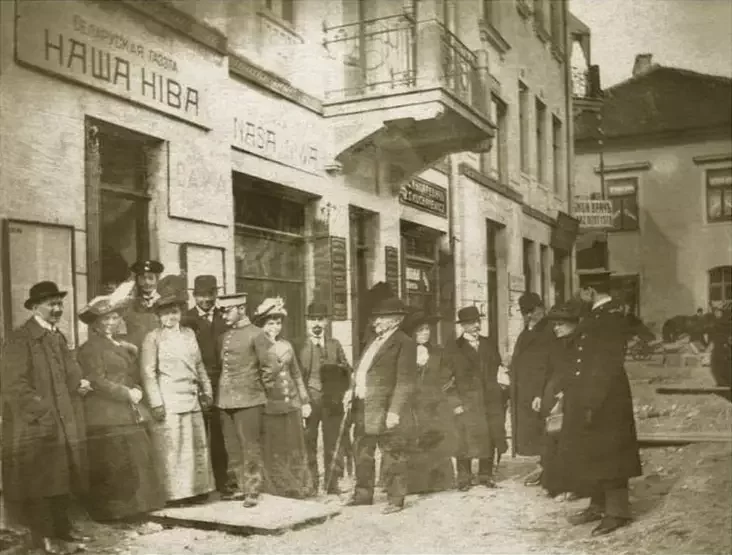
Lutskievich traveled extensively throughout Belarus, established a network of correspondents, collected antiques and resold them, and used the proceeds (about 40 thousand rubles) to maintain the newspaper, and also supported young authors, including Yanka Kupala, Yakub Kolas, Maksim Bahdanovich.
As historian Vasil Herasimchyk notes, Ivan Lutskievich adhered to the belief that even small steps matter and that one should work for the Belarusian cause under any government.
During the First World War, activities for the benefit of Belarusian identity became even more successful. Ivan became one of the organizers of the Refugee Aid Society, which expanded the Belarusian movement beyond the country's borders and prepared the ground for the proclamation of the BPR.
Despite a severe illness, on the eve of March 25, 1918, Lutskievich came to Minsk and participated in the negotiations that led to the proclamation of the independence of the Belarusian People's Republic.
After returning to Vilnius, he could no longer walk and remained bedridden. In April 1919, when the Bolsheviks occupied the city, they came to him as well, but seeing his serious condition, they did not arrest him.
Last Journey
After the Poles arrived, Lutskievich's fiancée, Yuliana Menke — a representative of a well-known Vilnius German family of entrepreneurs — persuaded him to go for treatment to Zakopane with her sister Lyalya, who also suffered from tuberculosis.

The preparation took several months, and on June 16, 1919, the seriously ill Lutskievich was carried by Belarusian activist Jan Charepuk (Zmahar) into a car that took him from Vilnius to Lida, from where they traveled by train to Warsaw.
In Warsaw, Lutskievich and his companions faced an unexpected problem: despite the presence of the Belarusian Committee and activists, they could not find accommodation. As a result, a Jewish carter acquaintance helped out, arranging for Lutskievich to stay in a small hotel.
There, he waited several days for Belarusians, hoping for a meeting, but only Branisłaŭ Taraškievič came, who later brought his Polish acquaintances to him. Even before leaving Vilnius, the doctor warned Yuliana Menke that this journey for Lutskievich was a one-way trip.
On June 21 at 8:30 PM, Lutskievich and his escort departed from Warsaw for Zakopane; Charepuk managed to secure a separate compartment for him. The next day they arrived at their destination. In Zakopane, Lutskievich felt an improvement and a surge of strength for some time; hope appeared that he would recover and return to Vilnius to continue the Belarusian cause — especially since his brother Anton was at that time in Paris at the peace conference, seeking international recognition for the Belarusian People's Republic.
Lutskievich spent his last two months in Dłuski's sanatorium in Kościelisko. It was here, at Lyalya Menke's request, that her sister Yuliana, Ivan's fiancée, arrived on August 13. On her way from Vilnius, she stopped in Warsaw to inform the Belarusian Committee activists of his critical condition and urge them to come for the funeral.

The meeting with Yuliana was touching: Lutskievich proposed to her and expressed hope that after returning to Vilnius, they could get married — but this was not destined to happen.
On the evening of August 20, Ivan Lutskievich died. His last words, addressed to Yuliana, were: «You are kind.» Yuliana took charge of organizing the funeral together with Ukrainians Mykhal and Ostap, who were also undergoing treatment at the sanatorium.
As Yuliana later wrote in her memoirs, Ivan Lutskievich was buried on August 23 in Zakopane in the New Cemetery on Nowotarska Street — awaiting Belarusians, including his brother Anton, but none of them managed to arrive.
During his lifetime, Ivan Lutskievich dreamed of being buried in Vilnius, but this wish was not fulfilled: the Polish-Soviet war prevented the reburial plans.

Fate of Memory
Despite the significance of Lutskievich's figure, due to the turmoil of war, his grave in Zakopane was not properly honored: a monument was never erected there, although it was written about and such intentions existed.
During World War II, the grave was damaged but existed until 1963. Afterwards, it disappeared — another burial was made in its place, as there was no one to pay for the grave: relatives were cut off by the Soviet border.
In 1972, Marian Pieciukevič, the third head of the Belarusian Museum in Vilnius, located the burial place and determined that it already contained the grave of the Zaliński family.
Only in 1991 did Oleg Latyshonok find documents about Lutskievich's burial, though without a precise location. He took a handful of earth from the presumed spot and transported it to Vilnius.
On May 18, a symbolic burial — without remains, only with this earth — took place in the Rossa Cemetery in Vilnius, in the presence of Belarusians from Grodno, Polotsk, Minsk and other cities, as well as Vilnius Belarusians. And in 1993, a monument to Ivan and Anton Lutskievich was erected at this spot — effectively a cenotaph.

In 2021, Belarusian activists visited Zakopane and were able to identify the place where the Zaliński family is buried. It turned out that in 2015-2016, a third burial had already appeared on the same plot. Thus, Ivan Lutskievich's remains are currently beneath two later graves.
Theoretically, at least a symbolic marker could be placed there in his memory, or even an exhumation could be carried out. However, this requires full certainty that Lutskievich rests in this exact spot.
Additional clues may come from neighboring burials: nearby are the graves of people buried in 1920 — Ludwik Bachnakevich (1861—1920), Romuald Sabatkowski (1885—1920) native of Minsk, and artist Vladimir Blotsky (1885—1920). If old photographs of these graves or Lutskievich's own burial site before 1963 could be found, this could provide evidence for a possible exhumation.
For now, the situation remains paradoxical: Ivan Lutskievich does not even have a mention at his burial place. And so it would be important for Belarusians who come to Zakopane to visit not only «Morskie Oko,» but also this plot in the cemetery on Nowotarska Street (square K6/10/9), where he likely rests.
The article was first published on March 31, 2026.
Now reading


"Nadzeya Stsyapanawna." Mikita Naydzionau Published a Poem Born in Zhodzina Prison. Such a Poetic Epic Has Not Yet Existed in Belarusian Poetry of the 21st Century.

"Nadzeya Stsyapanawna." Mikita Naydzionau Published a Poem Born in Zhodzina Prison. Such a Poetic Epic Has Not Yet Existed in Belarusian Poetry of the 21st Century.

"There are people in Belarus who don't like the Russian flag, the Soviet flag." A Russian man's BMW X7 with German license plates was damaged in Minsk


Comments