


A beaver strolls through the airport parking lot, hares merrily hop in the "Minsk-World" residential complex, and bears occasionally venture into settlements closest to the capital. The "Minsk-Novosti" agency investigated why four-legged guests from the forest are increasingly appearing among people.

What I see, I photograph
— Increasingly, photos and videos of wild animals spotted in the capital or on suburban roads can be seen on social media. Recently, hares were filmed on a children's playground in a residential building's courtyard. How is the migration of forest inhabitants to such unusual places for them explained?
— Primarily, by the improving quality of the urban environment thanks to the development of parks, forest parks, and green zones, explains Pavel Veligurov, a senior researcher at the Laboratory of Population Ecology of Terrestrial Vertebrates and Bioresource Management of the NAS of Belarus Scientific and Practical Center for Bioresources. — For example, in Minsk, a protective zone was fenced off along the railway to prevent unauthorized people from entering. However, the distance between the fence bars turned out to be quite sufficient for medium-sized wild animals. They can freely enter and move alongside the railway track. At the same time, the fence reliably protects them from large forest predators.
As for hares, according to the interlocutor, they have long settled in the forest park zones of the capital. Their numbers have hardly changed since the beginning of the 21st century. But if in earlier years city residents didn't have mobile phones with built-in cameras at hand, now every passerby has such a gadget in their pocket. The ability to instantly capture an encounter with an animal and upload the footage to the internet is the second reason why wild animals are seemingly noticed much more often within the city today.
Clumsy guests from the north
However, the number of bears in Belarus is indeed increasing. Over the past 15 years, the population of these large predators in our forests has grown from 120 individuals to almost 1,300. At the same time, the distribution of the population across the country is very uneven: about 74% of bears are concentrated in the Vitebsk region, approximately 23% in the Minsk region, and only 3% in the Mogilev region.
"Why the brown bear population is growing in our country, no one knows for sure," notes the zoologist. "The reasons for this phenomenon are linked to improved natural conditions and a good food supply. There are also assumptions that animals are migrating to us from the northern regions of Russia, where their population density is traditionally higher. The state border is not closed for animals, so bears willingly move into free territories in search of more favorable places to build their dens."
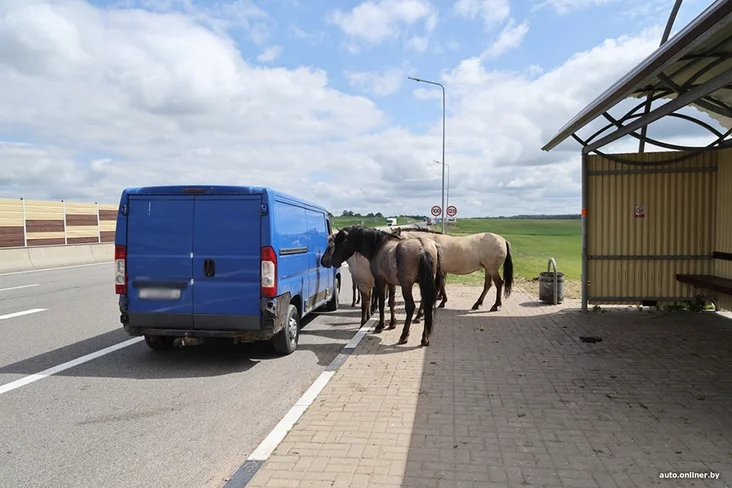
Who's waiting for the bus?
Recently, a curious incident sparked heated discussion on social media: near Volozhin, at a rural bus stop, local residents noticed wild tarpans. In the published footage, the herd looked as if the animals were deliberately hiding under the shelter from the intense heat.
According to Pavel Veligurov, these unique horses were brought to the Naliboksky Landscape Reserve in 2019 as part of an ecological experiment. To prevent the rapid overgrowth of floodplain meadows with aggressive shrubs, biologists decided to use natural grazing by wild herds. And the tarpans are doing an excellent job with their natural task.
However, over time, a part of the free-ranging herd migrated beyond the forest and moved closer to a busy highway, causing the horses to periodically come out onto the roadway near the village of Darahun. They were captured and relocated back to the forest, to their settlement area.
"In this case, natural processes of wild species dispersal are occurring," the interlocutor summarizes. "There is currently no need to take special measures to prevent such incidents."
The reserve administration keeps the situation under control and closely monitors the movements of the herd.
Keep your distance
— What basic safety rules should be followed during an unforeseen encounter with forest guests?
— Animals, finding themselves in an unfamiliar urban environment, experience strong stress, warns the zoologist. — Predicting their actions in such a state is almost impossible. In addition, wild mammals can be carriers of deadly diseases, including rabies. That is why maximum distance must be maintained when encountering them.
Remember that forest inhabitants usually fear humans themselves and try to hide at the first opportunity. The sooner an animal notices you, the faster it will try to get out of your way. If a large animal appears before you, under no circumstances make sudden movements, do not panic, and try to calmly, without fuss, retreat to a safe distance.

It's useful to gnaw
Beavers within city limits are a special story. Today in Belarus, their population is within optimal numbers, totaling about 52,000 individuals. According to Pavel Veligurov, there is currently very low demand for these rodents among hunters, so the animals are found in almost all settlements where there are even minimal water bodies: a river, stream, lake, or pond. Beavers phenomenally easily adapt to any living conditions. There are known cases where they successfully settled even in treeless areas and built durable dams from corn stalks.
"These are strictly territorial animals that aggressively defend their inhabited plot from outsiders," emphasizes the interlocutor. "Young individuals are often forced to explore new urban water bodies simply because natural wilderness areas are already occupied by their kin. People are not always happy with such a neighborhood. Sometimes, beaver dams cause flooding of garden plots and roads, and the animals themselves are not opposed to gnawing valuable fruit trees in gardens."
However, there are also positive examples in the world of beavers' impact on infrastructure. In the Brdy Landscape Park (Czech Republic), authorities from 2018 could not approve a project to re-wet the territory, estimated at about $1.2 million. While engineers and officials were drowning in bureaucratic approvals for years, beavers that came to a drainage canal independently erected a network of dams there in just two nights, completely solving the state problem and saving budget funds.
And this impressive example is not unique. In London, rodents even saved one of the problematic western districts from regular flooding. A family of five beavers was released into the local Paradise Fields park. In less than three years, the animals transformed neglected streams into a giant natural sponge that retains excess moisture. As a result, in the summer of 2026, during prolonged heavy rains, the Greenford subway station adjacent to the park did not suffer from flooding for the first time in history. Simultaneously, the ecosystem in the area recovered: fish returned to the flowing water, and the diversity of birds and insects in the park areas increased many times over.
Perhaps it is worth looking at the experience of foreign colleagues and attracting these rodents to combat the flooding in Minsk, which regularly suffers from heavy rains?
Now reading


The Return of Kaschei, the Abolition of Rusalkas, Navie from Polotsk, Kopsha and Vegelmof. What the First Belarusian Guide for Fantasy Translators Offers


Comments