


While Elon Musk develops the Neuralink chip, China has surpassed him in this technology
In China, a completely paralyzed man has started to work and control robots with the power of thought — thanks to a wireless system implanted in his brain.

As reported by Interesting Engineering, specialists from the Center for Excellence in Brain Science and Intelligent Technology of the Chinese Academy of Sciences announced that with the help of their innovative development, a completely paralyzed person was able to interact with the outside world again.
The main subject of the study was a man whom researchers call «Mr. Zhang,» who suffered a serious spinal cord injury in 2022 due to a fall. The injury left him completely paralyzed, with mobility only in the head and neck area. After a long period of unsuccessful rehabilitation, Zhang agreed to the experiment.
In June this year, a wireless system called WRS01 was implanted into the man's brain at a hospital in Shanghai. It consists of tiny sensors with flexible electrodes inserted into the brain and a microchip placed in a recess in the skull.
For the device to work, Zhang wears a specially designed hat that provides wireless power to the implant and reads his brain impulses. This setup eliminates the need for wires exiting through the skin, which is much safer for health and avoids the necessity of internal batteries.
As the publication notes, this scientific breakthrough largely echoes the Telepathy concept of Elon Musk's Neuralink project, but Chinese researchers have managed to advance further in practical application.
While American trials are currently focused on basic tasks such as video games or simple communications, the Chinese system is already integrated into daily life and professional activities.
The training results were impressive: after just two to three weeks of training, the man learned to control a computer cursor with his mind and got an internship at a vending machine company. His task involves remotely confirming the dispensing of goods.
In addition to work, the man gained significant autonomy in his daily life. Scientists connected physical objects to the interface. Zhang can now use a smart wheelchair, which allows him to move around outside and even go down stairs independently. He also commands robot dogs capable of bringing him food.
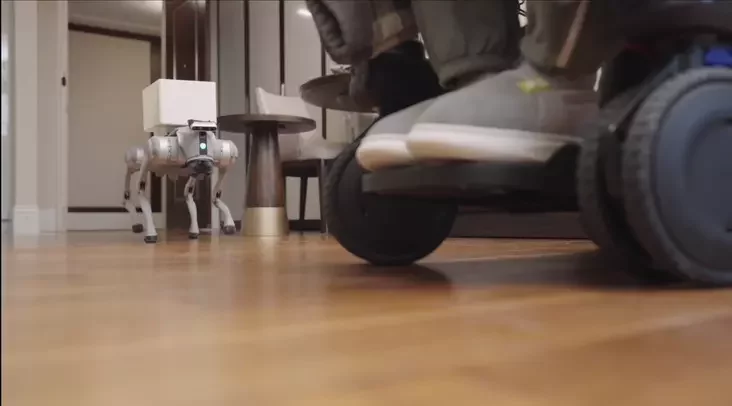
Researchers emphasize that such success was possible thanks to China's developed technological ecosystem, which includes 5G and 6G networks, semiconductor manufacturing, and advanced robotics.
Scientists note that the system works extremely fast: the delay between a brain impulse and the technology's reaction is less than 100 milliseconds, which is even faster than a human's natural reaction.
During the tests, an unusual effect was observed: the patient's brain gradually «adapted» to the interface and began to work more efficiently. While initially, a large number of neurons were required to perform an action, over time, only a narrow group of cells took over the task. This means that with each passing day, control becomes more natural for the man and requires less mental effort.
Chinese researchers are currently preparing to test the next version of the WRS02 chip with 256 communication channels. They hope that the increased power of the device will not only allow controlling technology in the future but also help paralyzed people «voice» their thoughts directly through a computer, even if they have completely lost the ability to speak.
Now reading


A grandmother with little money was treated contemptuously in a cafe — a Minsk resident paid for her lunch. "Panski Dranik" has its own version of events

A grandmother with little money was treated contemptuously in a cafe — a Minsk resident paid for her lunch. "Panski Dranik" has its own version of events


Belarus is no longer just about political prisoners. What Sviatlana Tsikhanouskaya brought to one of the main security forums in the USA and what Siarhei Tsikhanouski was doing there


Comments