


Poland, where the majority of Belarusian migrants reside, plans to tighten requirements for obtaining its citizenship. For many Belarusians, whom the Lukashenko regime has deprived of the opportunity to renew or change their passports abroad, this may mean yet another relocation – to a country where obtaining citizenship is easier and faster. Belsat compared the conditions for obtaining citizenship in Europe for Belarusians who have no relatives, partners, or roots in other countries – only patience.
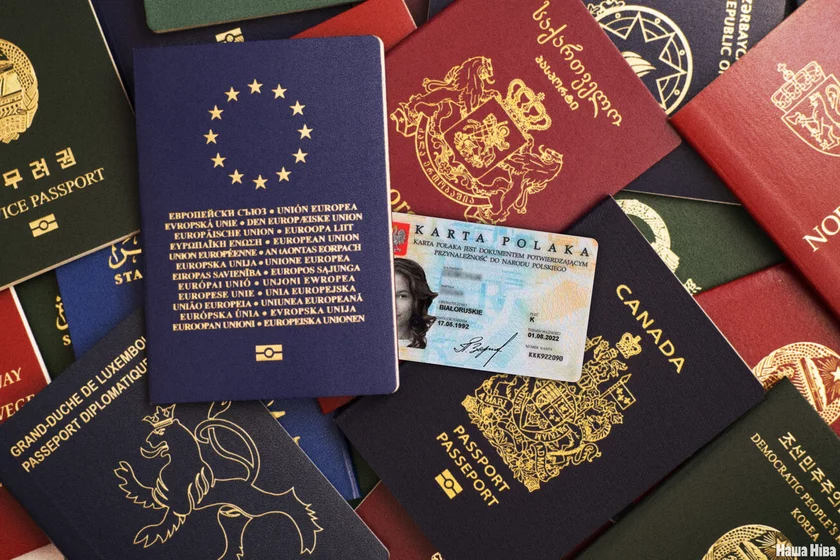
Obtaining EU Citizenship: Comparing Conditions for Belarusian Citizens
In many European countries, the requirements for obtaining citizenship are very similar: no serious criminal record, a basic knowledge of the country's language, history, and culture, and a certain period of residence in the country.
But right now, many countries are changing their policies regarding the issuance of passports to foreigners: Germany has reduced the term and allowed for second citizenship, while Sweden, Finland, Portugal, and Poland are planning to make the requirements more stringent.
For Belarusians, the barriers are even greater. Many EU countries require renouncing previous citizenship, which is an impossible condition for most Belarusians – this would require a trip to the country, and there's no guarantee that the Belarusian authorities will approve your decision (for example, former political prisoner Halina Derbysh repeatedly asked the court to strip her of Belarusian citizenship – she was refused). Secondly, a certificate of no criminal record in Belarus is required – and many European officials make no exceptions for political prisoners.
But all is not lost: some countries have fairly simple requirements for naturalization. Even if you start your life over in one of these countries tomorrow, there's a good chance you'll get a new passport faster than in Lithuania or Georgia.
However, keep in mind that in almost every European country, you'll have to wait a long time for your passport: the processing time for citizenship applications sometimes takes one to two years.
Germany
The German passport ranks third in the world in terms of passport power, granting visa-free travel to 174 countries. At the same time, naturalizing in the country is relatively easy compared to other EU countries.
In June 2024, Germany passed a law that made the country one of the most accessible for obtaining citizenship in Europe. The government reduced the minimum residency requirement from 8 to 5 years and abolished the need to renounce first citizenship. Now, five years of legal residency in the country on any legal basis is sufficient.
To obtain citizenship, you need to pass a German language exam at a level of at least B1 (certificate or test) and an exam on politics, social sphere, and history (300 questions in total, 30 of them on the test).
The Germans have also made an exception for Belarusians – citizens of the country are no longer required to have apostilles on documents or a certificate of no criminal record.
France
France is also known for its lenient citizenship rules. For naturalization, a foreigner needs to live in the country for at least 5 years on any basis and also prove knowledge of the language at a level of at least B2.
However, there is also bad news for many Belarusians: to obtain citizenship, you need a valid Belarusian passport, so this option is not suitable for those whose passport has expired. You also need a certificate of no criminal record from all countries where you have lived in the last 10 years.
In the case of graduating from a French university, the term is reduced to 2 years. And for those to whom France has granted refugee status, the residency requirement is not needed at all: you can apply for citizenship immediately (but there are many other criteria that will have to be met).
There is no special exam on the history of France, but there is an interview with the prefecture, where knowledge of culture, values, and citizen's rights is assessed.
Integration into French society is also taken into account – having a job, participating in social life, and not receiving social benefits for a long time.
Second citizenship will not be an obstacle – you do not need to renounce Belarusian citizenship.
What is pleasing is the stability: there have been no radical reforms in France for a long time, as in Poland or the Netherlands, and none are planned so far. The main change that came into effect in 2025 is the increase in the required level of French language proficiency from B1 to B2.
Belgium
To obtain Belgian citizenship, you need to live in the country continuously for at least 5 years, have an EU resident card or permanent residence permit at the time of application, pass an exam on knowledge of Dutch, French, or German at a level of at least A2, and also confirm social integration and economic activity (education or work in the country or completion of integration courses).
Without fulfilling the conditions for integration, the term increases to 10 years. But in practice, most people naturalize after 5 years, having fulfilled the other criteria.
Belgium also allows you to keep your previous passport. But, as almost everywhere, you need a certificate of no serious crimes in the countries where you lived before.
Sweden
To obtain citizenship of the most democratic Scandinavian country, you don't need that much: 5 years of residence in Sweden (4 years for refugees), as well as a permanent residence permit or EU resident card at the time of application. The stay must be continuous: you can stay abroad for no more than six weeks during the year.
To be eligible for a Swedish passport, you must not have any outstanding convictions, fines, or debts. If you have committed a crime, the required minimum term may be increased (served 6 years in prison – you need to live in the country for at least 10 years after release).
Those who wish to naturalize in Sweden do not even need to know Swedish: there is no language or integration exam yet. Dual citizenship is also allowed, so it is not necessary to renounce Belarusian citizenship.
However, Sweden intends to significantly tighten the requirements – increase the required experience to 8 years of residence and introduce mandatory exams: a test of knowledge of the Swedish language and the basics of society. They also want to more strictly assess reliability (rejecting applications in case of criminal records or large debts), but these are only plans so far.
At the same time, the rules state that an expired passport can be accepted as proof of identity.
Portugal
Portugal ranks second in the EU after Sweden in terms of the number of naturalized citizens. For a long time, this European country had the shortest minimum period of legal residence (on a par with France) – 5 years. A new citizenship law is currently awaiting the president's signature, according to which they want to raise this period to 10 years. But even so, Portugal looks like a much simpler option for obtaining citizenship than Poland in the event of stricter similar rules.
What is important: the period for citizenship is counted from the moment of obtaining a type D visa or residence permit, and not from the moment of obtaining a permanent residence permit.
In addition, there are many concessions for naturalization in Portugal if certain conditions are met. For example, if you have a residence permit and a child is born in this country, the term is counted from the moment you actually started living in the country.
In Portugal, you can naturalize with a D7 visa – for those who work for other countries, but subject to the purchase or rental of real estate, receiving a passive income of at least 870 euros per month, and some other conditions.
Citizenship also requires proof of knowledge of Portuguese at level A2 (basic). If the law is adopted in the proposed wording, an integration exam will also be introduced from 2026.
Portugal allows second citizenship, so you will not need to renounce your Belarusian passport, but you will need to provide a certificate from Belarus of no criminal record for crimes for which a penalty of more than three years is provided for in Portugal.
Luxembourg
Almost half of the country with a population of about 700,000 people are migrants. Which is quite logical: it is much easier to obtain citizenship here than in many other European countries. Moreover, citizenship requirements have only decreased recently. For example, the period of residence was reduced from 7 to 5 years (continuous, of which the last year must be without leaving). It is also required to have a permanent residence permit by the time of application.
From the difficulties: you must pass an exam in the Luxembourgish language, you must be fluent in it at the A2 level (oral speech) and B1 (written). But with due patience (as well as knowledge of German), this is quite possible: at least, statistics show that 70% of citizenship applicants successfully pass this exam.
You will also need to either take a course on civic integration (24 hours), or pass a test on knowledge about society and the state system of Luxembourg.
Additional conditions: you must have a clean past (serious crimes lead to refusal). The overall level of integration is assessed, the presence of work or other legal means of subsistence is welcome.
Second citizenship is also allowed – Luxembourg abolished the requirement to renounce previous citizenship in 2009.
Malta
According to the law, for naturalization in a popular tourist country with a number of residents equal to the population of Gomel, it is enough to live for at least 5 years on any legal basis.
However, in practice, everything works a little differently: the Maltese authorities are very reluctant to grant citizenship after 5 years and very carefully check the degree of integration of applicants from non-EU countries. To naturalize, a candidate will need to demonstrate a deep and lasting connection with the country and a high degree of integration. Therefore, in practice, many people obtain citizenship after 7-10 years of residence.
Secondly, the granting of citizenship is not an automatic right after 5 years of stay, but solely a decision of the minister. Moreover, the minister's decision to grant or not grant citizenship is not subject to appeal in court.
There are also some unusual requirements. For example, the presence of characteristics from three Maltese citizen-guarantors who confirm your reliability and integration into the local community. Also, the applicant must not have a criminal record.
From the good news: since English is the second official language of Malta, sufficient proficiency in it may satisfy the language requirement. It is not necessary to renounce Belarusian citizenship.
The country has recently made changes to the rules of naturalization. For example, it canceled "golden passports" for Russians and Belarusians. There were also plans to introduce a formal exam in the Maltese language for those who naturalize, but so far they have only made statements.
United Kingdom
To naturalize in the UK, you need to legally live in the country for at least 5 years plus 1 year after obtaining permanent resident status. In total – 6 years. During this time, you can be absent from the country for no more than 450 days, of which no more than 90 days – in the last year before submission.
It is also necessary to avoid serious criminal convictions, fines, violations of immigration rules (for example, visa delays). All this can lead to refusal.
But passing a computer test on knowledge of history, traditions and laws and a test on knowledge of the English language (level B1) will not be difficult.
The UK allows second citizenship, so you don't have to renounce your Belarusian passport.
Of the other advantages: you can apply for citizenship with an expired Belarusian passport, instead of it there will be a travel document.
Georgia, Latvia and Lithuania – with minimal chances of passing this quest
These countries, popular with Belarusians, can be considered for obtaining a passport only with a very great desire and only if you can go to Belarus without consequences. But even in this case, the path, unfortunately, will be very long and difficult.
Lithuania
Lithuania is one of the strictest countries in terms of naturalization for Belarusians. Let's start with a long period of residence: to naturalize in Lithuania, you need to live here for at least 10 years. By that time, the applicant must have a permanent residence permit (it is usually issued after 5 years of living with a temporary residence permit).
For refugees, Lithuania, unlike many other countries, also does not make any concessions – the minimum 10-year term remains the same.
In addition, you need to pass two exams: in the Lithuanian language (in writing and orally) and in the basics of the Constitution. The level of the language is approximately B1.
The requirement to renounce previous citizenship for many Belarusians reduces the likelihood of naturalization in Lithuania to zero. In 2019, a referendum was held in Lithuania on allowing second citizenship for emigrants, but it did not gain a quorum.
Georgia
To naturalize in Georgia, you need to live in the country for at least 10 years (and not be absent from it for more than 90 days a year). You also need to renounce Belarusian citizenship (and for this, go to Belarus and achieve withdrawal from citizenship) and know the Georgian language at a "sufficient level". There is no clear designation of a specific level (for example, A2 or B1): it all depends on the subjective assessment of the examination commission. In addition, all documents must be apostilled.
But given the political situation in Georgia and the fact that the country has not yet granted international protection to any Belarusian, the chances of obtaining citizenship here are reduced to zero.
Latvia
The conditions for the period of residence here are the same as in Lithuania: 10 years and the presence of a permanent residence permit/EU resident status. At the same time, you need to pass an integration exam and know the language at least at A2 (this is a low level for the EU, but the language is not one of the easiest).
To this must be added the mandatory renunciation of Belarusian citizenship and the absence of criminal records – and the path for many Belarusians to naturalization in Latvia will be closed.
Now reading


In Vialikaja Miadzviadcy, the grave of Ignacy Domeyko's brother was found. See how the nearby church, which the world-renowned scientist visited, has been defaced

In Vialikaja Miadzviadcy, the grave of Ignacy Domeyko's brother was found. See how the nearby church, which the world-renowned scientist visited, has been defaced


Fewer and fewer school graduates choose Belarusian language for the Centralized Testing. If 20 years ago almost half took it, now it's only one in six


Comments
Давайте грант.