


The veteran of the Belarusian movement is pleased that the US has started negotiations with Lukashenka: "The regime is not eternal, the people are eternal."
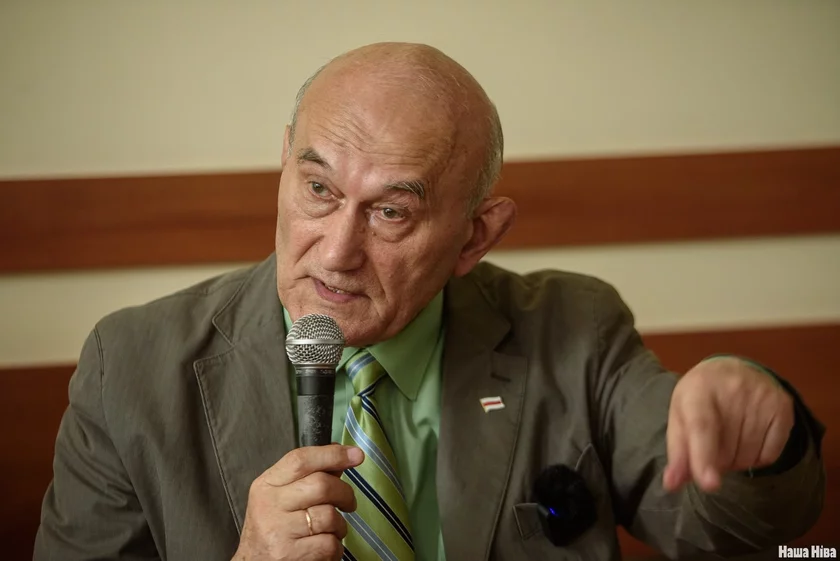
Zianon Paznyak, leader of the "Free Belarus" movement and chairman of the Conservative Christian Party - BPF (KHP-BNF), said on Belsat that he sees two reasons for the release of only 25 political prisoners, when the release of 200 or more was expected.
Paznyak called it good news that Belarusian potash supplies went to the United States, but bad news that they went through a Russian port, because it's expensive and it's "a certain dependence on Russia." He named the EU's resistance as the reason for this:
"The EU pursues its policy, based on the rejection of Lukashenka personally, Lukashenka's regime," said Paznyak. "But in fact, this is an an anti-Belarusian policy. Because in Belarus, the main thing is not Lukashenka, but the people, the main thing is the state."
Lithuania, he believes, "is completely under Brussels' influence," and with Latvia "there were problems," and through "Brussels' pressure" it was possible to persuade Latvia not to let in Belarusian potash. This, according to Paznyak, is "anti-Belarusian policy" that "contradicts international law."
Potash supplies to the States will not contribute to "detaching" Belarus from Russia, Paznyak stated. But he considers the very fact that the USA engaged in trade with Belarus to be good. He says he advocates for this, as it will allow the release of political prisoners and the lifting of sanctions that "hit the people, not Lukashenka."
He connects the potash issue with the fact that after the last negotiations between U.S. President's special envoy John Cole and Alexander Lukashenka, only 25 political prisoners were released. He named two reasons.
The first, according to Paznyak, is that "a few months before Cole's arrival, there was a large campaign in the press, pseudo-press, various bloggers and experts spoke there, saying how triumphantly Cole was gaining opportunities, that everyone would be released, that Lukashenka decides nothing, but Cole decides." Lukashenka, Paznyak believes, was offended by this and decided to "show who's the master of the house."
The second reason, Paznyak says, is that potash supplies through Baltic ports were expected: "Cole hinted at this, they hoped." He believes these supplies could not be arranged because "Europe is currently pursuing an anti-American policy in certain aspects."
Paznyak welcomes the US negotiations with Lukashenka, because "it is very important for Belarus to remain an independent state."
He calls the policy of Lithuania and Latvia "harmful to their national interests," because "the independence of Lithuania and Latvia depends on an independent Belarus."
Paznyak praises Poland's policy, which sees a "slight warming" with Lukashenka: this policy includes not only negotiations with Lukashenka, but also support for "Belsat" and the work of Polish Radio in Belarusian. Paznyak imagines that negotiations between Poland and Belarus could be continued, focusing on the restoration of transport links, including railways and aviation; the development of border trade – and ultimately "a return to normal relations."
"This will not lead to things being as they were before, because the situation is very dangerous now," Paznyak predicted. "It will not lead to liberalization, to the cessation of repressions, but step by step it can improve the situation."
"I have information. I believe it's inaccurate. Lists have been drawn up until 2032; arrests will be made every day," Paznyak said, among other things. "Until '32, GUBOPiK (Main Directorate for Combating Organized Crime and Corruption) and the police will be provided with work, they will seize people."
Therefore, he believes that negotiations offer prospects for change if the policy is consistent.
Paznyak considers Belarusians in Poland who fear that a "warming" with Lukashenka will come at their expense to be impatient. He explained: "This is a process, and you cannot skip certain stages."
In his opinion, the first step is the release of Andrzej Poczobut. The second step is a meeting of foreign ministers. Then — subsequent steps. Perhaps allowing some Belarusians to return home or permitting the processing of documents abroad.
Paznyak emphasized: repressions continue, but "this is how it is today, and tomorrow it will be different" provided that negotiations continue. If there were no negotiations, there were no shifts.
Now reading


Former Google CEO: Russia is catching up with Ukraine in military technologies and has significantly more resources. The main challenge will be "Rassvet"

Former Google CEO: Russia is catching up with Ukraine in military technologies and has significantly more resources. The main challenge will be "Rassvet"


"If the gun fires, it's unlikely to be a machine gun burst." Maxim Znak assessed the reality of Belarusian propaganda's threats to strip political emigrants of citizenship


Comments