


Briton spent almost a year in the ocean without touching land, having rowed across the Pacific and Indian Oceans
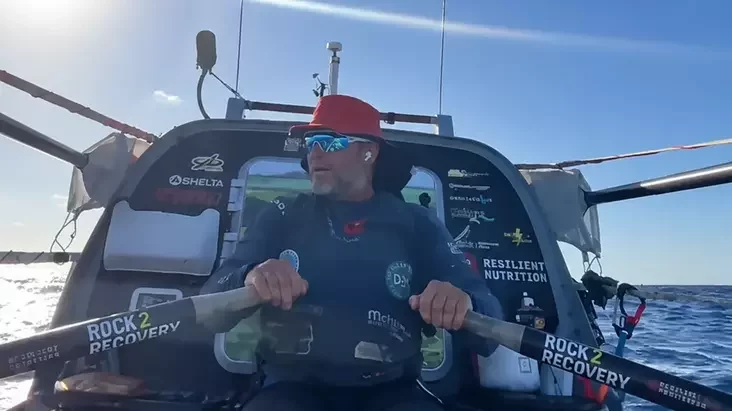
Former Royal Marine Dave "Dinger" Bell from Dorset, England, has completed a solo row across the Pacific and Indian Oceans. He spent 327 days at sea and did not set foot on land the entire time, writes the BBC.

Bell embarked on his journey from the west coast of Peru on November 9 last year. His carbon fiber boat was loaded with 350 days' worth of food and equipment. He finished in Kilifi, north of Mombasa, Kenya, where he came ashore on September 28, 2026, at 12:15 PM Belarusian time. During the journey, he rowed more than 15,000 nautical miles, or about 28,000 kilometers.
Bell also used his expedition to raise funds for Rock2Recovery – a charity that helps veterans and emergency service personnel suffering from post-traumatic stress disorder. To date, he has managed to raise over £110,000.
When Bell came ashore, he bent down and touched the sand, then, supported by his partner Georgie, walked unsteadily along the beach. There, he was handed a beer. The traveler himself admitted that the last week had been unusual for him, and the moment he touched land for the first time in almost 11 months was a very powerful experience.
Bell arrived earlier than expected, and so he still had about 20 days' worth of food left on the boat. During the journey, he encountered wildlife on several occasions. According to him, two white-tipped sharks swam behind the boat for several weeks – one on each side.
Before landing, Bell said that returning to land could cause him real sensory overload. He planned to first return to a hotel, wash, sleep, and rest, meet the people who were waiting for him, and then come back to the boat. The traveler understood that after almost a year at sea, he would need time to get used to walking on land again.
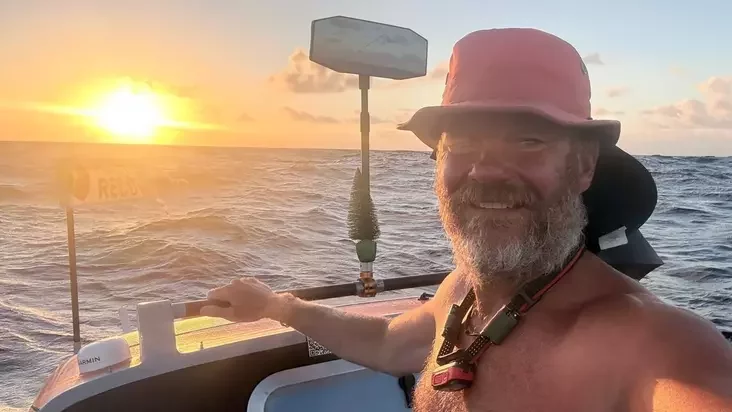
In 2021, Bell had already crossed the Atlantic Ocean – from New York to Newlyn in Cornwall, England. At the time, he said he would never do anything like it again. However, technological advancements, including the advent of lighter boats, more efficient solar panels, and autopilots, reawakened his curiosity about what else was possible.
During the voyage, Bell listened to podcasts and audiobooks, and exchanged voice messages to avoid constantly focusing on time. He explained his decision to embark on this expedition by strong curiosity. According to him, the thought that such a journey could be real came to him, and he could no longer abandon it.
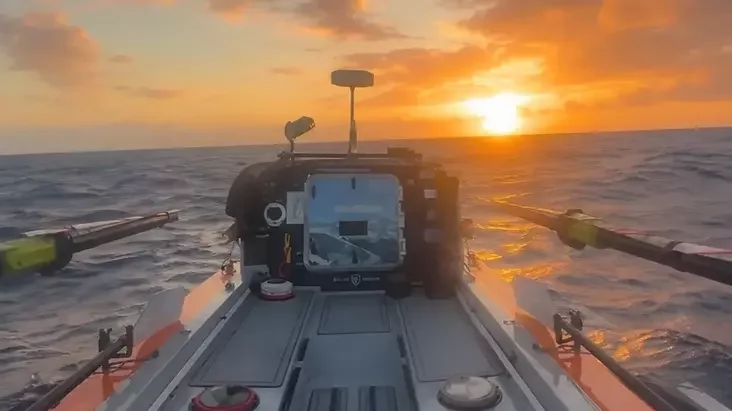
The route passed west across the Pacific Ocean, the Coral Sea, the Great Barrier Reef area, the Torres Strait, and along the northern coast of Australia, after which Bell crossed the Indian Ocean.
One of the most difficult moments was the need to almost completely stop rowing for eight weeks in the South Pacific. Bell was moving too fast and risked entering the Coral Sea during cyclone season, so he had to deliberately slow down. According to him, it was psychologically very difficult to sit in the middle of the ocean, knowing that there were still seven, eight, or nine months of travel ahead, but not being able to row.
Bell was congratulated on his achievement by various well-known personalities, including television traveler Jason Fox and former footballer Graeme Souness. They highlighted the scale of his journey and its charitable purpose.
Now reading


He had four teeth knocked out, and then was expelled from the country. Now the former political prisoner has been arrested in Latvia with six migrants in his car

He had four teeth knocked out, and then was expelled from the country. Now the former political prisoner has been arrested in Latvia with six migrants in his car


"I love the Belarusian language even more than Russian — it's closer to my heart." A Moroccan has lived in Salihorsk for 18 years and can't get enough


Comments