


Office of the Belarusian Passport Center in Vilnius closes, work to continue without an office
What will happen to the New Belarus passport, 600 of which have been issued?
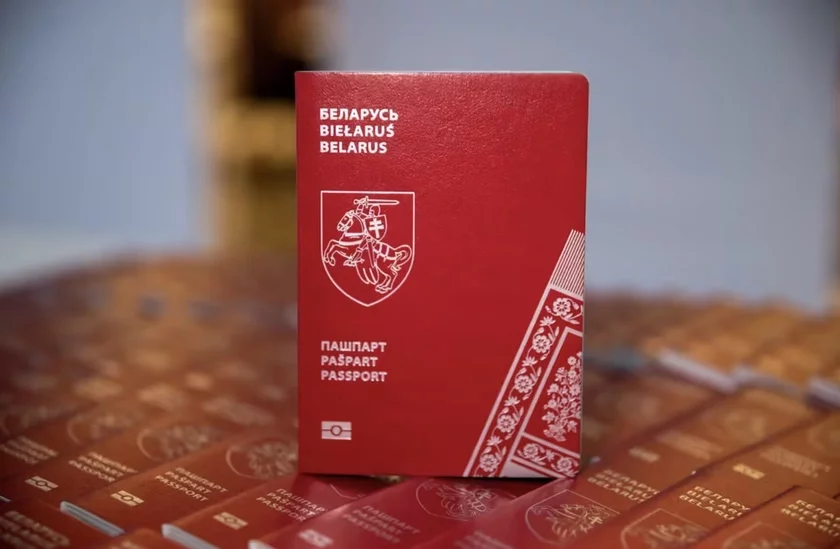
The Belarusian Passport Center in Vilnius is closing. The opening of new centers in Poland or other countries is not yet planned. However, the documents themselves will continue to be issued, despite low activity from potential owners and incurred costs, Radio Svaboda reports.
The idea of a New Belarus passport was announced at the "New Belarus" conference in Vilnius in August 2022. The development of the project was undertaken by the United Transitional Cabinet under the leadership of Sviatlana Tsikhanouskaya.
The document was intended to become an alternative for political refugees and Belarusians abroad, providing an opportunity not only to identify themselves with the Belarusian nation but also to perform entirely practical functions — confirming identity during travel and in communication with authorities of foreign countries. The relevance of the latter increased many times after the Belarusian authorities abolished the possibility of obtaining new "blue" Belarusian passports at Belarusian consulates abroad in the autumn of 2023.
The developed layout of the "red" New Belarus passport was demonstrated shortly before this. According to its creators, it fully complied with all norms required for official and internationally recognized passports.
To implement the New Belarus passport project, the Belarus Passport Center company was registered in Lithuania in 2023, and applications for the first documents began to be accepted in January 2025. Soon after, the first owners received their "red" passports.
"I was one of the first to receive a New Belarus passport, definitely among the first hundred," lawyer Ales Mikhalevich tells Svaboda. "As a lawyer and as a person, I truly love institutions. Both the passport and belonging to the Belarusian state can be issued by our legitimate bodies. I consider both the Cabinet and the Office as our legitimate bodies. The passport is an integral part of this process."
Ales Mikhalevich says he keeps the New Belarus passport with his other documents but doesn't take it with him on trips. He uses it very rarely but still considers this document very precious to him. The last time Mikhalevich used the New Belarus passport was when he voted in the Coordination Council elections.
"If Lukashenka continues to engage in unacceptable things, I think this passport will have the possibility of recognition by democratic countries, the civilized world," Ales Mikhalevich continues. "I show it to friends, acquaintances. I was in Georgia and boasted about it there to Belarusians in Georgia."
According to the interlocutor, his acquaintances used the New Belarus passport when checking into hotels, showing it along with their residence permit card in an EU country.
"It's not yet possible to show it during passport control, but work is underway," Ales Mikhalevich optimistically continues. "I hope we can achieve that too. This passport is very well designed. From an aesthetic point of view, from a heraldic point of view. It is aesthetically made as something beautiful, wonderful, Belarusian. This already adds a lot of value to it."
In September 2026, the "Belarusian Passport Center" published new statistics.
According to it, by the beginning of September, about 600 New Belarus passports had been issued. Another 60 applications, it is claimed, were in process.
Scaling down operations in Lithuania, multi-thousand expenses
"An audit has been conducted, the center's structure has been reformed, and non-critical expenses have been optimized," states the report of the Belarusian Passport Center on Sviatlana Tsikhanouskaya's official website. "This should help the project achieve self-sufficiency in the future, accelerate administrative processes, and establish closer interaction with citizens and international partners."
According to the Lithuanian portal Rekvizitai.lt, which collects and publishes registration and financial data about Lithuanian companies, the last employee of the Lithuanian company Belarus Passport Center was dismissed in July 2026.
At its peak, in 2024, its staff numbered four people.
Based on the same sources, derived from official reports to Lithuanian state bodies, the company's financial inflows and expenditures can be traced from its inception until the end of 2025. According to these data, Belarus Passport Center received approximately 110 thousand euros in 2024 and over 250 thousand euros in 2025. The company ended 2025 with a loss of approximately 30 thousand euros. Data for 2026 will become available later.
Marius Gudelaitis, who officially represented the Lithuanian company Belarus Passport Center, did not respond to Svaboda's request for an interview. The journalists' inquiry about the sources and volume of the program's funding, sent to the Belarus Passport Center's email, also remained unanswered at the time of publication.
"We have reduced our presence in Lithuania," Sviatlana Tsikhanouskaya's advisor Franak Viachorka tells Svaboda. "In Lithuania, you can now only submit biometric data. The passport center itself as a physical premises was still operating until the beginning of this year. Public events were held there, and aid was distributed to those released. But then we reduced our presence and created a decentralized system. We cut expenses. The most important thing is the collection of biometric data, and then — the sending and issuance of passports."
According to Viachorka, the legal entity of the "Belarusian Passport Center" in Lithuania still has a formal director, but there is no longer a physical office.
Viachorka does not disclose details about where and how passports prepared for issuance will now be stored, citing the confidential nature of this information.
According to him, this is a secure storage facility, and the transfer of documents to owners occurs either hand-to-hand or through operators of the "Belarusian Passport Center" who do not have access to people's personal data.
"No Belarus Passport Center Polska is planned," Franak Viachorka continues. "The 'Passport Center' was jointly created by the Office and the Cabinet (UTC. — RS) as a subsidiary technical company. It does not engage in international negotiations. Its task is to ensure data collection, verify people so that there are no agents or stateless persons among them. Now there is no point in registering a new legal entity; we operate within the existing framework."
According to Franak Viachorka, the collection of biometric data for those wishing to obtain New Belarus passports is regularly organized in Poland and Lithuania, where it can be done weekly.
In addition, it is possible to apply in other European countries, as well as in US cities, where data collection will be organized locally.
According to the "Belarusian Passport Center" itself, they are currently working on making it possible to send biometric data for obtaining the "red" passport remotely.
Franak Viachorka is not ready to state exactly how much the entire "New Belarus passport" project has cost so far and what the money was spent on. According to him, most of the funds went to launching the project, obtaining necessary permits and licenses, purchasing equipment, and other expenses.
"All major expenses were at the start," says Viachorka. "Now the infrastructure already exists. Administrative expenses remain. Their reduction occurs due to a decrease in the number of people involved in the project and rental costs. I cannot comment more precisely here… This year's goal is to reach, if not self-sufficiency, then the lowest possible costs. The amount of 97 euros (the cost of the "red" passport for the user. — RS) does not cover all expenses for producing the document. It is necessary to cover the cost of verification, there are expenses related to the issuance of each document, with the security system — renting cloud services. The cost price of the document is higher, but if the price is increased, fewer people will want to get it."
"Legislation won't be changed for the sake of 600 people"
Franak Viachorka adds that he cannot provide statistics on the countries where the New Belarus passport is most in demand. According to the interlocutor, these are EU countries that do not offer Belarusians an alternative in the form of a foreigner's passport, meaning not Poland and Lithuania.
The Office notes an increased demand for the "red" passport in the USA. Franak Viachorka primarily links this to increased problems with legalization for Belarusian refugees in that country.
Viachorka points out that when New Belarus passports are issued, their owners are warned about the impossibility of using such documents for travel. However, he also states that no cases of persecution of Belarusian citizens for possessing the "red" New Belarus passport have been recorded so far. More or less officially, such a document can currently only be used during voting for the Coordination Council.
"At the moment, I have little belief that any country will fully recognize this passport as a travel document or a state document," adds Franak Viachorka. "But it will still acquire some additional functions.
Together with a team of international experts, we have prepared such a "roadmap" for the worst-case scenario, if the situation in Belarus does not change. How such a document can be developed. There are several options, including one with a country code, which will allow it to be legitimized in the future."
Sviatlana Tsikhanouskaya's legal advisor and head of her Office's legal department, Liavon Marozau, tells Svaboda that he is working on the legal recognition of the New Belarus passport. According to him, there is a greater chance that a country outside the European Union will help with the international legal recognition of the document.
"We are working both there and here, but it is more likely that this recognition will happen outside the European Union," says Marozau. "I recently joined this project. I work on a volunteer basis. I contacted ICAO experts (the UN international organization dealing with air travel safety and standardization of documents for international travel. — RS). Legally, the passport is ready and can be recognized. Politically, we are working on that."
According to Marozau, he arranged meetings in Armenia. This country was chosen because both Georgia and Armenia may currently have many Belarusians who could need such a document. Marozau states that he has not yet held specific negotiations on the political recognition of the document.
In addition to the lack of substantive negotiations, there is another legal peculiarity. If the government of a country agrees to help with the international recognition of New Belarus passports, there is a possibility that already issued "red" documents will have to be exchanged for new ones.
"Hypothetically, if Armenia gives the 'green light,' we will take your New Belarus passport and make it a travel document," says Marozau. "This means that legally it will be conditionally Armenian, and politically — Belarusian."
According to Franak Viachorka, Sviatlana Tsikhanouskaya's Office is not going to close the program, despite the expenses and not the largest number of people willing to get a passport. Tsikhanouskaya's advisor says that this is also an image project, whose value has already been appreciated by specialists.
"Those who see this document highly respect it," says Franak Viachorka. "How it is organized, how it is made. Including border guards, police. Especially when we underwent an audit. All this commands great respect. But we run into international law. The modern world is very regulated. Currently, there are no universal solutions for Belarusians in exile. Perhaps the situation around Belarus will worsen… This has symbolic meaning — the indomitability of Belarusians in exile. Of course, I would like more passports to be issued. If a thousand or two were issued, it would be much easier to lobby for their legalization. For the sake of 600 people, they will not develop instructions or change legislation."
Now reading


Putin Wants a New 'Yalta' — a Division of the World into Spheres of Influence Between Moscow, Washington, and Beijing. Over the Heads of Europe and Ukraine

Putin Wants a New 'Yalta' — a Division of the World into Spheres of Influence Between Moscow, Washington, and Beijing. Over the Heads of Europe and Ukraine


"People commented that salmonella entered the chat." A Belarusian went to work in Silicon Valley - and became a culinary blogger with 28 billion views


Comments
- Геральдычная рада з Забугай і Вячоркай атрымалі грошы;
- Кухар Гудэлайціс і Пашпартыстка Габія атрымалі грошы;
- Літоўская дзяржава атрымала грошы;
- Беларусы: папалі на крыміналкі.