


Chapel in Smarhon District Restored After Being Hit by Drunk Driver. But Not As It Was
Instead of scientific restoration, a new building has been erected, differing from the historical original in proportions and details.

In the village of Rasla, construction work has been completed at the site of the destroyed 19th-century Catholic chapel, which held the status of a historical and cultural heritage site. The results of the restoration were analyzed by the Telegram channel "Spadchyna" (Heritage).
The architectural volume of the chapel has become squatter: vertically elongated rectangular facades were replaced with horizontal ones, and the height of the plinth part almost doubled. Dark boulders, previously not visible, began to protrude from the plastered walls. A concrete platform, made of material alien to a historical object, was poured around the chapel.
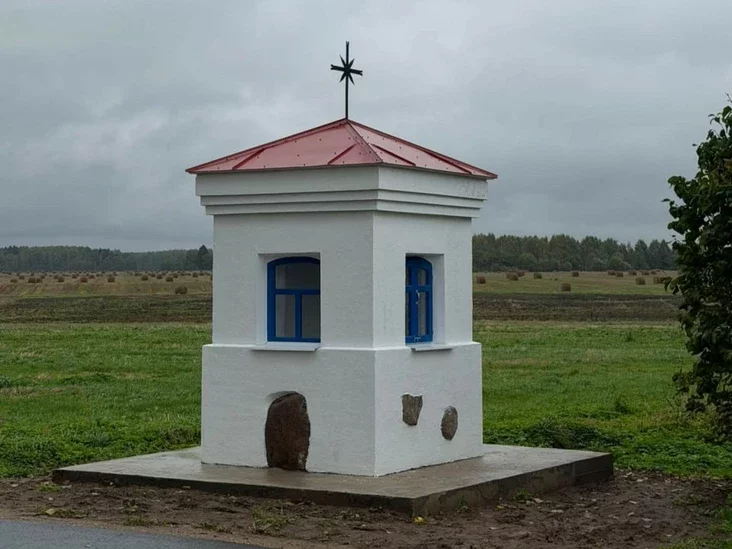
It is understandable that a chapel rebuilt from scratch will have a somewhat idealized appearance, without replicating all its historical irregularities. However, in Rasla, even the main proportions and dimensions were disregarded.
The builders completely changed the shape of the niches. In the authentic building, they were of different sizes, with a lower opening on the roadside, and had segmental (bow-shaped) arches. Now, the openings have been made identical and strictly rectangular, with window fillings inserted that have an unsuitable segmental top.
The cornice also underwent simplification: from three historical moldings, only a simple step was left. A "forehead" (frieze/band) appeared above the cornice, which did not exist before, and the authentic cross was replaced with a new, larger one.

The destruction of the original roadside chapel occurred on October 17, 2025. As we reported earlier, a 25-year-old local resident, severely intoxicated, was driving an Audi, rushing to pick up his child from school. When geese suddenly ran onto the road, the man lost control and crashed into the building. The impact turned both the car and the brick chapel into ruins; the driver himself was not seriously injured.
The judicial and financial investigation of the accident revealed the specific nature of heritage protection legislation. For driving under the influence and causing an accident, the man received a five-year deprivation of driving rights and a fine of 8400 rubles. However, for the physical destruction of an architectural monument under Article 20.3 of the Administrative Offenses Code, the district administrative commission assigned him a separate fine of only 270 rubles.
The costs for designing and constructing the new object amounted to a significantly larger sum. In July 2026, information emerged about the allocation from the budget of 5 thousand rubles for research and design work and another 27 thousand for construction. The Smarhon District Prosecutor's Office announced its intention to recover this sum, equivalent to 11 thousand dollars, from the driver responsible for the accident.
Thanks to the project documentation from tender procurements, it is known that the Smarhon District Center for Ensuring the Activities of Budgetary Organizations acted as the client for the object, and the developer of the scientific and design documentation was Yauhen Kalbovich, an architect-restorer from Vitebsk.
Already at the design stage, incorrect squat proportions and an unjustifiably high plinth were laid down. However, the details in the project still corresponded to historical accuracy: the drawings included correct segmental (bow-shaped) openings and a complex cornice with a quadruple molding.

However, the builders who were restoring the object ignored even these drawings, simplifying their work as much as possible. Instead of creating segmental arches, they left rectangular holes, and replaced the decorative cornice with a simple step. Technical supervision, which according to the tender documentation cost only 300 rubles, turned a blind eye to this amateurism and deviations from the project.
The reason for such quality was catastrophic haste. According to the procurement terms, the tender was held in mid-July, and the completed object was required to be delivered by August 31, 2026. In fact, the builders were given about a month and a half to clear the rubble of the destroyed chapel, pour a new foundation, erect brick walls, plaster them, and install a standing-seam roof.
The official permit from the Ministry of Culture for carrying out the work categorically prohibited solutions that could "lead to scientifically unfounded changes in the architectural appearance and loss of distinctive qualities." The department demanded unconditional preservation of historical dimensions, colors, and materials, which in practice was completely ignored.
In total, there are 16 similar brick roadside chapels from the 19th century in the Smarhon region that have been granted the status of historical and cultural heritage sites, including another three-tiered chapel in Rasla. However, this status, as it turns out, is unable to withstand unprofessionalism and the transformation of monuments into replicas.
«Nasha Niva» — the bastion of Belarus
SUPPORT US-
A historic brewery from the Svyatski family estate is being sold for one base value. Yanka Kupala also worked on the same estate
-
"St. Petersburg Vibe." Russian Director Staged "Heart on the Palm" by Shamyakin at Kupalauski — Reviews Are Polar
-
Today Belarusians in Białystok and Warsaw will participate in the "Night of Bookstores"
Now reading


"Why should we somehow restrict ourselves?". RTBD director explained why she staged a play based on Pushkin in one of the last theaters in the country that worked in Belarusian


Comments
выглядае, як туалет тыпу сарцір
а была, як скульптура.. дарэчы скульптарам (нармальным) яе б і аднаўляць
такая душэўная была