


"I have only one dream — to get my Dzmitser back." The mother of former political prisoner Dzmitry Hopta tells about her son's new misfortune. And asks to order more cakes from her to cope
When in 2020, 21-year-old Dzmitry Hopta, a young man with intellectual disabilities, was sentenced to two years in a penal colony, his mother thought it would be the hardest ordeal of their lives. But after her son's release, another battle awaited — this time with drug addiction. Today, Volha is raising money for his rehabilitation, working as a pastry chef, helping other former political prisoners, and continuing to do what she has lived for many years — saving her Dzmitser.

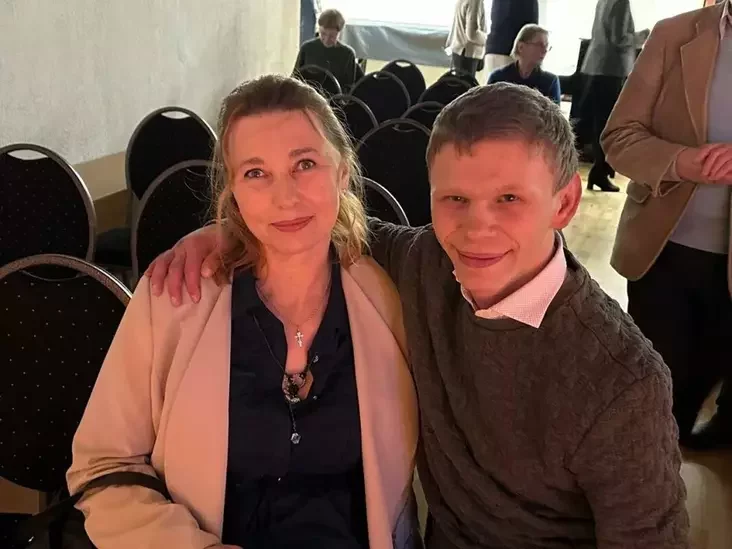
Volha Hopta meets me on the terrace of a cafe, a few minutes' walk from Vilnius Old Town. A light dress, a wide smile, neat makeup. If you didn't know her story, you would hardly guess that for the past six years her life has consisted of courts, colonies, emigration, her son's rehabilitation, and a constant struggle for him to simply live.
Volha jokes easily. When she talks about cakes, a childlike excitement appears in her eyes. When she talks about her son, her voice becomes quieter.
Most of her life, Volha worked at "Belaruskhleb" in Zhlobin. First, she made bread and buns, then she mastered confectionery. Now she bakes cakes in Vilnius — in one of the local shops, and in her free time she takes private orders. She says it's her way to relax.
— When I come home tired and start baking something — that's my relaxation. Especially when I can invent something new.
Volha's phone is a real portfolio. She scrolls through photos quickly, as if slightly embarrassed by her work. Here's a yogurt cake, a recipe she invented herself. Here's a meringue roll. Here are canelés — "you wouldn't distinguish them from store-bought ones, only the shape is a bit smaller."
— A new cake is already being born in my head, — she smiles. — I've already figured out the main highlight. Now I'm thinking about what to combine it with. I can do it this way, or that way. That's the most interesting part — experimenting. But I'm really bad at promoting it, advertising myself on Instagram.
Later Volha admits: she would like to have more orders.
— Honestly? I would like to have more cake orders. Then, maybe, I wouldn't need to raise funds for my son's rehabilitation…
Today Volha is raising money for the rehabilitation of her 27-year-old son Dzmitry. The former political prisoner has congenital developmental disabilities. Although he is an adult by passport, emotionally and psychologically, according to his mother, he is only now going through his "teenage years" — very trusting, emotional, and easily swayed by others. After his release from the colony and relocation to Vilnius, this vulnerability was exploited by people who drew him into drug addiction. Now Dzmitry is undergoing a year-long rehabilitation program, and Volha is trying to raise funds so he can complete it.
You can support the Hoptas family via the link.

"The hardest part was accepting that my child was different from others"
— Dzmitser is very kind, very affectionate. And very trusting, — Volha describes her son.
Then she smiles.
— He gets easily excited about things. A new idea sparks — and that's it, he only wants that. But he cools down just as quickly. Today he wants one thing, tomorrow another. He likes changes of scenery. He likes something new.
The brightest event of recent years for Dzmitry was a trip to Georgia after moving to Lithuania.
— We met relatives there. And he loved flying on a plane so much! The first flight was when we were evacuating, and then we were both so exhausted that I didn't care anymore, and he was scared. But after that, he would say himself: "Oh, we're flying!" He really liked the sea. He was simply happy.
Volha speaks very softly about her son. But when the conversation turns to his childhood, her voice becomes quieter.
— He was born with developmental peculiarities. He only started walking at eighteen months. Then he had three eye surgeries due to congenital strabismus. When we underwent examinations, doctors said: genetically everything is fine. But, most likely, antibiotics I had to take during pregnancy due to severe sinusitis played a role. I said I was pregnant, but the doctor said there would be nothing terrible.
The hardest part was admitting, realizing that my child was different from others. Dzmitser was in a specialized kindergarten for children with visual impairments. Then he went to school, an integrated class. While he was little, I always hoped: now he will catch up with his peers, now it will work out. But he lagged far behind everyone, and teachers started talking about it. And that's when the understanding came that, yes, he really is different. Probably that was the hardest thing — just to accept it. Dima doesn't have a school certificate, only a certificate of completion. But he is a very good person. You know, even too good. I always wanted him to be a little less trusting… He is very trusting. Like a child. And, probably, that always scared me the most. Because there are people who take advantage of that.

"I didn't believe until the last moment that my son could actually be imprisoned"
On August 28, 2020, Volha was at work. First, her brother's wife called.
— She says: "Volha, the police are looking for Dima." I asked: "Why?" All sorts of things popped into my head. I thought, maybe some teenage story.
A few minutes later, her daughter called.
— "Mom, Dima's been taken."
At the moment they came for him, Dima was mowing reeds on a dried-up lake near the house.
Within a few hours, the investigator informed her: her son had been detained for participating in post-election protests.
— I just started laughing hysterically. I said: "Where is Dima, and where are the protests?"
To this day, she remembers that feeling of complete unreality of what was happening. The accusation was based on a confession the boy made after several hours of interrogation. The reason was a message from an acquaintance: "Dima, come to the square, it will be very fun."
Until the very end, Volha didn't believe that her son could actually be imprisoned.
— I remember an acquaintance telling me: "Volha, pack him some warm clothes." And I was still angry: "Why? They'll announce the verdict now, and we'll just go home."
But she still packed a small bag, "gritting her teeth."
On the day the verdict was announced, state journalists were already waiting near the court.
— I understood that they wanted to film mothers crying. Dima was sentenced to two years in a penal colony. When they put handcuffs on him… I was still holding on. I handed over the packed bag of things, followed him with my eyes. And when I left the court and went behind the building… There was a real hysteria.
Volha falls silent for a few seconds.
— You know… It's still hard for me to remember this. I want to forget it all like a bad dream.
More than the sentence itself, Volha was afraid of something else — how her son would be treated in the colony.
— I was afraid that people wouldn't understand his peculiarities, that they would start bullying him, that he wouldn't be able to explain something simple. Certain everyday trifles are known only to parents.
But something she didn't expect happened. Several political prisoners who were serving sentences with Dzmitry virtually took him under their care.
— They looked after him, gave him advice, helped him. If Dima didn't get in touch for a long time, they would pass on messages through others: "Tell her everything's fine." I am endlessly grateful to them for everything to this day!
They went for short visits regularly. Long visits were never allowed.
— We were only given four hours. Never more.
Dzmitry also didn't like writing about what happened in the colony.
— In his letters, everything was very simple: "Everything is fine with me." And that was it.
But Volha remembers something else: how many people wrote to her son then.
— He received a lot of letters. We even started an initiative in Zhlobin. Once a month, several dozen people would gather, sign fifty postcards, and send them to political prisoners. We had a series called "Zhlobin is with you." On each postcard — a photo of the city in different seasons. January, February, March… We would sign them and send them out. To our own — always. And to the others — just to random people.
Later, after the start of the full-scale war, postcards almost stopped reaching their recipients.
"Mom, I simply won't be able to endure this a second time"
On December 31, 2022, Volha woke up around three in the morning. She had to go to the Vitebsk colony. Dzmitry's release was scheduled for that day.
— I wrote a letter to the head of the colony in advance. I asked for only one thing: tell me when he will be released. He won't be able to get home by himself, I need to pick him up literally hand-to-hand.
The journey was difficult. When there were a few kilometers left to the colony, the car spun on the ice and ended up in a ditch.
— By a miracle, our car didn't flip onto its roof. A truck driver approaches: "Is everyone alive? Well, shall we pull it out?" And I look at my watch and realize: Dima could be released at any moment.
She got out of the car. In her pocket, only her phone and a pack of cigarettes.
— I say: "Do what you want, I'm leaving."
She walked to the colony.
— Then our people arrived. The car was pulled out. And we just stood and waited. When the gate opened and Dzmitser came out, I cried. So small, thin…
They celebrated the New Year a few hours after returning home. Their daughter managed to cook something for the holiday. Dzmitry ate a little, sat down at the table with everyone, waited for New Year's, and almost immediately went to bed.
— He was no longer in the mood for celebrations, — Volha says quietly. — He was very tired.
The next day they went to visit acquaintances. Their son had also recently been released.
— And so we entered the house, and Dima… He just kept looking around all the time. He was scared of everything. Then it was the same outside. He was very afraid of people.
Volha cannot say that the colony completely changed her son. Rather, it made him withdraw.
— Dima is such a person… It was difficult for him to talk about what was inside even before. And after the colony, even more so. He simply seemed to have erased a lot from his memory. He didn't talk about bad things at all. Sometimes he would remember something. But only good things. For example, some funny incident, something about the guys. But when you start asking about the difficult parts, he immediately says: "No. I don't want to talk about it." I didn't ask anymore, I understood that if a person doesn't want to remember, it means it hurts him.
Only a month passed after his release, and there was a knock at the door again. Not literally. First, Dzmitry began to be summoned to the Investigative Committee.
— Then I realized that it wasn't about him. They needed me, — Volha recalls.
After her son's arrest, Volha joined volunteer assistance for political prisoners: she brought parcels, helped other families, and wrote letters.
That's when the thought of leaving first crossed her mind.
— They called me and asked: "Are you thinking of leaving?" I said: "Probably, yes. Dima is being summoned again." A few hours later, a new question came: "Can you leave within 24 hours?" I answered: "What else can we do?"
On January 18, 2023, they left Belarus. On the 20th, they were already in Vilnius.
Before leaving, Volha had a long conversation with her son.
— I told him: "Dima, do you understand that if we leave now, we might never come back? You might never see your relatives again."
At first, he replied: "No, no."
He paused. And then he said a phrase that decided everything: "Mom, I simply won't be able to endure this a second time."

And recently it became known that Belarusian law enforcement officers again searched the Hoptas' house in Belarus as part of a new criminal case.
It seemed the worst was over, but…
In Vilnius, Dzmitry still lived as if between two worlds for a long time.
— For the first few months, he didn't even go outside the "Castle" without me. If he needed to go to the store, or anywhere else — only together. He was scared of the police. Seeing a police car — and he would flinch. It got easier with time. He made new acquaintances, he got used to the city. But the trauma didn't disappear. It seems to me that after the colony, he cut off a part of his life. He simply doesn't want to go back there.
In Lithuania, Dima finally got a disability status. In Belarus, they didn't allow it, although he has enough diagnoses. But here, they passed the commission, and he was immediately given lifelong disability. I don't even have to constantly take him for new medical examinations and prove anything anymore. That's when I first thought: okay, that means we can live here.
It seemed life was finally starting to settle down. There was work, friends, Volha started baking cakes to order. Dzmitry gradually got used to the new country.

But one day someone offered Dima to try marijuana. And that's when another struggle began.
— There were these guys who gave him a taste. And then it turned into extorting money. They understood that he was very trusting.
At first, the family tried to cope on their own.
— We struggled for about half a year ourselves. He was hospitalized twice. Five days — they release him. He comes home, and everything starts all over again.
She sighs.
— He didn't understand what was happening to him. He got angry, asked us not to put him in the hospital. But he already needed help.
Gradually, her son's behavior began to change.
— He's an emotional person by nature. But then real aggression appeared. When he needed money for weed, he saw nothing else around. He only needed one thing: to get it.
Volha even went to the police — against those who were exploiting his condition.
— I took Dima's phone. Opened the correspondence with those guys, took screenshots, printed everything out, and took it to the police. Then we were informed that those guys had been detained. But, they said, they found nothing during the search. I want to believe that at least they are now under their control. It's even awkward for me to say this, but Dima is not the only one like this. How many other people fall into such traps?
"Now my old Dzmitser is returning"
A turning point was a meeting with people who had gone through addiction themselves. Dzmitry was taken to a rehabilitation center that works with the "Twelve Steps" program. It is designed for one year.
— When we first arrived there, I even smiled. It was an old holiday resort from Soviet times. A lake, small houses… I even joked: "What do I need to do to get in here myself?" — Volha smiles.

Everything there is built on routine and responsibility. Residents cook, clean, carry firewood, saw it themselves. Group meetings are held daily.
— The program is a bit religious. There are prayers. I see how Dima is beginning to comprehend. He already says: "I was wrong. Maybe God will give me another chance."
She pauses.
— And now… my old Dzmitser is starting to come back.
This phrase sounds almost like a whisper.
— You understand… Not the political prisoner after the colony. But my Dzmitser, whom I knew before.
She no longer hides her emotions.
— He is asking for forgiveness now. He says: "Mom, forgive me for everything I've done." And I tell him: "The main thing is that you are alive."
I am convinced that the program works. I have seen people who have completed it. They have been living without addiction for many years. And that is why I really want Dima to go through this entire journey. Not half a year, not eight months, but exactly a year. So that nothing is interrupted.
"That's the most important thing — to make sure a person is no longer alone"
Today Volha is a mentor at "Zamak" (Castle), a shelter for former political prisoners and people who have just arrived in Lithuania. But at first, she herself was one of those who didn't know how to buy a bus ticket, where to get documents, and how to start life anew at all.
— For the first six months in Vilnius, I thought: God, how do people even navigate this city? I thought I would never remember all these streets. And now I can lead anyone anywhere, — Volha smiles.
That's why, when she was offered to become a mentor, she didn't hesitate for long.
— Even before this, I couldn't pass by if someone needed help. I helped Ukrainian women, gave advice to girls. Then they told me: "Can you try yourself in mentorship?" I answered: "Why not?"
Volha recalls one story with particular fondness.
— A new employee, a young Ukrainian woman named Katya, came to my workshop at work. I just looked at her and immediately asked: "You're new to Lithuania, aren't you?" She replied: "Three weeks." "How did you know?" — the girl was surprised. "By your eyes."
Volha laughs.
— It's hard to explain. But that look… Big eyes. Confused. The person doesn't understand anything yet. I remember myself like that clearly. And now I help people like me. When new friendships emerge, that's probably the most pleasant thing. When you see that people who were on their own yesterday start becoming friends, supporting each other. And you realize that they are no longer alone.
She falls silent for a moment.
— You know… Perhaps that's the most important thing in mentorship. To make sure a person is no longer alone.
Volha talks much less about herself than about others. Even when I ask if everything she's been through has changed her. She doesn't hesitate.
— Very much.
— How?
— Before, I thought I couldn't endure many things. But now… now I know that a woman can endure a lot. Surviving emigration, her son's imprisonment, relocations, fear, uncertainty. Somewhere inside, a core simply appeared. Of course, sometimes you get tired, you want to cry, but you pull yourself together and keep going.

Sometimes it seems to me that Volha in 2020 and Volha now are two completely different people. Before 2020, I was gradually becoming disillusioned with people. It seemed everyone was for themselves. And then August happened. Political prisoners, queues outside detention centers, parcels. Strangers who suddenly became kin.
That's when I understood one very important thing. People can still support each other. We are not strangers. When a person is left alone — it's very difficult. But when someone appears nearby who has already walked this path and says: "First do this, then this," — it immediately becomes easier.
"I dream of a house with a big kitchen"
Today Volha's life is divided between work, home, and trips to her son. Almost every week she goes to the rehabilitation center.
— I make something tasty and bring it to him. He's always happy. Yesterday he called: "Mom, come." He misses me…
Volha didn't ask for help right away.
— They told me: "Let's do a bigger fundraiser." And I replied: "No. Only for accommodation." That's 500 euros a month. We need an amount for six months. Everything else… somehow I'll manage myself.

Volha really tries to manage herself. She works, bakes to order, buys medicine for her son, visits him.
— Honestly, I would really like to have more orders, not fundraisers, — she smiles.
At the end, I ask what she envisions for Dima's future. Volha doesn't think long.
— For my Dzmitser to return. Very kind, affectionate. I would like good people to be around him, for him to make friends. So that he never gets into bad company again. I don't want to lose him.
And what does she dream of for herself? Volha smiles.
— Of a house with a big kitchen. So I can bake cakes, so people can come. So I can live by it and bring joy to others.
-
"I don't have the opportunity to see my son's body and say goodbye to him in a humane way." Tikhon Klyukach's mother recorded an appeal to his commanders
-
One of the Oldest Priests of the Grodno Diocese, Nikolai Hliad, Has Died
-
Imprisoned head of ZROBIM architects sells another property — a plot for a tourist complex in Vileyka


Comments
Дзякуй, Божа, за добрых Людзей!