


Ukraine strikes Russian space communication centers. What does this achieve?
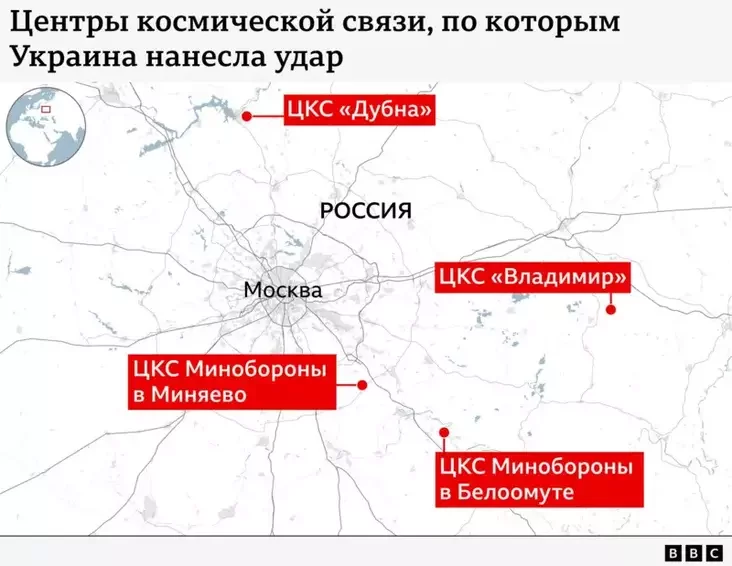
Ukraine has carried out several drone strikes on Russian space communication facilities. In total, during five strikes, four ground-based satellite communication complexes were damaged, two of which belong to the Ministry of Defense, and the other two to FSUE "Space Communications". The Russian Service of the BBC summarized information about these attacks and tried to assess the scale of the damage and the possible consequences of these strikes.

The strike on the space communication center of the Russian General Staff in the settlement of Beloomut, Moscow region, became known on July 1. Ukrainian monitoring channels reported this, also disseminating footage of the strike's aftermath taken at the facility itself.
Earlier, on the night of June 26, according to the Ukrainian press, the Armed Forces of Ukraine (AFU) struck another space communication center – "Meshcherino-1", located near the village of Minyaevo in the Moscow region. This strike became known on July 1 from publications in the Ukrainian press.
On the night of June 30, in the Moscow region, Ukrainian drones repeatedly attacked the teleport in Dubna. The strike was reported by Ukrainian President Volodymyr Zelenskyy. This facility was hit for the first time on the night of June 22.
On June 25, Ukrainian drones hit the "Vladimir" Space Communication Center near the city of Gus-Khrustalny.
There is no precise data on the consequences of the raids. Information about damage to the facilities came either from official Ukrainian sources or based on the study of satellite images.
Meanwhile, on the evening of July 1, the Telegram channel "VChK-OGPU", citing a single source, wrote that after drone strikes on space communication centers in Dubna, Beloomut, and Gus-Khrustalny, some government communication channels were disabled, as well as communication between components of the Missile Attack Warning System (MAWS), including the main MAWS center in "Solnechnogorsk-7". This system tracks the launches of intercontinental ballistic missiles. It receives data from satellites and ground-based radar stations.
It is impossible to verify the reliability of information about MAWS damage through open sources. Russian authorities have not commented on the strikes on military facilities in Beloomut and Minyaevo.
On June 30, the governor of the Moscow region, Andrey Vorobyov, reported that "in Dubna, an administrative building was damaged as a result of falling drone debris. There were no casualties." FSUE "Space Communications" itself stated: "The functioning of television broadcasting and communications is not disrupted. Measures are being taken to eliminate the consequences. Personnel of the SCC were not injured."
What was damaged?
There is no precise data on the results of the AFU strikes on satellite communication centers. The Ukrainian monitoring channel Exilenova+ published photographs which, according to the authors, were taken at the facility in Beloomut after the strike. They allegedly show a severely damaged antenna on the roof of a building with broken windows. Other images show minor damage to other windows and doors.
The extent of damage to the communication center in Minyaevo is also quite difficult to determine – Ukrainian news outlets report that, according to satellite data, two buildings on the territory of the communication center were damaged. What kind of buildings these are is not specified.

The Russian pro-military Telegram channel "Voenny Osvedomitel" analyzed satellite images of the "Vladimir" center in Gus-Khrustalny after the strike and assessed the damage as "serious".
"Two buildings were damaged, including the hardware and software and hardware and technical buildings, as well as the complex's main 25-meter antenna and other equipment on its territory," the publication states.
The General Staff of the AFU stated that in "Vladimir", they also managed to hit the central part of the complex building, where satellite modem and multiplexer halls are located, as well as the central switching node, to which fiber-optic communication lines from other space centers converge.
In addition, as the General Staff claims, hardware and technical building No. 1 was damaged, which houses transmitting and receiving complexes, the central switching cable route of the SCC antenna posts, and equipment for cooling transmitters and electronics of the complex's main antenna.
Damage to hardware buildings could potentially completely disable the entire communication complex – everything depends on whether the electronics were damaged and which ones specifically. Damage to the antenna is also quite difficult to repair.
During the first raid on the complex in Dubna, according to the AFU General Staff, the hardware-modular complex of the 32-meter MARK-IV antenna was hit, as well as a technical building next to this antenna.
In addition, the Ukrainian General Staff reported damage to the main production and administrative (hardware and software) building, which led to the partial destruction of one of its walls. This building includes the central hardware communication line, ground control complex equipment, and the central control panel of the satellite network.
What are these facilities?
Space communication centers, or teleports as they are also called, are antennas that transmit signals to satellites and receive them from them. Such teleports are needed for large data streams and communication with satellites in high orbit.
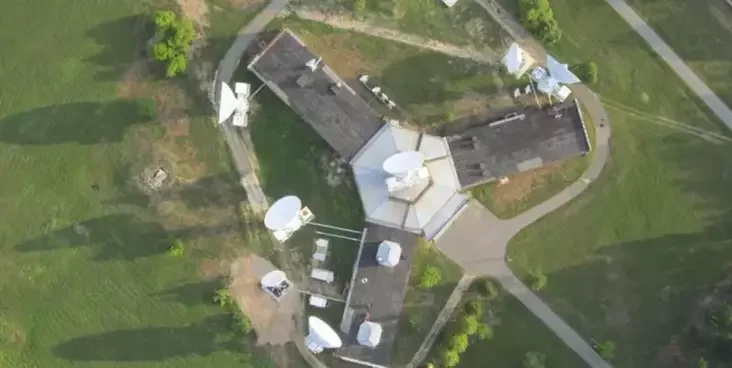
For example, in geostationary orbit, at an altitude of 35,786 km. This is where communication satellites, including military ones, are located. They move at such a speed relative to the Earth that they constantly remain above a specific point on its surface. All of them are located above the equator. The signal from such a satellite can be transmitted over a very long distance, and the power of the apparatus is such that it is capable of transmitting huge amounts of data.
There are not many such satellites. They are used for government communication and television signal transmission. One satellite can perform many communication functions simultaneously. However, the satellite itself, like the antenna, does not encrypt the signal – this happens in ground-based information centers.
The architecture of such a satellite constellation differs from a network similar to Starlink, where there are, on the contrary, very many satellites, and they are located low above the Earth. Communication with satellites in low Earth orbit does not require large antennas and powerful hardware complexes – a small terminal is sufficient.
The second function of a teleport is satellite control. To constantly stay in geostationary orbit, they must maneuver, correcting their position. This correction is performed using onboard engines, and they are controlled from Earth. Possibly, a teleport can also maintain communication with satellites in other orbits.
Network structure of "Space Communications"
The communication centers in Beloomut and Minyaevo belong to the Russian Ministry of Defense; they are presumably connected to other satellites. Judging by information on the "VCh-contact" website, the task of the Beloomut center is to control satellites in orbit and ensure data transmission through them.
Ukrainian Telegram channels and news websites claim, citing sources, that the center in Minyaevo is a secret military unit of the Main Intelligence Directorate of Russia. It is impossible to verify this information through open sources.
In addition to the space communication centers in Dubna and Gus-Khrustalny, FSUE "Space Communications" also has teleports in the Moscow region ("Medvezhy Ozera" and "Skolkovo"), as well as "Zheleznogorsk" in the Krasnoyarsk Territory and "Khabarovsk" in the Far East. Furthermore, the enterprise's infrastructure includes a technical center in Moscow on Shabalovka Street.
The infrastructure of "Space Communications" is structured as a network. The presence of several teleports increases the resilience of the entire system and allows for the redistribution of some functions between several sites in case of problems at one of them. However, in such a case, the load on them would significantly increase.
However, due to the lack of precise data on the damage sustained, it is impossible to understand how much the load on the remaining space communication centers might have increased.
Russian space channels contain almost no information about the consequences of the raids, and one expert in astronautics, with whom the BBC Russian Service spoke, noted that he had no data on large-scale disruptions in the operation of satellite communication systems.
Oleg Chernysh, a correspondent for the BBC Ukrainian Service, interviewed Andriy Kolesnyk, an expert in astronautics and a former employee of the Ukrainian State Space Agency.
According to Kolesnyk, the Dubna SCC specializes in government communications, while "Vladimir" specializes in managing the Russian GLONASS satellite navigation system. The key, in his opinion, is the defeat of the satellite antennas themselves, not the telemetry equipment. Repairing antennas, especially their lifting and turning mechanisms, is a "non-trivial task," the specialist said.
Overall, according to the expert, the Ukrainian campaign of strikes on space communication centers could be successful if it is prolonged and prevents Russia from restoring the damaged facilities.
Now reading


In Belarus, rules for the evacuation of valuables in case of war approved: bricks from Brest Fortress with inscriptions will be saved before paintings by Chagall and Soutine

In Belarus, rules for the evacuation of valuables in case of war approved: bricks from Brest Fortress with inscriptions will be saved before paintings by Chagall and Soutine


Former Gazprombank Vice-President Volobuev – on serving in the AFU, connections with the "Black Spark" underground, and abandoning his family in Russia

Former Gazprombank Vice-President Volobuev – on serving in the AFU, connections with the "Black Spark" underground, and abandoning his family in Russia


"Have you seen the wallpaper from the developer? It's a nightmare." Why is state-provided renovation in apartments for those on the waiting list criticized?


Comments