


Ministry of Natural Resources wants district officials to stop prohibiting swimming in bodies of water without explanation
Only two permitted swimming spots for almost 100 bodies of water in Dokshitsy district is absurd.
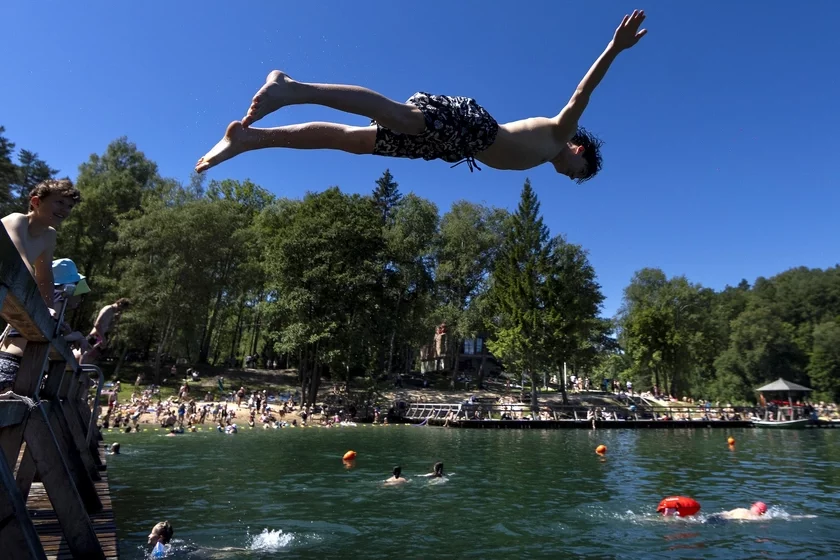
Photo: AP Photo Mindaugas Kulbis
The Ministry of Natural Resources and Environmental Protection has prepared a draft resolution of the Council of Ministers "On Activities in the Field of Water Protection and Use." The draft and its justification have been published on the forumpravo.by portal. The resolution is expected to come into force on January 1, 2027, along with the new edition of the Water Code.
Four Swimming Spots for 102 Rivers and Bodies of Water
In its justification, the ministry acknowledges that local authorities prohibit swimming without a unified approach and mostly do not explain why.
Three districts are cited as examples. In Dokshitsy district, with a population of 19,630 people, only four swimming spots have been designated. Swimming in other places is prohibited. Meanwhile, according to the state water cadastre, the district has 55 watercourses and 47 bodies of water. Anyone swimming in them outside the four permitted locations risks administrative liability.
In Asipovichy district, with a population of 42,273 people, only two places for water recreation have been designated. Swimming in other places is also prohibited. In total, the district has 40 watercourses and 41 bodies of water.
In Rechytsa district, in January 2024, two places for recreation were designated, while swimming was prohibited in 23 watercourses and 13 bodies of water. In total, the district has 44 watercourses and 53 bodies of water. According to the ministry, this creates "uncertainty" regarding the status of the remaining ones.
The ministry refers to rescuers: people drown primarily not due to the condition of the body of water (uneven bottom, fast current, steep bank), but due to intoxication, overestimation of their abilities, and the desire "to demonstrate their bravery." In 2025, out of 50 people who drowned directly while swimming, 68% were intoxicated. When minors die, one of the main reasons remains that adults left them unsupervised.
According to the ministry, if additional swimming spots become available, districts will become more attractive for tourists, and there will be less burden on existing recreation areas.
What Will Be Considered Dangerous
The draft introduces a list of danger criteria for life and health. Based on these, local authorities will be able to prohibit or restrict swimming, boating, and water intake for household and drinking purposes. The use of the following will be considered dangerous for swimming and water intake:
- bodies of water where water quality does not comply with hygienic standards;
- water-filled quarries, reclamation canals, dug ponds, and technological reservoirs;
- bodies of water in sanitary protection zones of objects that affect human health and the environment, as well as in protected zones of power grids;
- places closer than 100 meters from ports, piers, and hydraulic structures, as well as navigation channels and places closer than 50 meters from their boundary;
- places closer than 1000 meters from the discharge of domestic and industrial wastewater and closer than 500 meters from the discharge of stormwater;
- areas where dangerous weather phenomena of orange and red levels are forecast.
Prohibitions can be imposed on the entire body of water or a part of it, temporarily or indefinitely. The condition of bodies of water must be assessed at least once a year, before the start of the swimming season, as well as on an unscheduled basis.
Leasing Bodies of Water
The new Water Code allows leasing bodies of water or parts thereof for recreation, sports, and tourism. According to the justification, this is done within the framework of the state strategy for promoting the "national tourist brand."
Only a legal entity can be a lessee.
It will not be permitted to lease a part of a body of water that includes the only or only well-maintained access to the water. It will also not be possible to lease fishing grounds and habitats of Red Book species. There is no separate provision in the draft for free public access to bodies of water leased for recreation. Such a provision is only added to the rules for leasing ponds and quarries for fish farming: there, the lessee will not be able to prevent people from approaching the water, but will be able to prohibit fishing.
Now reading


Young teacher resigned from school and moved to Batumi. But the head of studies still filed a complaint against her with the police for her TikTok livestreams


Comments