


On Belarusian roads, artificial intelligence has started looking for moose. How does it work?
A standard road sign "Wild Animals" only warns drivers that an animal might run onto the road. On two sections of Belarusian highways — M6 in the Valozhyn district and M10 in the Rechytsa district — a more modern system is now in operation. When the sign starts blinking yellow and a warning appears on the electronic display, it means that an animal is already near the road, writes "Smartpress" publication.
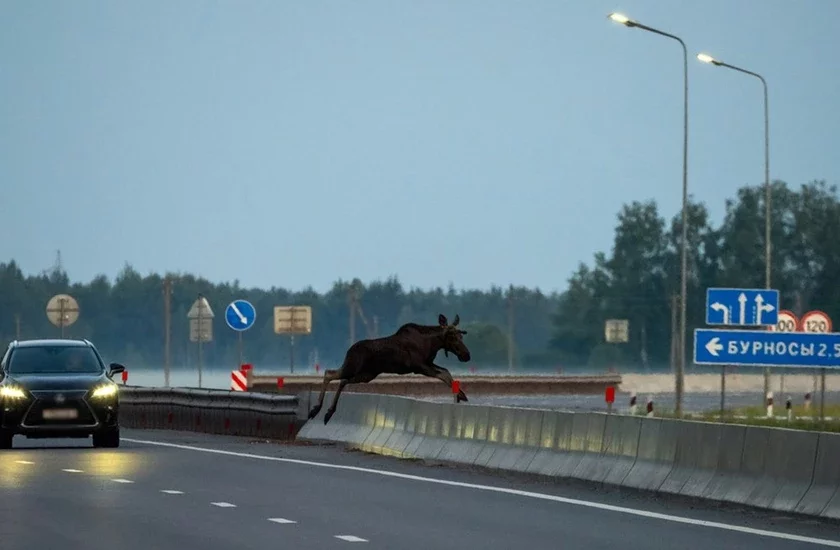
Camera spots an animal — sign lights up
The principle of the system's operation is quite simple. A special crossing is monitored by cameras with video analytics. When they detect an animal approaching the road, drivers are warned by a flashing light on the road sign and a message on the electronic display. The alarm works until the animal leaves the dangerous zone.
The Ministry of Transport emphasizes that the flashing of the sign on such a section means a real danger of an animal appearing on the roadway.
Almost 5 thousand cases in a year
The implementation of such systems is associated with an increase in the number of accidents involving wild animals. In 2025, 4998 cases of wild animals killed or injured as a result of traffic accidents were registered in Belarus — 32.3% more than the year before. In total, 5100 animals were injured or killed.
Most of them were roe deer — 3526. Moose came in second — 1111.
The increase in such incidents continued in 2026. For the first quarter, the Belarusian Society of Hunters and Fishermen has already reported 932 traffic accidents involving game animals, in which 957 animals were killed or injured. This is 210 cases more than in the same period of 2025.
Possible reasons include increased traffic flow, an increase in the number of wild animals, and seasonal dispersion of young animals.
The society classifies the most dangerous roads in this regard as M2 Minsk — Minsk National Airport, M6 Minsk — Grodno — Polish border, M1 Brest — Minsk — Russian border, M4 Minsk — Mogilev, and M5 Minsk — Gomel.
Thus, the new system appeared on one of the highways where the problem of collisions with animals is particularly noticeable.
Why is a moose particularly dangerous?
A moose, like any other wild animal, does not assess the speed of a car and can unexpectedly change direction. This is especially dangerous at night: an animal illuminated by headlights can become confused, blinded, and start moving chaotically on the road.
Therefore, if a moose is on the roadside, one should not expect that it will necessarily stay there.
A moose has come onto the road. What to do?
The State Traffic Inspectorate advises drivers to reduce speed as much as possible as soon as an animal appears near the road, rather than waiting until it is directly in front of the car.
If an animal has come onto the roadway, you should give it a chance to leave. You should not sharply swerve to avoid the animal: a startled moose may rush precisely towards the car. It is also not recommended to honk, as a loud sound can make the animal behave unpredictably.
It is also worth remembering that if one animal crossed the road, others might be nearby. Therefore, immediately speeding up after the animal has disappeared is also dangerous.
At night, the recommendations are even more specific: if an animal has stopped in the headlight beam, you should stop, turn off high and low beams, leaving only parking lights and hazard warning lights on, and give the animal time to leave the road.
What to do if a collision could not be avoided?
It is forbidden to leave the scene of the accident. You must mark the accident location and call emergency services: 102, and if there are injured persons — 103.
Approaching an injured moose is also dangerous. A wild animal in a state of shock can attack.
It is also forbidden to take a deceased animal with you — the State Traffic Inspectorate warns that such actions can be considered poaching.


Comments