


Ukraine's Ambassador for Belarus Issues: Kyiv Can Meet Lukashenka If It Saves Lives
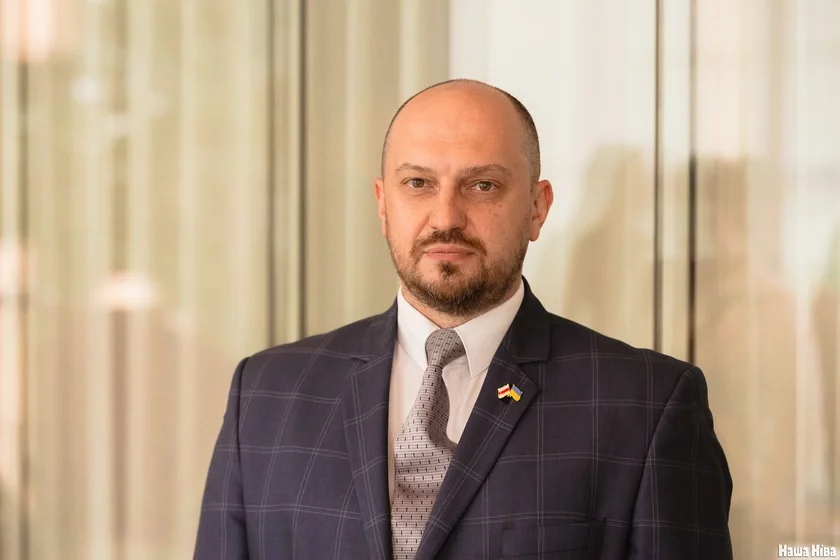
What does Kyiv actually think about Belarus and Belarusian democratic forces? Does Ukraine consider the Belarusian opposition a real political partner? Why did the attitude towards Lukashenka's regime change during the war, and are there really non-public contacts between Kyiv and Minsk? "Radio Svaboda" spoke about this in Warsaw with Yaroslav Chornohor — Ukraine's Ambassador at Large for cooperation with Belarusian democratic forces.
What does Ukraine expect from Belarusian democratic forces?
— Is the Belarusian opposition for Ukraine today just a moral partner, an ally, or still a real political entity?
— Since the president clearly stated that we separate Lukashenka's regime from the Belarusian people, the Belarusian democratic forces are precisely the entity that is a representative of the Belarusian people for the Ukrainian state.
Belarusian democratic forces have the potential, after the change of Lukashenka's regime, to come to power in the country and ensure the democratic, independent development of Belarus as a national state and a regional European player.
— The Belarusian opposition has no real power: it controls neither the sky, nor the army, nor the territory of Belarus. What does Ukraine expect from it today?
— We would like the Ukrainian state to have partners from both the Belarusian and Russian democratic circles who could genuinely change the situation in their countries. Because the matter of regime change, the democratic transition of these countries, is entirely the responsibility of these peoples themselves. Democratic forces must take the lead and change these authoritarian regimes in their countries.
Why Kyiv changed its attitude towards Tsikhanouskaya
— Why has Ukraine's policy towards Belarusian democratic forces changed precisely now? Why, after a long wait, did the meeting between Volodymyr Zelenskyy and Sviatlana Tsikhanouskaya take place this May?
— Ukraine's logic is not the linear logic of a peaceful country's state policy. Everything for us is tied to the logic of war. Ukraine is in a state of war with the Russian Federation, and at one moment or another, the state leadership determines the priority of its actions to ensure that Ukraine stands strong and, preferably, wins this war.
If at the beginning of the full-scale invasion, Belarus was perceived, although not legally recognized at the legislative level, as a co-aggressor, it was certainly voiced politically. Restrictions on the rights of Belarusian citizens in Ukraine were the same as restrictions on citizens of the Russian Federation.
Thus, the Ukrainian state showed that it treated Belarus and Russia as co-aggressors.
— Why did Ukraine for some time try to minimize public criticism of Lukashenka?
— The issue was resolved diplomatically, although not through public channels. Belarus stopped providing its territory for Russian troops. Russian troops were gradually, for the most part, withdrawn. Two or three military bases remained with a limited contingent of Russian troops, who perform a number of functional duties there, but do not directly participate in the war against Ukraine.
Therefore, the Ukrainian side had such a position: to minimize the danger from the north, Lukashenka's regime would not be overly criticized publicly. All efforts were directed towards preventing military actions from the north. This goal was achieved.
But Lukashenka's regime, instead of using this opportunity to further distance itself from the war, used this time to increase assistance to the Russian Federation from military-industrial enterprises, as well as to provide territory. This showed that ignoring the problem became more costly than before. The enemy is strengthening.
Does Ukraine really talk to Lukashenka?
— What else would Lukashenka have to do for Kyiv to stop talking about Belarus as a co-aggressor — not only for February 24, 2022, but even today?
— It would be maximally desirable for the Republic of Belarus to cease being an ally of Russia, to withdraw from the agreements signed within the framework of the so-called Union State. Belarus should move towards transforming itself into a democratic state and not use its territory for Russia to circumvent sanctions.
Then the danger from the north for Ukraine would gradually decrease, and for Belarusian society, the prospect of democratization and improvement of its situation, including on the international arena, would emerge.
— Lukashenka stated that the Belarusian side has contacts with representatives of Ukraine. Do official Minsk and high-ranking Ukrainian officials really have conversations?
— The fact that communication between Ukraine and Belarus is happening is a proven fact. Firstly, if only because the Embassy of Ukraine in Belarus is not closed, diplomatic relations are not severed.
Again, we see the constant transit of Ukrainian and Russian prisoners of war through Belarusian territory. And this shows that without communication with Lukashenka's regime, this would be impossible. Therefore, we can assume and see examples of the realization that such communications are taking place. At what level and who meets with whom — is unknown.
— In your assessment, is Alexander Lukashenka an independent actor who makes decisions and influences the situation in Ukraine, or is he still a proxy of Russia, where everything is controlled by Putin and the Kremlin?
— This is a very simplified view of politics. It doesn't work that way. Lukashenka is sovereign in some aspects, a proxy in others, and directly a satellite of Putin in still others. Therefore, each question requires analysis, and the conclusion depends on this analysis: where is Lukashenka's independent action, what are the limits of his independent steps, and where is it a direct instruction from the Kremlin that he carries out.
The fact that Lukashenka is maximally dependent on the Kremlin is beyond doubt. But regarding his specific steps, it's difficult to say what he does of his own volition and what under coercion from the Kremlin.
He tries to balance. He went to Putin in Valdai, went to China, to other countries. He tries to stay in power. That's what we know for sure.
— If Ukraine allows a meeting with Putin, does Kyiv allow that it makes sense to meet with Lukashenka as well? Is there anything to negotiate with him about?
— There is a category of values, and there is a category of survival. If, in wartime conditions, it becomes necessary to reduce the number of human casualties, to stop military actions altogether, and it becomes necessary for the President of Ukraine or some Ukrainian state officials to meet with one or another adversary, a representative of the opposing side, then such actions might be carried out.
I'm not saying it will definitely happen. But if the price of this meeting is worth it, especially for saving human lives, then anything is possible.
Why are the problems of Belarusians in Ukraine not being resolved?
— We observe dramatic situations where Belarusians who volunteer or fought for Ukraine cannot obtain documents, and sometimes are forced to leave the country. Why is this happening?
— In fact, this question is probably not for me as a representative of the Ministry of Foreign Affairs. To get a complete answer, you need to ask representatives of the state migration service, which deals with the legalization of foreign citizens on the territory of Ukraine.
I cannot answer for the activities of other central executive bodies. There is legislation within which they operate. I also operate within my powers.
There are other ways. They are complicated, but Ukraine tries, in wartime conditions, to adhere to the letter of the law and democratic norms. Within these norms, it sometimes seems that they create difficulties for people. But these are certain safeguards to ensure that the state stands firm, that the state exists and can guarantee the safety of its people.
Sometimes other citizens fall under this, including citizens of Belarus or stateless persons. But, excuse me, sometimes even citizens of Ukraine suffer from restrictions. In fact, these sufferings are less dangerous than the consequences of the war we face due to Russian aggression.
Therefore, I would urge your viewers and readers to understand: Ukraine is in wartime conditions. These conditions are difficult, and the entire state is focused on ensuring victory. There are problems, but they are being worked on.


Comments