


"20 Tons Fly Over Our Heads". Brother and Sister from Belarus Share How Much They Earn in the Port of Gdynia, Poland
Dzianis and Veranika — a brother and sister from Belarus — live in Gdynia and work in local ports. Dzianis climbed the ranks from a worker to a foreman, while Veranika has been working as a freight forwarder for over two years. They told MOST how they got into this field, how much one can earn in Polish ports, and why they have already helped a dozen acquaintances find jobs there.
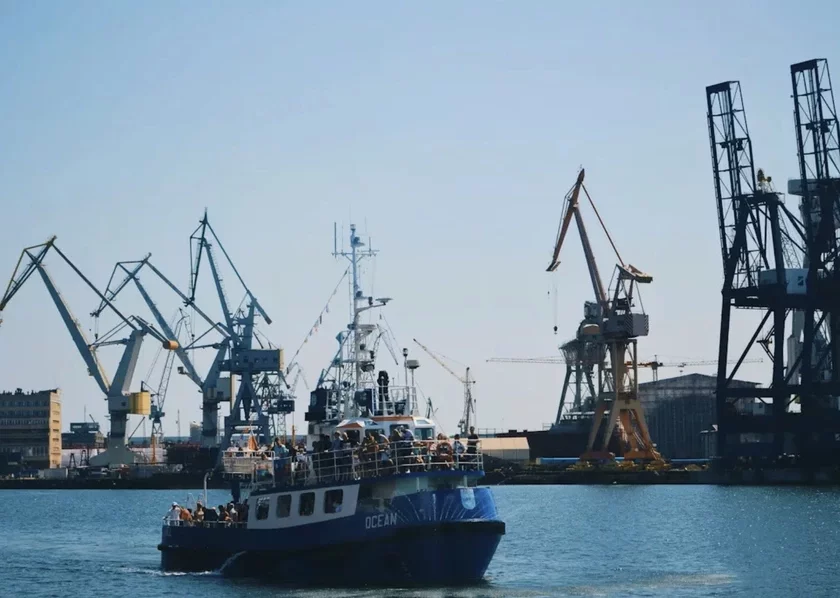
Dzianis is 21 years old. He came to Poland in 2023 with his family. A few months later, the young man turned 18 — and on that very day, he started working.
He first worked in a chain of grocery stores, then in a communal service. And then an acquaintance invited him to work at the port. At first, the Belarusian thought it was about a shipyard and wanted to refuse.
— I heard from many people that it's a bit like slave labor there, dirty. Acquaintances who worked as grinders had lung problems. I didn't want to go there, — says the Belarusian.
However, it turned out that it was specifically about unloading and loading vessels.
"You just had to move a lot"
Through an intermediary firm, Dzianis got a job as a stevedore — a port worker whose duties include loading, unloading, and safely placing containerized cargo on vessels.
The schedule was flexible — it depended on the arrival schedule of ships. Shifts usually lasted eight or 12 hours, but sometimes there were "unusual" ones — four hours or until the servicing of a specific vessel was completed.
Physically, the work for Dzianis was not difficult — "you just had to move a lot." This was not a problem: the young man previously engaged in professional sports, and in emigration, he maintained his fitness at the gym.
— There are holes at the corners of containers where locks (corner fittings. — Note by MOST) are inserted. These locks secure the containers to the vessel so that they don't fall off during transport and storms, — the Belarusian describes the specifics of the work. — So I walked around, making these fastenings or, conversely, dismantling them. This was one of the main tasks.
At that time, Dzianis was also studying at a policeal school, and, as a student, could count on a higher rate thanks to tax benefits. On average, his monthly income was 5‑6 thousand zlotys ($1300—1600).
"I saw fingers being torn off"
After nine months, Dzianis was offered a promotion — to hatchman. For this, the Belarusian underwent a one-day training, passed a test, and received a confirming document. According to him, it was not difficult: he already knew the specifics of the new job well, often talked to hatchmen, and was interested in the nuances.
— The hatchman is the eyes of the operator. You stand on the ship or under the ship and give commands, — explains the Belarusian. — This is a big responsibility: you need to monitor the equipment, know the tonnage of the cargo, and how much the fastenings can withstand. There are containers of specific sizes — you need to figure out how to hook them up. Plus, you are responsible for people's safety. And during this time, I've seen a lot in the port: like fingers being torn off, for example.
The Belarusian's salary in the new position increased to 6‑8 thousand zlotys ($1600—2150) per month. The final amount depended on the number of hours worked and bonuses for unloading specific cargo.
"20 Tons Fly Over Our Heads"
Recently, Dzianis was promoted again. At 21, the young man became a foreman. Now even more responsibility fell on him.
He organizes the work of the team, distributes tasks among workers, compiles and submits reports on employee working hours, and trains newcomers.
— 80% of new employees have to be guided by the hand, everything explained and shown. They don't understand where they are at all. 20 tons fly over your head there, and if, God forbid, it breaks loose, nothing will be left of you. And I will be responsible for the person, — says Dzianis.
Now he works night shifts — from six in the evening to six in the morning.
In his busiest month, he worked 298 hours and earned about 12 thousand zlotys ($3200).
"He apologized and almost cried"
Dzianis supervises workers of various ages. The oldest, according to him, is 58 years old. The young man says that his relationships with colleagues are good, and no open conflicts have arisen. And he admits that sometimes he doesn't hesitate to raise his voice if they don't want to listen.
The foremen are calm about him being a foreigner. He says they don't hide that they value him as a specialist. But a colleague recently got into an unpleasant situation.
— I was standing on the ship with a radio, and my colleague-foreman, with whom we work in shifts, was supervising the unloading. He, by the way, is also from Belarus. I noticed that a container was placed unevenly — and told the operator that it needed [to be corrected]. And the operator said in Polish: "If they don't know how to hook it up, let them go fight in Ukraine," — the Belarusian recounts. — The colleague was going to write a report to management about this: for such a thing, you can even be fired here. But that [operator] waited for him after work, apologized, and almost cried.
"It's difficult for a woman to get a job in the port"
Dzianis's sister Veranika is 26 years old. She has also been working at the port for two and a half years, though in a different position — as a freight forwarder. Her brother helped her get the job.
— It's more difficult for a woman to get a job in the port; you need to know Polish at a sufficient level. Minimum B1, I would say. I immediately had a goal to learn Polish well. I passed the B2 exam, — says the Belarusian woman. — The thing is, the freight forwarder is constantly in touch with the planner and the operator, as well as the ship's crew. And these are almost always Poles.
At work, Veranika controls the process of loading and unloading containers from vessels. In fact, she coordinates the actions of the port crane operator: he is in the cabin at a great height, while Veranika is on the ground, and using radio communication, she tells him where and how to place the container.
Veranika is also responsible for checking containers for damage after they are unloaded.
— The work is not difficult. I like everything, — says the Belarusian woman. — The only thing is, you have to talk a lot with new people: new vessels are constantly arriving. I generally like talking to people, but sometimes you get tired of communication.
For the first two months, Veranika worked through an intermediary firm under a mandate contract. Then she was offered to join the port's staff and sign an employment contract.
Veranika's schedule is flexible. In total, she works 15 days a month, 12 hours a day.
— I come home from work [from the night shift], sleep from 7 AM to 2 PM. And until 7 PM, I have time for tutors, the gym, and other things. I also have a registered sole proprietorship for sewing lingerie, — says the Belarusian woman, explaining that she develops her small business on weekends.
At the start, Veranika earned about 5.5 thousand zlotys ($1500) per month. With each new contract, her rate increased, and now her salary is about 7 thousand zlotys ($1875) for 168 hours per month.
In two and a half years of work, the brother and sister have managed to recommend port work to many of their acquaintances. According to Veranika, thanks to their recommendations, about ten people have already found employment here.


Comments
"складае каля 7 тыс. злотых ($1875) за 168 гадзін у месяц" - 10 евро в час.
За изматывающий физ. труд. Это хоть нетто?
Вам там ОК вообще?!