


"Take both the basket and the fish." 81-year-old Viera recorded memories of Davyd-Haradok in the 1950s and made audio recordings of her beloved dialect
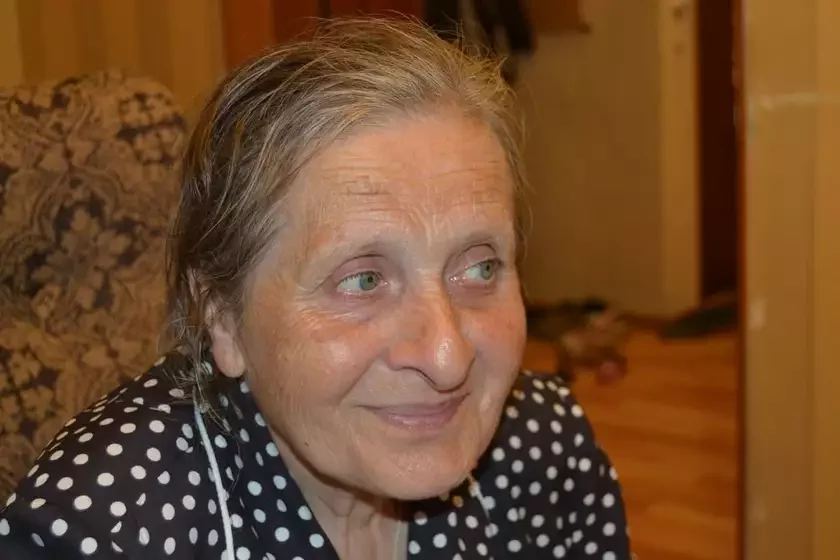
Viera Batsyukova, née Zhuk, was born in Davyd-Haradok, Stolin District, in 1945. She studied at a foreign language institute and then lived in Mahilioŭ. But she never forgot her native dialect — so colorful and beloved. Her memories were published on Facebook by her son, Aliaksei Batsyukov, former director of the Mahilioŭ Museum. And on Instagram, he also posted audio recordings of the Davyd-Haradok dialect . We retell the main points here. And we ask in advance: record elderly people and publish what they share.
In my time, my Davyd-Haradok had three schools: Belarusian, Russian, and an evening school. Both my brothers attended the Belarusian school. I ended up in the Russian school, where we learned many new words and concepts without dictionaries or translators. Everything around us began to be called in a new way. In our houses, we walked on the "podlozi" (but at school they said: "pol" [floor]) and looked at the "stolyu" (but at school — "potolok" [ceiling]). We scratched our "patylitsa" (at school: zatylok [nape]) when solving a difficult problem. And next to the stove stood a "chipleya" (at school — ukhvat [pot hook]). We carried books to school in a "techka" (like a shopper bag, instead of a backpack). All this had to be learned in Russian. And we didn't have electric light, radio, or television then.
We read a lot aloud in Russian, pronouncing each word as it was written. We read "Здравствуйте" [Hello], carefully enunciating each consonant. The greeting "Здрасте!" [Hi!] seemed rude to us.
I was a diligent and obedient student; I took Russian seriously and was happy when a new word appeared in my vocabulary. When I was in elementary school, my neighbor Maksim Kazliak, my friend's brother, once picked up an accordion to play something. Our accordionists were entirely self-taught, but they wonderfully energized teenage audiences at street dance spots.
— You're out of tune, — I told Maksim.
He knew it himself. Maksim was six years older, and my remark simply enraged him.
— You could have said it simply, instead of "falshy-y-yvi-i-i-sh" [you're out of tune-e-e-e], — Maksim grumbled in a bass voice.
I remained silent but was secretly proud of myself. And Maksim, unfortunately, stopped playing the accordion.
Later, as a student, I once asked someone on the street: "Скажеце, сколько сайчас часоў?" [Will you tell me, how many o'clock is it now?].
My ignorance of the Russian language made him cringe.
— Девушка, нужно спрашивать не сколько часов, а сколько времени. [Young lady, you shouldn't ask "how many hours" but "what time is it."]
And why, I thought to myself. If there is one hour, then there can be several hours. They explained to me that "часы" [chasy] in Russian also means a device for measuring time (a clock/watch).
We had a wonderful teacher of Belarusian and Russian languages, Eŭfrasinnia Fiodaraŭna. In response to a phrase like "У мое бабу е новая ківенька" (My grandmother has a new walking stick), she once casually remarked that in some regions of the BSSR, instead of the word "e" [is], the word "yo" [is] is used.
My classmates only knew the Haradok dialect and simply didn't suspect that someone far away, even 50 km from them, could speak so unusually. The class burst into laughter: "Yo"! It's incredibly funny that somewhere near us, some strange people are mutilating our dialect with the absurd word "Yo". Eŭfrasinnia Fiodaraŭna did not expect such a reaction and quietly remained silent. Perhaps she herself was from such a "yokaюchy" (using "yo") area and felt her mistake.
Already in adulthood, when Russian became a working tool for me, I made a gross mistake in Russian, which my Russian-born colleagues drew attention to.
— На тебе книга, — I said to someone sitting nearby. [Take a book (nominative case)]
— Трэба казаць «на тебе книгу», — they corrected me. [You should say "на тебе книгу" (accusative case)]
— А ў маім Давыд-Гарадку існуе прымаўка «На тобе й кош і рыба», — I parried. I speak like a resident of Haradok. (На табе і кош і рыба (Na tabe i kosh i ryba) means "here's everything; I give up, just leave me alone." Кош (kosh) — a woven basket of an elongated or conical shape for catching or storing fish in water — NN.)
Russian had to be polished to bring it up to the required level. Every time I came home for holidays, my distant relatives (with some envy) emphasized that I spoke Russian better and better. Their envy is completely understandable: every spring they sold their seeds throughout the Soviet Union (growing vegetables and flowers for seeds was and remains a traditional business for the residents of Haradok), and knowing Russian would be a good help for them, because language determines "one of us or a stranger," and people trust "their own" more.
The only person for whom my Russian brought suffering was my mother.
— Шчо гэто за слово «почему»? — she asked, emphasizing the sound "ч". — Трэба казаць чому, навошчо, колі. [What kind of word is "почему" (why)? You should say "чому" (why), "навошчо" (what for), "колі" (when).]
I loved my mother very much and didn't know how to justify myself. Dad understood me more, he was fluent in Polish.
It turned out that after the Haradok dialect, I immediately switched to Russian, and the Belarusian language became secondary.
Unfortunately, now there are not many people left who speak Belarusian not only at home but also at work. And when I heard pure, beautiful Belarusian in Minsk in 2015 in a polyclinic, I was very pleasantly surprised.
You speak Belarusian! — I exclaimed with delight
I am Belarusian! — smiled the middle-aged nurse.
But the Belarusian language has natural opponents, those for whom it is incomprehensible. They want to simplify everything and are therefore ready to mock our great heritage.
I remember once cycling in the Moscow suburbs, accompanied by a gentleman.
— Спой что-нибудь по-белорусски, — he asked. [Sing something in Belarusian.]
Sitting on the bike, I began to sing loudly as in childhood:
… Помніш, калі я спаткаўся з табою, зорка Венера ўзышла… [... Remember when I met you, the star Venus rose...]
Что за слово «спаткаўся»? Споткнулся, что ли? А «зорка»? — удивился кавалер. [What kind of word is "спаткаўся" (met)? Stumbled, or what? And "зорка" (star)? — the gentleman was surprised.]
That offended me greatly then. I am Belarusian! For every ray of that star, I was ready to fight with my fists!
I am glad that now the language of my Homeland is being revived as some kind of craving for freedom and liberty.
And my Haradok dialect is present in my memory as the most basic and reliable information (at the cellular level). When I lack words in Russian, I recall them in the Haradok dialect.
We had many sayings and proverbs. Here are a few examples:
Поманяў быка на індыка (This is how "памяняў" [exchanged] was pronounced in Davyd-Haradok). [He exchanged a bull for a turkey.]
Ні до пары — з’ядзяць цабэ татары (There was an ancient custom of giving everything in pairs, fours, sixes, etc. It was believed to bring happiness, protect). [Not in pairs — the Tatars will eat it all.]
Дурэнь і мяло поломіць. (A fool will break a pestle too.). [A fool will break even a pestle.]
Була ў собакі хата. (Ironically said about complete impoverishment, when nothing is left.) [A dog had a house.]
Шчо голова, то й розум (equivalent to the Russian "сколько голов, столько и умов"). [As many heads, so many minds.]
And now a little poem I remember from childhood:
Дожджык, дожджык, перэстань
Му поедом у Ёрдань
Богу моліцца
Хрысту поклоніцца.
Little rain, little rain, stop
We will go to Jordan
To pray to God
To bow to Christ.
Шчэ хочу сказаць усім і собе тожэ:
I also want to say to everyone and myself:
Баражэцэ свою говорку, навэт колі гэто нікому ні знакомуй діалект.
Cherish your dialect, even if it's a dialect unknown to anyone.
Here are a few more examples from my native Haradok language.
Нішчэшко муліць ёй у пантопэльцы. (Something is bothering her in her slipper.)
Цапэр папо поплуў по віш. (Today dad went to swim for sedge/reeds.)
Ходзем, купім тобе сведор. (Let's go, we'll buy you a sweater.)
У мое зовіцы хорошые панчоxi. (My wife's sister has nice stockings.)
На прыпачку набоковаты глечык. (On the back of the stove, there's a crooked pitcher.)
We call our dialect the Haradok language, because each of the surrounding villages had its own peculiarities in speech, clothing, and rituals. A Haradok resident would listen to a person and immediately hear: this one is from Tserablich, and that one is from Olpen. Each settlement had different roots, its own language, its own culture.
In the Haradok language, for example, diphthongs "ie" and "uo" are present (some tribe whose language had these diphthongs spread thinly from Stolin region through the vicinity of Byaroza and Pružany all the way to Bielsk in Podlachia; the same diphthongs are preserved in the Lithuanian language — NN). They pronounced "viera", "dzielo", "dzied", "vuol", "kuoń", "tuok" and so on.
Thanks to my knowledge of the Haradok dialect, it was easier for me to read the Bible in Church Slavonic, which I acquired from a priest in Kazakhstan when churches began to open and Christian literature became available. I was looking for some secret information, a hidden truth, encrypted in the magical letters and symbols of the Bible. By the way, my mother taught me to read the Bible. To understand what is written in this great book, you have to think a lot. "Blessed are those who hunger and thirst for righteousness, for they will be filled."


Comments
Дзякуй!
там розныя гаворкі, ёсць і класічныя беларускія нават на Украінскім баку, да таго, там літвіны жывуць каля Чарнігава.