


This plant repels mosquitoes no worse than the most popular chemical repellents
The plant is best known for its unusual ability to affect cats.

A lotion based on catnip oil (also called catmint or sometimes, incorrectly, melissa or lemon balm) showed similar effectiveness to diethyltoluamide (DEET), which is considered the gold standard among mosquito and tick repellents, during trials in Uganda. Researchers hope that a cheap local alternative will help in the fight against malaria in regions where expensive drugs are unavailable.
Catnip (Nepeta cataria) is a species of flowering plant in the mint family, 35 to 100 centimeters tall. It grows over large areas of Europe and Asia, and has also naturalized in North and South America, Africa, and New Zealand.
Catnip is best known for its unusual ability to affect cats: many animals, after contact with the plant, begin to rub against it, roll on the ground, and behave playfully. This effect is caused by nepetalactone — a natural substance found in the plant. However, as preliminary observations have shown, for humans this compound may be useful for a completely different reason: it is capable of repelling insects, including mosquitoes.
Scientists from Cardiff University and their colleagues from Uganda tested whether catnip oil could be used to create a cheap and effective mosquito repellent. They presented the results of their work, as reported by The Guardian, at the Society for Experimental Biology conference in Florence.
First, the researchers confirmed in laboratory conditions that catnip oil indeed repels mosquitoes. After this, they organized field trials in eastern Uganda. Volunteers applied various repellents to their legs, and scientists counted how many mosquitoes landed on their skin during the evening.
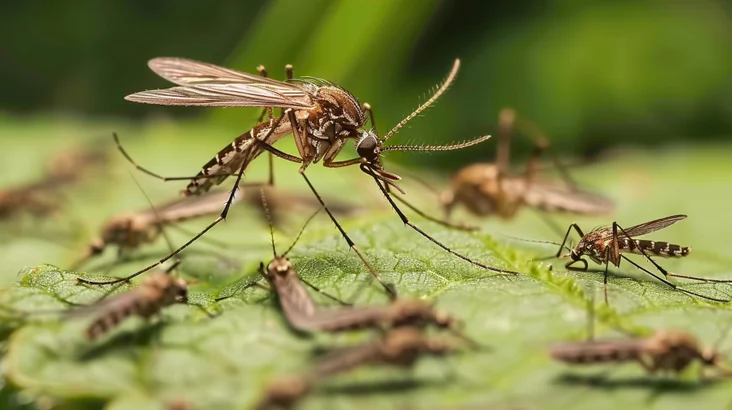
Some participants used lotion with 15% DEET (diethyltoluamide). This concentration is most widely represented in commercial repellents in Uganda.
Others received lotions with 2% or 6% catnip oil, while the control group received a placebo.
It was found that the lotion with 6% catnip oil protected against bites just as effectively as the DEET-based product. The 2% oil version also worked well, although it was slightly less effective than the other two options.
According to the head of the study, Cardiff University lecturer Simon Schofield, the main advantage of the new product is its affordability. For many small farmers in rural areas of Uganda, commercial repellents are too expensive, so they often do not use mosquito protection at all.
The study showed that the production of the lotion could be organized locally.
Schofield himself also humorously admitted that the researchers did not check whether the smell of the new lotion would attract cats.
The search for new means of mosquito control remains highly relevant. It is estimated that in 2024, about 282 million people were infected with malaria, and 610 thousand died, mostly young children in African countries. In addition, experts are increasingly talking about the growing resistance of mosquitoes to insecticides and of pathogens to antimalarial drugs.
-
Pryluki near Minsk on a wave of hype — Belarusians massively went there for photos in the "Twilight" style. Locals are not thrilled
-
Brazilian man sold all his property and traveled 2000 kilometers for a woman. But he faced a harsh disappointment
-
An epic battle took place under the walls of Kreva Castle VIDEO
Now reading


"He invited me on a date and came with a bag of tomatoes instead of flowers." What they remember about Jan Pamedor Reutski, administrator of a multi-thousand community of Belarusians in Poland


Comments