


The Indian army received the first batch of "Miratvorets" drones. The drone in India was named Agniveg ("Agniveg"), it is capable of developing speeds up to 450 kilometers per hour and is designed for strikes on radars, headquarters, and other objects.
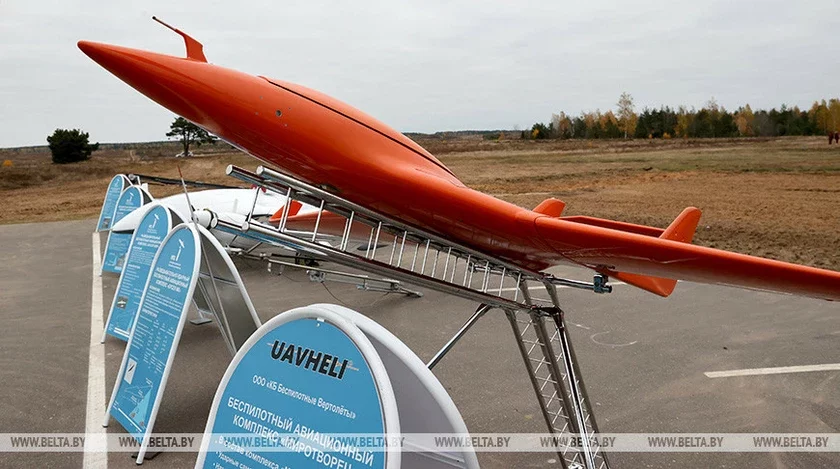
The "Miratvorets" at a stand during Lukashenka's visit to the "Abuz-Lyasnouski" training ground in 2022. Photo: BelTA
The Indian army has been bolstered by more than a hundred jet kamikaze drones, which India presents as "domestic" weapons and an example of the "Make in India" policy. However, the "domestic" aspect here is very conditional: the Agniveg attack drone is actually a rebranded Belarusian "Miratvorets," developed by the Indela design bureau, which is now under European Union sanctions. In official statements by SMPP and in Indian media, the Belarusian origin is not mentioned — it only comes from information from sources in defense structures.
The delivery of the first batch of Agniveg ("Agniveg") drones was reported by The Print, citing the Indian company SMPP. According to the publication, the military received 106 units, of which 100 are intended for combat use, and six more for operator training.
The Agniveg ("Miratvorets") belongs to the class of loitering munitions — attack drones often referred to as kamikaze drones. Such devices, after launch, can remain in the air for a certain period searching for a target, and then attack it and are destroyed along with their warhead.
According to the stated characteristics, the drone with a turbojet engine has a wingspan of 2.8 meters, carries a warhead weighing 10 kilograms, develops a speed of up to 450 kilometers per hour, and can operate at a distance of up to 180 kilometers.
The Indian Army gets delivery of 106 kamikaze drones, with 180-km range, from SMPP Limited to boost its deep-strike capabilities in a contested battlefield, countering enemy signal jamming and spoofing operations.https://t.co/3XI1kUl9bH
— Arming India (@armingindia) June 11, 2026
The company also claims that the drone is resistant to electronic warfare countermeasures and cannot be deviated from its course by spoofing navigation signals. According to the developers, after target identification, it is capable of performing fully autonomous missions and delivering high-precision strikes without human involvement.
SMPP states that the appearance of "Agniveg" should help the Indian army close the gap between the capabilities of long-range artillery and missile systems. The drone is designed to hit targets such as command posts, radar stations, logistics hubs, and other important military infrastructure facilities.
According to company information, during tests, the "Agniveg" demonstrated a circular error probable of less than five meters even under conditions of electronic interference and simulated navigation signal spoofing.
Sources from The Print in defense and security agencies claim that this drone was originally developed in Belarus by the Indela Design Bureau, which cooperates with SMPP. It was selected for the Indian army after trials at the Pokhran range in 2025.
It should be noted that "Indela" (or JSC "Unmanned Helicopters") and its chief designer Uladzimir Chudakou are currently under sanctions by several countries.
The Print also reports that cooperation between Indela Design Bureau and SMPP is taking place within the framework of a technology transfer agreement. In the first phase, the Indian company has already localized the production of the drone's warhead. Subsequently, as orders grow, SMPP is expected to gain access to an increasing number of production technologies, including turbojet engine manufacturing technologies.
Sources of the publication also reported that SMPP has already offered the Indian army a next-generation kamikaze drone. According to their data, the new model should develop speeds up to 750 kilometers per hour, which is almost 1.5 times more than the current "Agniveg".
Details about the new system have not yet been disclosed. It is also unknown whether it will be developed in cooperation with Belarusians. However, the statement itself indicates that the Indian side views the current project not as a one-time purchase, but as a foundation for the development of an entire family of high-speed attack drones.
Now reading


Tsikhanouskaya on the attack on the bus with Belarusian children: Don't risk your life - don't go to Russia, which is waging a criminal and unjust war


Comments