


New Ambassador of Ukraine on Belarusian Issues: «We recognize Tsikhanouskaya as the leader. Lukashenka has no monopoly on the voice of the people»
Yaroslav Chornohor has become the Ambassador-at-Large of the Ministry of Foreign Affairs of Ukraine for relations with the democratic forces of Belarus. Agreeing to diplomatic work in the Department of Countries Unfriendly to Ukraine, he wrote: «Over 10 years, I have moved from an academic scholar who volunteered for the wounded in a military hospital to an SSO AFU officer. Then I served as program director of an analytical center in the public sector, and now it's service again, this time diplomatic. And the main factor in my life changes remains the aggressor country and its satellite — Putin's Russian Federation and Lukashenka's Republic of Belarus. Resisting them is a serious challenge, and I have accepted it».
We asked the ambassador about his first steps in the new position, his attitude towards Lukashenka before 2022, contact with Tsikhanouskaya, his vision for Belarus's path to freedom, and concrete actions to simplify life for Belarusians in Ukraine.
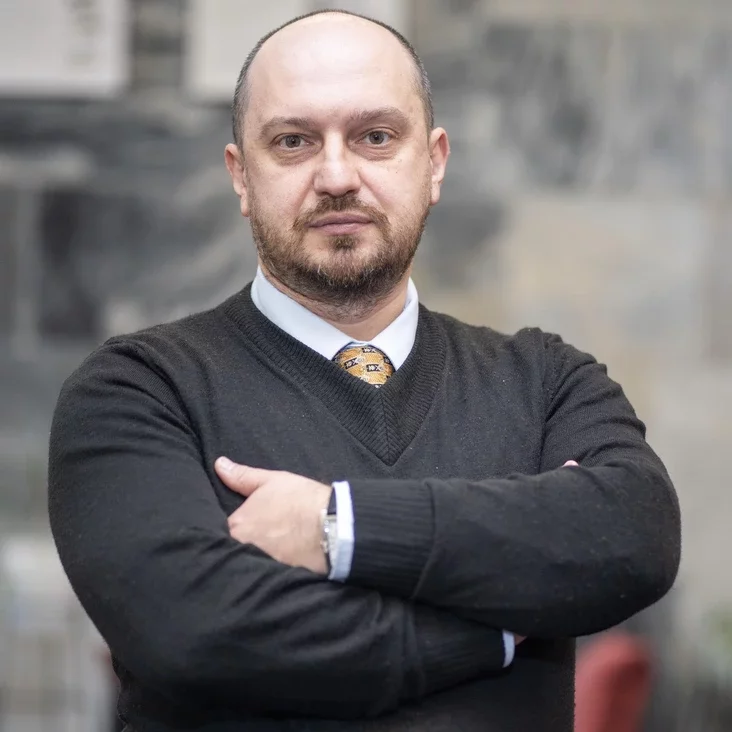
Yaroslav Chornohor
«The last straw is the construction of a base for «Oreshnik»»
«Nasha Niva»: How true is it that Sviatlana Tsikhanouskaya's visit to Kyiv was postponed partly due to the slow process of your appointment?
Yaroslav Chornohor: Partially, that is true. It cannot be the main reason, of course, but every situation consists of different puzzles. And the puzzle of appointing an Ambassador-at-Large who would be responsible for the Belarusian direction is one of them.
It's hard to imagine in what capacity I would have met Sviatlana Tsikhanouskaya if this hadn't happened. Perhaps as a representative of a public organization. But after my appointment, a more complete picture emerged: a representative of the Ministry of Foreign Affairs, familiar with Sviatlana Tsikhanouskaya, meets her at the station, organizes the visit, and accompanies her.
In principle, one of the reasons why I was taken into the Ministry of Foreign Affairs and appointed as ambassador, and given powers for contacts with Belarusian democratic forces, is my expert experience in interacting with them. I participated in more than one event of democratic forces. And I myself organized the Ostroh Forum for four years in a row, and this year, together with the United Transitional Cabinet, I organized the regional security forum «Path to Freedom». In May, I was present at the conference of Belarusians worldwide in Warsaw, and Sviatlana Tsikhanouskaya awarded me the medal «For fruitful work for the benefit of Belarus» there.
Overall, I met Sviatlana Tsikhanouskaya, if I'm not mistaken, two years ago in Stockholm at a forum on Belarus organized by the Swedish Ministry of Foreign Affairs. And when she emerged from the train car upon arrival in Kyiv and saw me, we exchanged mutual sincere smiles because we know each other.
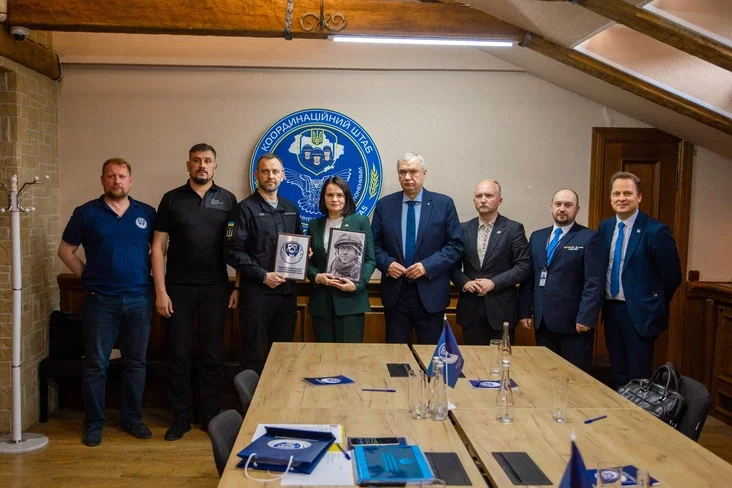
Photo: Sviatlana Tsikhanouskaya's Office
«NN»: There has been a lot of analysis and explanation about why Volodymyr Zelenskyy only entered into dialogue with the Belarusian opposition precisely now — what is your answer here?
YCH: Because the situation has changed. After February 2022, when an attack on Ukraine was launched from Belarusian territory, the northern regions of the country were under threat. The fact that Belarus, led by Lukashenka, did not fully enter the war then was considered a very positive factor. And the entire policy was built on preventing this from happening further; that was the priority.
But three years later, firstly, Ukraine has strengthened militarily, and secondly, Lukashenka's regime, apparently, does not really value the agreements on non-interference in the war that were made in 2022. In particular, I mean the presence of nuclear weapons on Belarusian territory, facilitating the flights of Russian drones (or retransmission). And the last straw is the construction of a base for «Oreshnik».
For every action, the situation must ripen. Here, it has ripened in such a way that we must respond asymmetrically to threats from Belarus.
Sviatlana Tsikhanouskaya came to Kyiv — Zelenskyy's Office showed that we have someone to talk to, we recognize her as the leader. And Lukashenka has no monopoly on the voice of the Belarusian people.
And at every meeting, in interviews, both Mr. Zelenskyy and Foreign Minister Sybiha emphasize that we distinguish between Lukashenka's regime and the Belarusian people.
«NN»: I saw many different reactions to Tsikhanouskaya's arrival in Kyiv, including negative ones. Allegedly, Zelenskyy will now achieve the opening of a new front. What have you heard about this from ordinary Ukrainians?
YCH: There were different reactions to this even among the Belarusian democratic forces themselves, let alone Ukrainian society.
But it's normal for a democracy to have different opinions. And I don't see much point in delving into this, because it's unrealistic to please everyone.
We have tasks that need to be implemented. I have started them. Organizing that same visit is a huge amount of work that was done by experts, by the Ministry of Foreign Affairs, and by the Office of the President. I am a proponent of talking about what we are working on. And other people's opinions and comments — let their authors justify them themselves.
«NN»: What will you do in your new position? Representatives of the Ukrainian Ministry of Foreign Affairs, Heorhiy Tykhyy, voiced voluminous but rather abstract goals for your work, such as «coordinating pressure on the regime» and «neutralizing threats from Belarus».
YCH: The main goal is to use the favorable situation regarding contacts between Ukrainian authorities and Belarusian democratic forces to resolve a number of issues. An interdepartmental group will be created to coordinate the resolution of problems faced by Belarusians in Ukraine. Including — Belarusian volunteers.
Perhaps this will contribute to an increase in the number of volunteers in Ukraine. We truly need intellectual and hardworking people, who, I believe, actually form the basis of the wave of immigration that began after 2020. Of course, the war does not really encourage them to come to Ukraine, but perhaps we can change this situation for the better, even if only slightly.
«Lukashenka's complicity [in the war] has not gone away»
«NN»: Many have previously promised to solve the problems of Belarusians in Ukraine, but little has changed. The same bank accounts of many Belarusians are still blocked. Are you confident that with you, the matter will move from a dead stop?
YCH: The problems are indeed extensive, but thanks to previous work, like that of Sviatlana Shatsilina from the Mission of Democratic Forces, it's easier for me now; we're not starting from scratch.
Literally the day after Sviatlana Tsikhanouskaya's departure, a part of the Belarusian democratic forces delegation remained in Kyiv, and we held a meeting with deputies. From the Belarusian side, Anatol Liabedzka, Sviatlana Shatsilina, and Pavel Barkouski were present. A whole number of volunteers were also there, who submitted their proposals to us in writing. And we discussed them quite substantively with the people's deputies, because in this matter, much depends on them as representatives of the legislative branch.
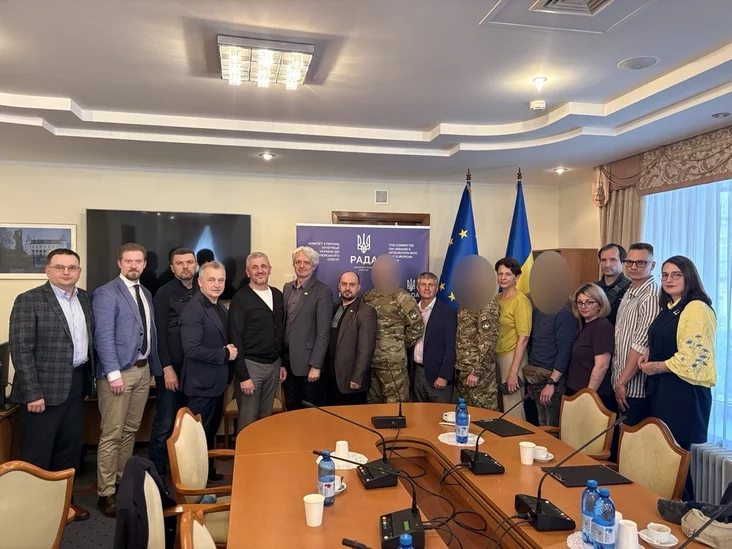
Meeting in the Verkhovna Rada of Ukraine
By the way, since this year, a simplified system for obtaining permanent residency or even Ukrainian citizenship has become available to foreign volunteers. And there are already positive cases.
Of course, it won't be that I was appointed in May, and by June, the problems will be solved — that's too fantastic. But since Ihar Kizim's retirement, we haven't had anyone specifically responsible for working with Belarusians. And my appointment gives us all a chance to move forward here.
Regarding blocked accounts, as far as I know, if Belarusians live in Ukraine, all this is resolved on an individual basis. For this to become simpler and accessible to everyone, there is only one way — to exclude Belarusian citizens from the lists of those responsible for the war alongside Russians. But while the war is ongoing, there are difficulties with this. You see that Lukashenka's complicity [in the war] has not gone away. The threat from his side is not diminishing; on the contrary — it is increasing.
Through all our channels, we speak about the danger from the territory of Belarus. The format is unclear, but they speak about it. Against this background, lifting restrictions on Belarusians looks a bit utopian.
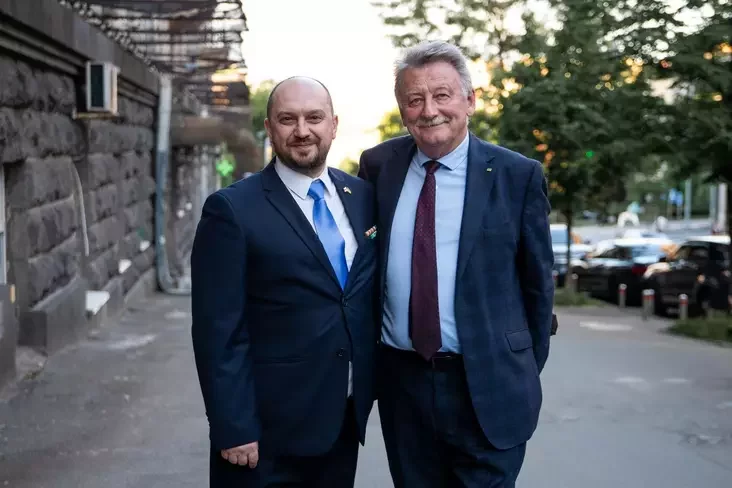
Yaroslav Chornohor and Ihar Kizim
«2014 overturned our entire reality»
«NN»: Tell us a little about yourself and your family.
YCH: I come from Cherkasy Oblast. My father has worked as a history teacher all his life. My mother worked in our town's council for a long time. An intelligent family.
I went into history, one might say, under my dad's influence. Although at one time I dreamed of being a military man. In the end, I was able to serve. Only first, I graduated from university, postgraduate studies, and started working at the Academy of Sciences.
After military department, I was considered a reserve officer, but I didn't even mention military dreams. However, 2014 overturned our entire reality, I remembered that I was a reserve officer and went to the enlistment office to register. Because I have three children, they didn't take me immediately. Then I started volunteering.
And when the Special Operations Forces were being created, I went as a volunteer. There was concern for my family, of course, because my youngest daughter was only born in 2013. But I saw that Russia would not leave us alone, so I dismissed all doubts. I got into a unit that had been withdrawn from Crimea and therefore needed personnel replenishment. I served there for two years, and then taught for three more years at a military institute. I participated in the ATO in Donbas, I am a veteran of that war.
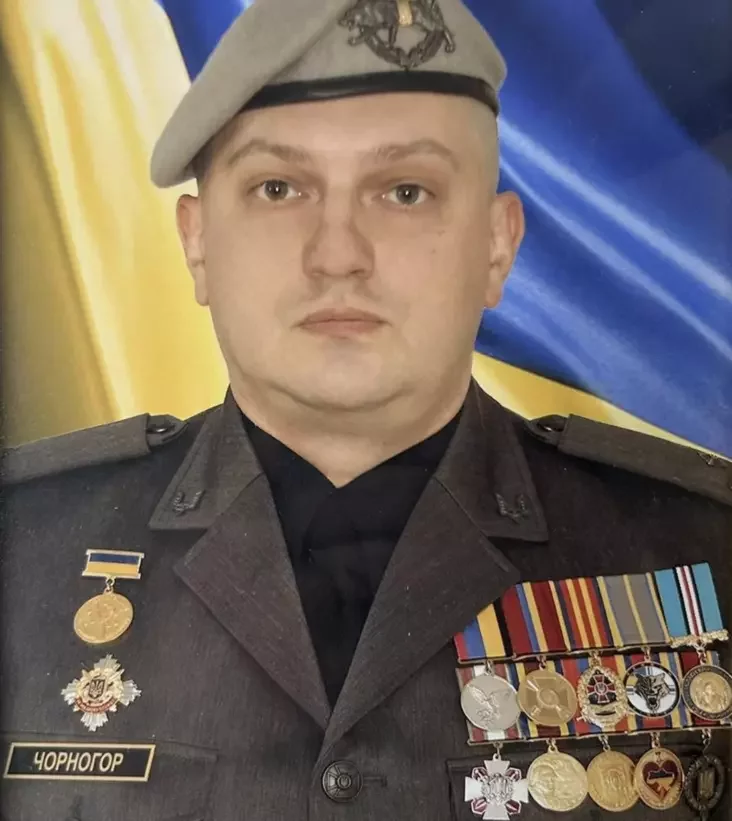
Photo: Yaroslav Chornohor's personal archive
«Now in Ukraine, hardly anyone will say that Lukashenka is a «master»»
«NN»: Before 2022, many Ukrainians were fascinated by Lukashenka as a strong master. Did you yourself not observe this?
YCH: No, I never had sympathy for Lukashenka. If only because I was always interested in democratic practices. I wrote my master's thesis on local self-government in Sweden. My dissertation — on social movements in Germany and the Green Party, which grew out of them.
I am convinced that only a democratic system can contribute to the development of both a specific individual and the prosperity of the state. An authoritarian regime can be effective for a short period, but if it drags on for decades, it definitely leads to a crisis.
«NN»: Where does this fascination with an obviously bloody leader come from, not even within the country, but among residents of neighboring countries?
YCH: This clearly shows how superficially people understand different issues. When a certain stereotype easily sinks into the subconscious, and it's then easier to retransmit it instead of delving deeper. Like «Putin is the president of the world» or «Lukashenka is a strong master». In Ukrainian society, it was the same with Yanukovych for a long time, until the meme «Yanukovych is a villain» won.
But now in Ukraine, hardly anyone will say that Lukashenka is a «master», and if they call him «father», it will only be with a negative connotation.
«NN»: Belarus is on the list of countries unfriendly to Ukraine. Who else is on this anti-rating?
YCH: Only Belarus, Russia, and North Korea.
Belarus got on it thanks to the so-called Union State. For many years, it was such a mythical-symbolic thing, but after 2020, we see that they began to develop a number of joint programs, and everything is moving towards absorbing Belarus. The Belarusian people are gradually dissolving into the Russian context — this is a great misfortune and threat.
«NN»: Some political scientists and analysts call the state of affairs in Belarus a hybrid occupation. How does it look to you?
YCH: Here I will act as a historian, not a diplomat. Lukashenka's regime is a Kremlin satellite. And among the closest analogies that come to my mind is the Vichy regime in France during World War II. When a part of the northern territory was under full Nazi control, and in the south there existed a conditionally independent part of France, but completely subservient to the Germans — that is, their satellite. At the same time, in North Africa, the «Free France» legion with Charles de Gaulle was forming, which was an ally of Britain and the United States.
Following this analogy, Lukashenka's regime is analogous to the Vichy regime, and the Belarusian movement, including the Kastus Kalinouski Regiment and other units — is something like «Free France».
«NN»: You mentioned the Kalinouski Regiment — some Belarusians still place their hopes on it for the liberation of Belarus. What ideal scenario do you yourself see here?
YCH: You know, what strikes me most about the Belarusian community that has left the territory of Belarus, which lives by democratic views, is their belief in easy and simple solutions. Like: Ukraine will win — Lukashenka's regime will fall. Or the Kalinouski Regiment exists — it means they will defeat the regime, and we will return home.
But there are no easy scenarios. And the path for Belarusians to return home lies through a whole complex of actions. One of the reasons why I support Sviatlana Tsikhanouskaya's Office, the United Transitional Cabinet, the Coordination Council, and other organizations simultaneously, is because only in a complex of efforts lies the democratization of Belarus. And one must prepare for this.
Perhaps the situation will generally escalate in such a way that Belarus will indeed be drawn into the war, and then the path to democratization will be completely different. That is why the Ukrainian side organized the meeting with Tsikhanouskaya.
An alternative to the regime exists (for a long time, it was believed that there was no alternative to Lukashenka's regime). And it is important for us to convey that if the regime ultimately falls completely under the influence of the Kremlin and enters the war — the consequences for it will be catastrophic. The commander of unmanned systems forces clearly stated that in such a case, 500 targets have already been identified on the territory of Belarus. Therefore, the regime had better think about it, and even independently seek contacts with Belarusian democratic forces.
By the way, I believe that the United States is making a mistake in trying to negotiate with Lukashenka. Authoritarian regimes somehow consider any agreements to be a manifestation of weakness.
«NN»: You once stated that you are confident that the Russian Federation will collapse. Where does this confidence come from?
YCH: Here I am again basing my opinion on my historical education. The processes that are currently taking place in Russia are identical to those that occurred in 1917-18 and in 1990-91. With each such turn, a number of territories break away from Moscow.
I think the next stage will be similar, because the Kremlin holds on tightly, but it is precisely the war that contributes to the corrosion of ties. Even if Putin, conditionally, sells some of his successes on the front as a victory, economic processes will break everything.
Now reading


"Soy extremists must work off a bowl of strawberries." He complained about working conditions in the KGB, and now he's pitching trainings to security forces — who is Anton Shabunevich


Comments
Колькі добраахвотнікаў і валанцёраў прывезла з сабой Святлана Ціханоўнская?
Нуль. А магла б цэлы аўтобус прывезьці на фронт разам з дабраахвотнікамі, гуманітаркай, дронамі, бронежылетамі. Але не. Не прывезла нічога. Прыехала з пустымі рукамі.
З дыяспарамі і валанцёрамі, якія ўжо працуюць ва Украіне не сустрэлася.
Затое чамусьці паехала ў Чарнобыль і лекцыю ўкраінскім дзецям прачытала. (Навошта?...)
Так што не паспрыяе.