


Elephant with a Dead Calf, Coyote in San Francisco, Puma on a Fence… Here are the Winners of This Year's "Wildlife Photographer of the Year" Contest
An emotional scene of an elephant carrying a dead calf earned Italian photographer Federico Veronesi the title "Wildlife Photographer of the Year 2026" (Photographer of the Year 2026), writes the BBC.
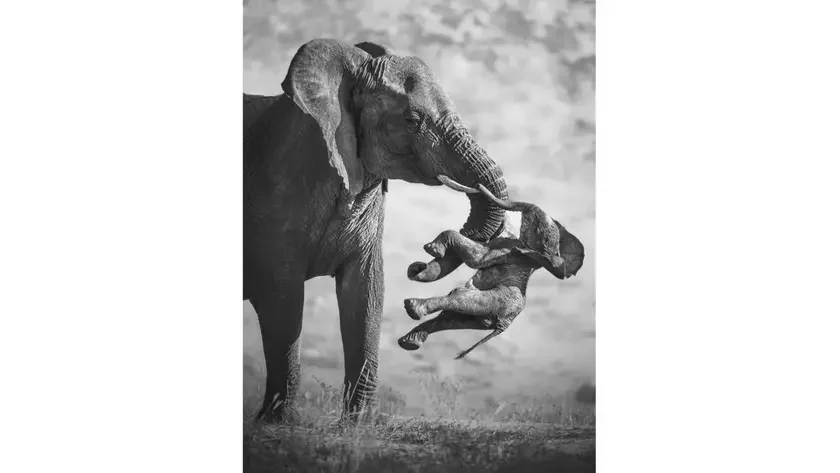
While observing elephants in Namibia's Huab River Valley, Federico Veronesi noticed an unusual trail of drag marks from a body being pulled across the sand of a dry riverbed.
Following these tracks, he came across a female elephant carrying a dead calf. One of the calf's legs was wedged between the adult animal's tusk and trunk.
Initially, Veronesi assumed the elephant was the calf's mother. However, after he showed his photos to elephant researchers working in the area, it turned out that this was not necessarily the case.
Researchers identified the elephant as a female who had lost her own calf several years prior. According to their data, she had also previously picked up dead calves belonging to other females.
For Veronesi, this encounter had profound significance.
"In all my 20 years of photographing animals, this is the most heartbreaking, captivating, and dramatic event," he said.
In his opinion, this incident "reveals the depth and complexity of animal emotions and feelings."
The photographer hopes that his image will encourage people to look beyond the external appearance of animals and see them as individual beings with their own relationships, memories, and emotions.
"It's a small window, just slightly ajar, allowing a glimpse into the complex world of animals," he said.
The annual exhibition of the contest will open at the Natural History Museum on Friday, October 16, 2026. Other awarded images can be seen below.
A Labour of Love
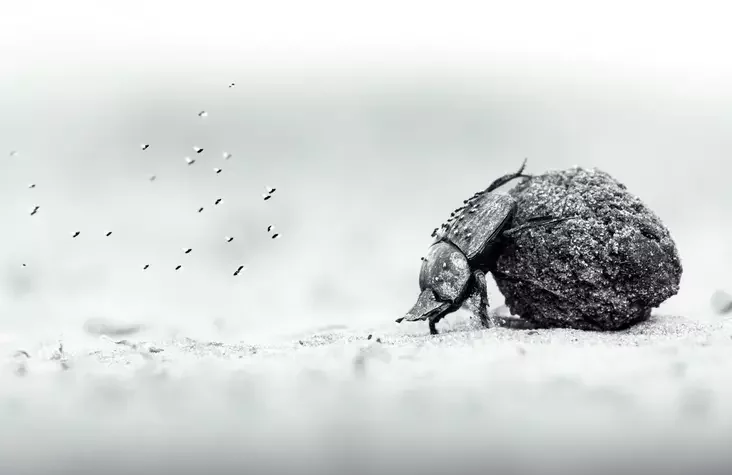
Category: Grand Title Winner, Young Wildlife Photographer of the Year, 11-14 years old
Photographer: Oscar Whitfield, Zimbabwe / UK
Location: Zambezi National Park, Zimbabwe
Only by lying on the dust and photographing the beetle at its eye level could Whitfield show how much effort this work requires.
During a family safari trip in Zimbabwe, near his home in Victoria Falls, he spotted a dung beetle laboriously pushing a ball of dung uphill through the sand. A dense swarm of flies followed the beetle. Experimenting with different angles and compositions, the photographer captured a moment that reveals the extraordinary effort required for this seemingly simple task.
"I hope that by looking at this picture, people can also see that and perhaps appreciate how much can happen in one brief moment in the natural world," says Whitfield.
Bumblebee Flight
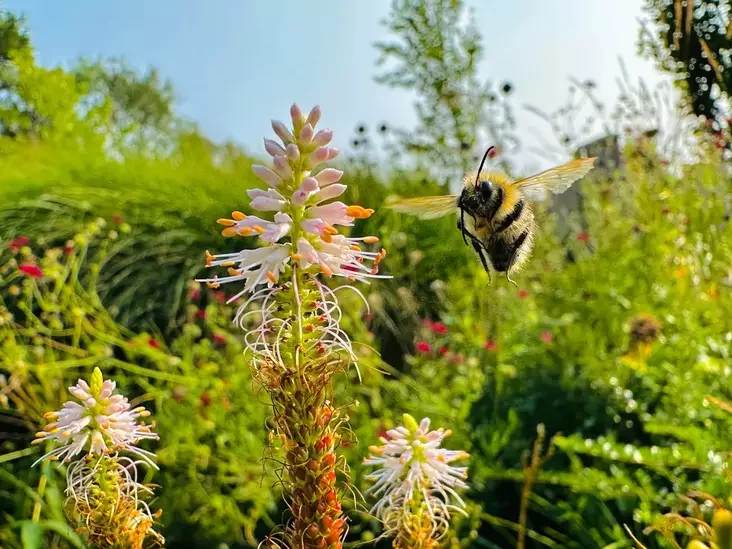
Category: 10 years and under
Photographer: Amelie Davies, UK
Location: Surrey, England
To take an award-winning photo, you don't necessarily need a camera or a plane ticket. Davies took this shot in her garden using her father's smartphone.
The photograph freezes in time a single wing beat of a common white-tailed bumblebee as it prepares to land on a flower.
Meeting Place
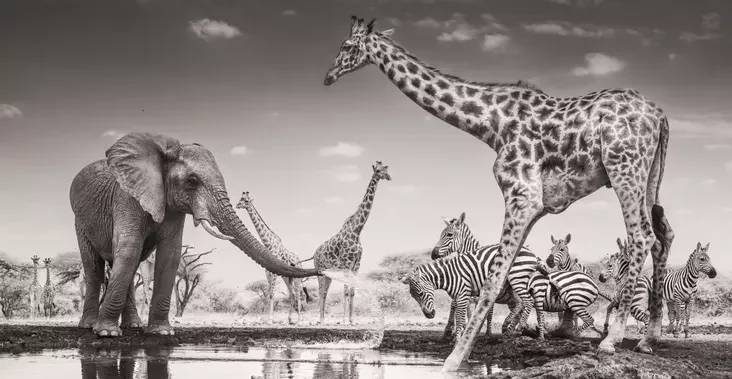
Category: Animals in their Environment
Photographer: James Lewin, UK
Location: Chyulu Hills National Park, Kenya
Lewin captured this contemplative black-and-white image of a young male elephant splashing water at zebras near a watering hole.
To soften the usually harsh light, he used a camera modified for infrared photography.
Keen Eye

Category: Animal Portraits
Photographer: Aaron Sanders, UK
Location: Portscatho Beach, Cornwall
Common octopuses are most often found in the warmer Mediterranean Sea. However, due to global warming, spring sea temperatures are rising, leading to a sharp increase in sightings of these animals in southwest England.
Sanders described the moment he spotted one eye peeking out from behind the kelp:
"We stayed perfectly still and watched each other with a sense of shared curiosity."
Scenes from the Swamp

Category: Birds
Photographer: Isaac Pretorious, South Africa
Location: Mabamba Swamp, Uganda
It is estimated that fewer than 5300 adult shoebills remain in the wild. However, Pretorious managed to photograph two such birds during a canoe trip with a guide. They were likely a pair collecting nesting material.
Despite their name, shoebills are actually more closely related to pelicans, herons, and ibises.
Bird Song, Painted with Light
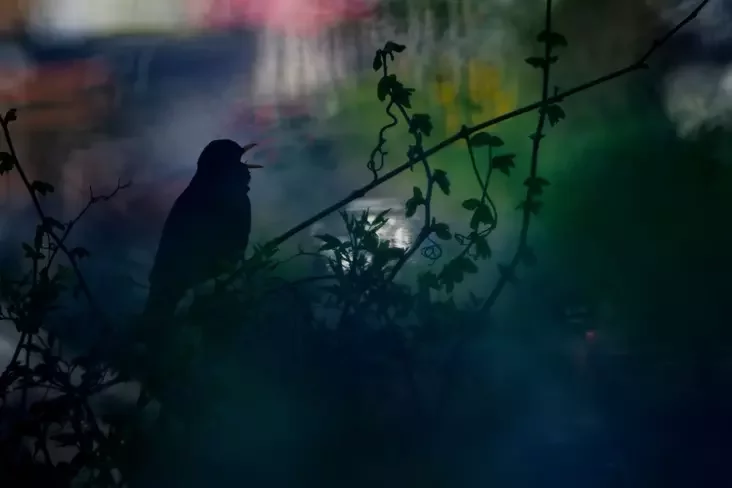
Category: 15-17 years old
Photographer: Konrad Greter, Germany
Location: Baden-Württemberg, Germany
In spring, male blackbirds seek elevated spots from which to sing and try to attract a female.
This shot was taken in a vineyard at dawn, when the birds perform their most complex song compositions.
Urban Jungle

Category: Urban Wildlife
Photographer: Seth Forrestson, UK
Location: Lumpini Park, Bangkok, Thailand
Forrestson lay in the mud to photograph a common water monitor against the backdrop of the city skyline.
These adaptable lizards live in cities throughout South and Southeast Asia. They eat anything they can find, including catfish and koi carp.
Photographing Moray Eels

Category: Underwater World
Photographer: Tony Wu, USA / Japan
Location: Kagoshima Prefecture, Kyushu Island, Japan
According to the Natural History Museum, this is likely the first time the mating ritual of Eboshi moray eels has been photographed.
Tony Wu collaborated with biologists and used dim red light and a specially configured "fisheye" lens to disturb the fish as little as possible.
San Francisco's Cunning Coyotes
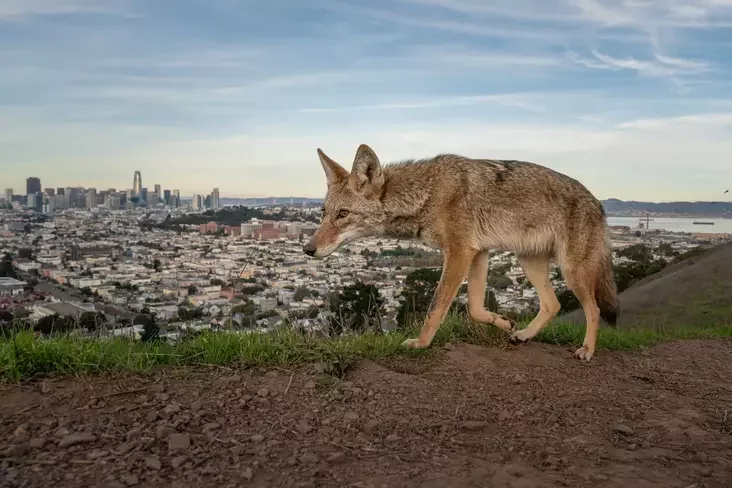
Category: Photojournalism Story Award
Photographer: Lauren Elliott, USA
Location: USA
It is estimated that about 100 coyotes live in San Francisco, coexisting with a large human population. They can prey on domestic animals but also help control disease-carrying rodents. Residents' attitudes towards coyotes are mixed.
Protective Stance
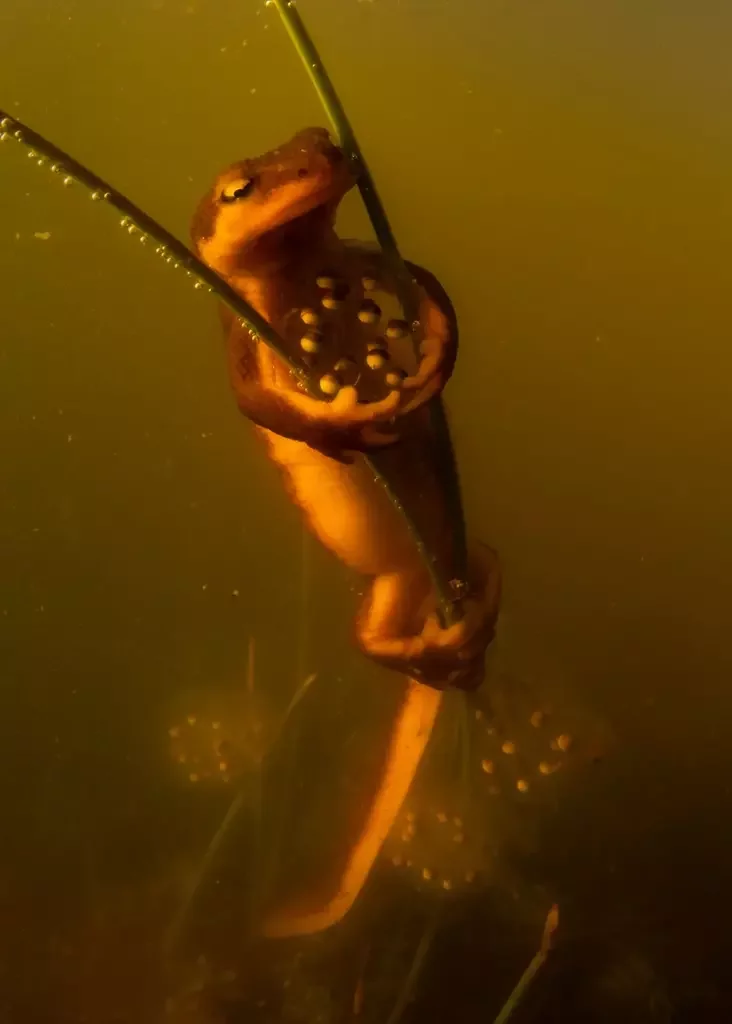
Category: Behaviour: Amphibians and Reptiles
Photographer: Anton Sorokin, USA
Location: Contra Costa County, California, USA
Sorokin lowered his camera and lighting equipment into a murky pond to capture this moment of a female California newt laying eggs.
Shifting Sands
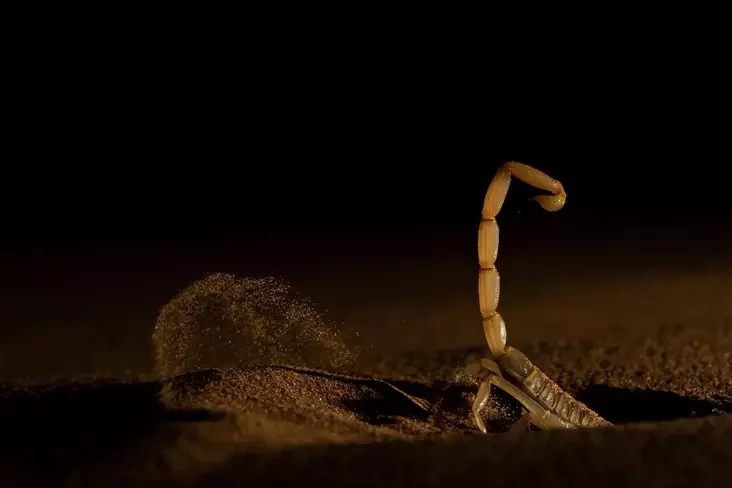
Category: Behaviour: Invertebrates
Photographer: Sitaram Raul, India
Location: Thar Desert, Rajasthan, India
The photo shows a scorpion burying itself in the shifting dunes of India's Thar Desert.
Exploring the dunes at night, Raul saw many scorpions searching for prey. However, after sunrise, as temperatures began to rise, the scorpion buried itself in the sand to escape the intense heat.
Night Prey
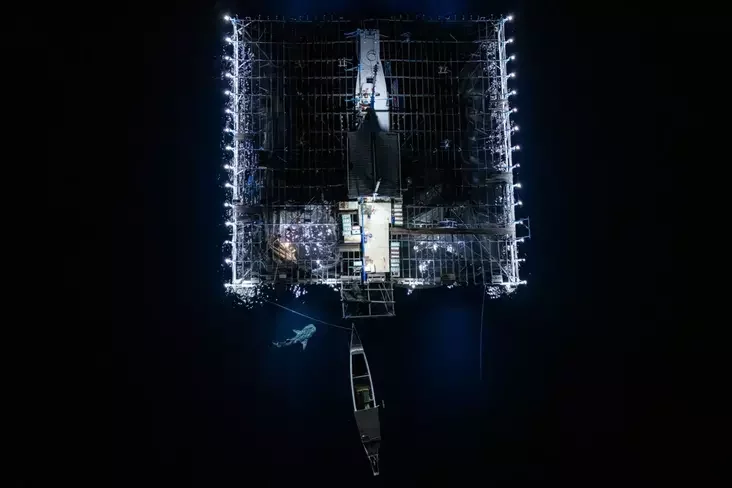
Category: Oceans: The Bigger Picture
Photographer: Alex Lindbloom, USA
Location: Waters near Cenderawasih Bay, Papua, Indonesia
A whale shark examines the catch of a mobile net fishing platform, known as a bagan. Lindbloom searched for sharks at dawn, using the platform's bright lights to illuminate them at a time when natural light was insufficient for drone photography.
Light Revealing Secrets
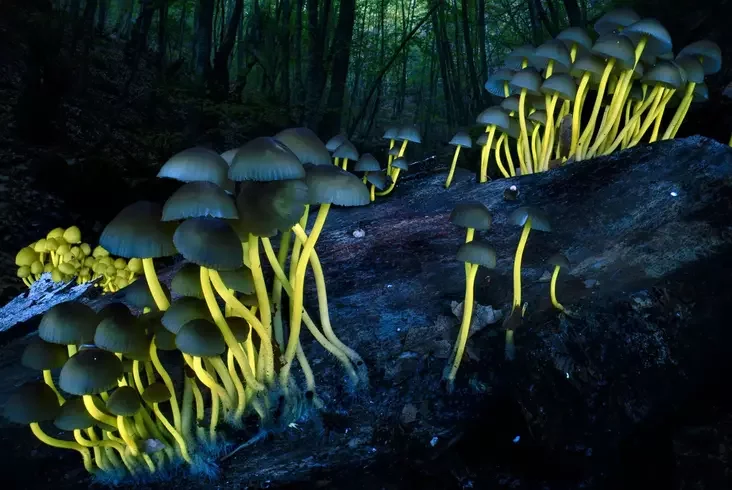
Category: Plants and Fungi
Photographer: Agarastros Papatsanis, Greece
Location: Litochoro, Pieria, Greece
Papatsanis used ultraviolet light to illuminate fungi known as "beautiful bonnets." They grew on a rotten log on the lower slopes of Mount Olympus in Greece.
Hidden Depths
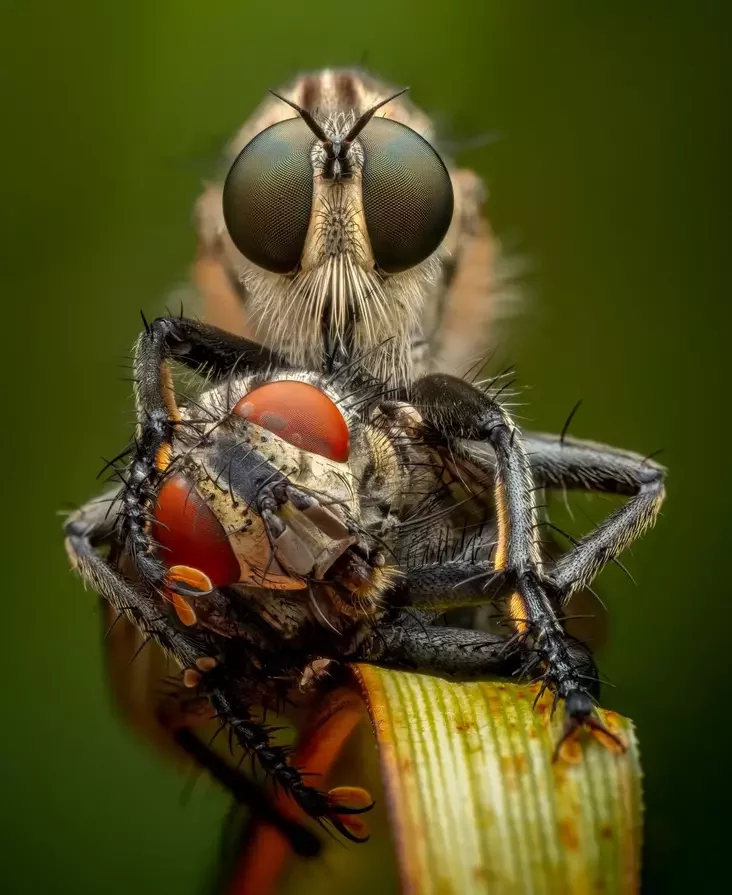
Category: Rising Star Award
Photographer: Alexis Tinker-Tsavalas, Germany
Location: Germany and Northern Ireland, UK
Tinker-Tsavalas uses macro photography to reveal the intricate details of small animals that are easily overlooked, especially in urban environments. His interest in macro photography developed during COVID-19 lockdowns when he was restricted from visiting places outside the natural areas near his home in Berlin.
The Art of Escape
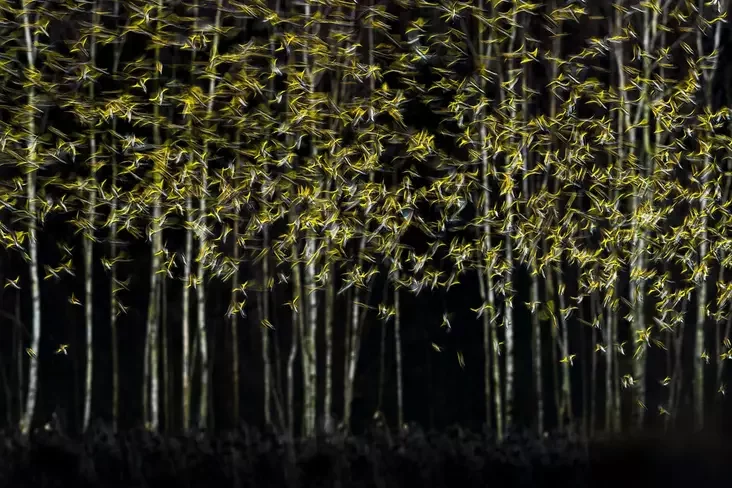
Category: Natural Art
Photographer: Michał Michalski, Poland
Location: Litochoro, Pieria, Greece
Michalski used a long exposure to photograph birds flying against a backdrop of leafless birches. Unharvested sunflowers remained in the field, attracting mixed flocks of birds, especially greenfinches and bramblings. The birds took to the air when they were startled by a sparrowhawk.
The Great Divide
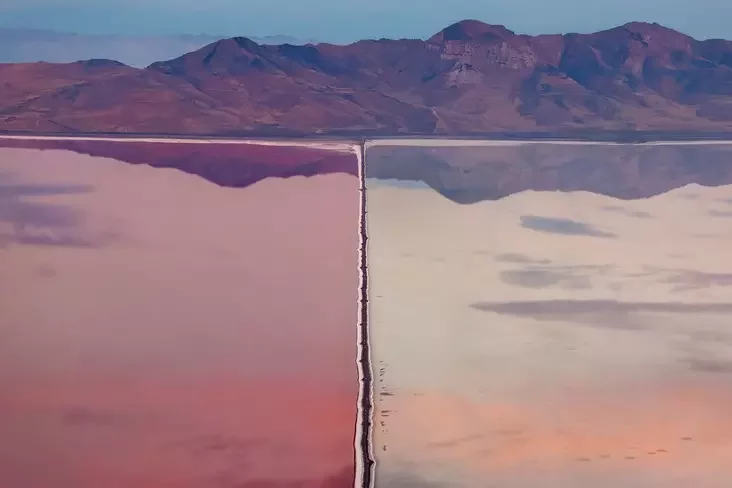
Category: Wetlands: The Bigger Picture
Photographer: Alex Visbal, Colombia
Location: Stansbury Bay, Great Salt Lake, Utah, USA
As part of a long-term project on the impact of industry on waterways, Visbal documents how a single man-made line can transform entire wetlands. The pink color of the water is caused by microorganisms blooming in the extremely salty water after this area was cut off from freshwater.
Warning Sign
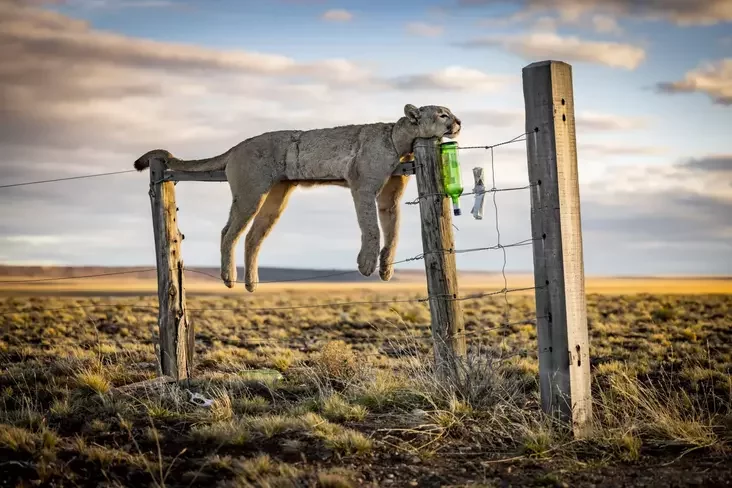
Category: Photojournalism
Photographer: Francisco Negroni, Chile
Location: Route 40, Santa Cruz Province, Argentina
Negroni captured a scene where a dead puma is displayed as a hunting trophy in Santa Cruz Province, Argentine Patagonia. Although hunting pumas was banned in Santa Cruz in 2025, their illegal persecution continues.
Secret Worlds
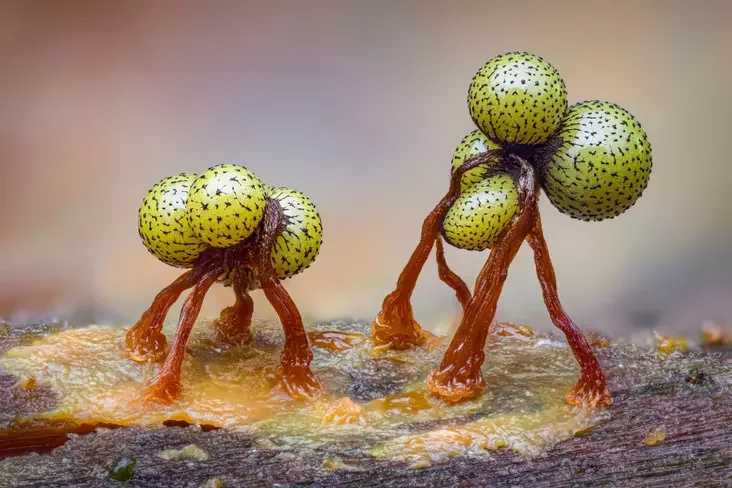
Category: Portfolio Award
Photographer: Kutub Uddin, Bangladesh / UK
Location: West Sussex, England, UK
In his photographs, Uddin explores the miniature world of slime molds – organisms that can be almost invisible to the naked eye. Their fruiting structures are only one to two millimeters tall.
Now reading


He had four teeth knocked out, and then was expelled from the country. Now the former political prisoner has been arrested in Latvia with six migrants in his car

He had four teeth knocked out, and then was expelled from the country. Now the former political prisoner has been arrested in Latvia with six migrants in his car


"I love the Belarusian language even more than Russian — it's closer to my heart." A Moroccan has lived in Salihorsk for 18 years and can't get enough


Comments