


"Normalizes Soviet military aesthetics": British politicians call for "Masha and the Bear" to be removed from streaming services
A large group of representatives from various political parties has appealed to the UK Minister of Culture with a call to stop the broadcasting of the Russian animated series "Masha and the Bear" in the country.
Fifty parliamentarians believe that the series is an example of "soft power," through which Russia tries to influence Western audiences, writes the BBC.
The global platform Netflix has been showing the Russian animated series for 11 years. This year, the company acquired the rights to the eighth and ninth seasons of the stories about a mischievous little girl and a retired circus bear. Besides them, the series features a female bear, with whom the Bear is madly in love, various forest animals, Masha's cousin from Moscow, and even aliens.
In a letter to the UK Culture Secretary Lisa Nandy, 50 MPs from six British parties — Labour, Conservatives, Liberal Democrats, Greens, representatives of the Scottish National Party and the Welsh Plaid Cymru — argue that the animated series is propaganda, and "not very subtle" at that.
However, like many critics before, parliamentarians cite only one of the old episodes of the series, "The Border is Locked" (it was released in Russia in autumn 2010, long before the start of Russian aggression against Ukraine, and appeared on Netflix in 2015) as proof.
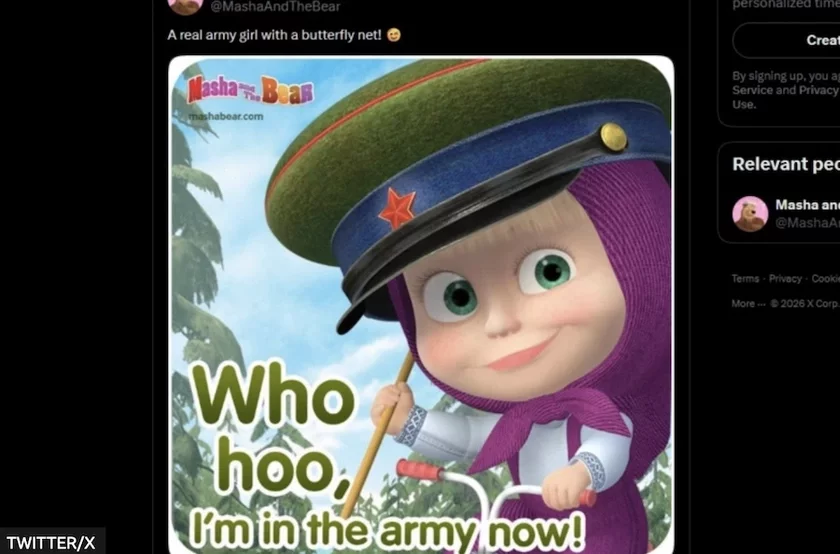
In this episode, Masha, while guarding the Bear's garden, first puts on a cap with a blue band and a red star (similar to those worn by NKVD officers), and later a tank helmet.
Initially, the popular cartoon received mostly positive reviews from viewers. However, the first statements that fairy tales could be a tool of Russian propaganda appeared even before Russia's full-scale invasion of Ukraine in 2022. Such claims were heard in Finland, Estonia, and Lithuania.
After the start of the full-scale war, the voices of critics became even louder. Recently, Estonian Foreign Minister Margus Tsahkna reacted to Netflix's decision to acquire rights to new episodes of the cartoon.
"Russia wages war not only with rockets but also with narratives," he wrote on social media. "Masha and the Bear" is part of the Kremlin's soft power, embedding pro-Kremlin and militaristic imagery into entertaining children's content, normalizing Russian aggression and imperial ambitions. The world would not accept children's products that positively depicted Nazi symbols. Soviet symbolism deserves the same unequivocal moral assessment."
Tsahkna reminded that for many nations, including Estonians, NKVD symbolism is associated with occupation, mass murders, and deportations. An illustration with the cap was used on the official Twitter (now X) account of the animated series in April 2015 with the caption: "Hey, now I'm in the army." British parliamentarians recall that the NKVD was responsible for mass deportations, executions, and persecution of tens of millions of USSR citizens. In their opinion, such advertising "actively normalizes Soviet military aesthetics for a global children's audience."
In the UK, besides Netflix, the series is also streamed by ITVX, a streaming service owned by the British broadcasting company ITV.
"The series reaches British children through the largest global platform and a well-known British broadcaster. We consider this unacceptable," the MPs note. "British parents have the right to expect that content their children receive through licensed platforms has been properly vetted, especially when our allies have already expressed legitimate suspicions regarding state propaganda."
Animaccord, the studio that produces the animated series, rejects accusations of propaganda. In 2025, the company finally left Russia and emphasizes that no Russian state funds are used in the creation of the series.
The British newspaper The Guardian quotes Hollywood PR consultant Melanie Bonvicino, representing Animaccord:
"My client categorically rejects the false and defamatory claims that the 'Masha and the Bear' series is in any way linked to propaganda."
However, the MPs who signed the letter claim that, despite its Cypriot registration, the studio still pays taxes in Russia.
"Its revenues, including those derived from international streaming, in the form of taxes, go to fund the Russian state," states the appeal to the Minister of Culture. "The scale of this funding is significant: according to analysts' estimates, advertising revenues alone from views in Europe amount to millions of dollars annually. [...] British children watching these programs on Netflix or ITVX are part of an audience that may be generating profits for a studio that is effectively helping to fund the Russian war machine."


Comments