


Why the Kremlin cannot stop the fuel crisis in Moscow even at the cost of a total deficit in the regions
Russian authorities found themselves in a deadlock trying to save Moscow from queues at petrol stations after Ukrainian drones damaged all four key refineries in the capital region. To maintain the situation in the capital, the Kremlin is forcibly depleting provincial fuel reserves and arranging imports. "Vazhnye Istorii" explains why, amidst continuous Ukrainian strikes, these attempts are futile.
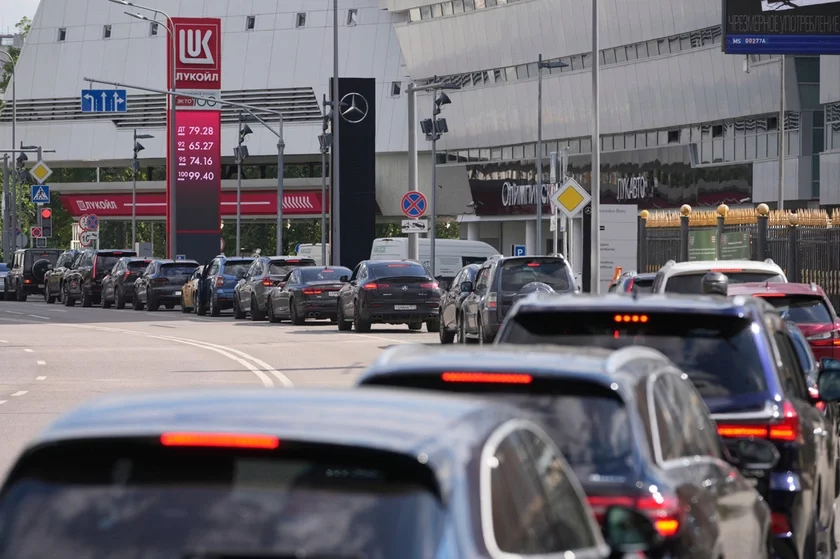
Cars queue at a Lukoil petrol station in Moscow, June 30, 2026. Photo: AP Photo / Pavel Bednyakov
The petrol crisis in Russia has worsened, affecting the capital region among others. Queues form daily at Moscow petrol stations, and major petrol station networks are forced to introduce limits on fuel sales per person.
To prevent a collapse in Moscow, the authorities are using harsh administrative methods, demanding to "send all reserves to the capital" from other regions.
"Moscow cannot be left without petrol. Samara, Mordovia can be left. Crimea – say it wasn't delivered. <…> When Moscow runs out – everyone who has any reserves and who doesn't, the command: 'Send everything to Moscow!'" – this is how, according to former Deputy Chairman of the Central Bank of Russia Sergey Aleksashenko, Russian authorities are combating the petrol crisis in the capital region.
For example, in the Irkutsk region, the local refinery has been ordered to send 60% of its fuel limit to Moscow, causing the region itself to face its own deficit, and people queue for 18 hours.
Such emergency fuel redeployment completely depletes the reserves of regions neighboring the Moscow Oblast (Yaroslavl, Ivanovo Oblasts) and creates a severe deficit there.
Why the usual supply to the capital has stopped
Under normal conditions, Moscow and the region consume about 14% of all fuel in the country – approximately 0.45 million tons of petrol per month.
This demand was met by four major oil refineries: Moscow (in Kapotnya), Ryazan, Nizhny Novgorod, and Yaroslavl. The key delivery link was the Moscow Ring Main Oil Product Pipeline (KMNPP) and its main station "Volodarskaya".
Today, this system has been destroyed as a result of regular strikes by Ukrainian drones.
The Moscow Refinery (supplied 35-40% of the region's needs) stopped after attacks on June 16 and 18, at least until the end of the year.
The Ryazan Refinery has not been operating since June 15.
The Nizhny Novgorod Refinery (Kstovo) stopped after the attack on June 24 and was attacked again on July 2.
The Yaroslavl Refinery, after another strike on June 28, if it is working at all, is not at full capacity.
The KMNPP infrastructure also suffered – in May, after a strike on the Solnechnogorsk loading station, at least four fuel tanks burned down.
The scale of the problem is nationwide: in May, 16 plants across the country were hit, including 8 of the 10 largest. Of the top 10, only the plants in Omsk and the Irkutsk region have survived so far.
Problems with imports
In June, overall petrol production in Russia fell by 25% (to 2.7 million tons per month). With the country's usual consumption level of 3-3.2 million tons, the monthly deficit is between 0.3 and 0.5 million tons.
The internal reserves (1.7 million tons) declared by Vladimir Putin will only last for 3.5-6 months at this rate.
Attempts to substitute fuel with imports do not solve the problem.
Belarus can physically supply Russia with no more than an additional 1-2 million tons of petrol per year.
Kazakhstan will send only 50 thousand tons in July-August as humanitarian aid.
India and China are ready for supplies (India has already sent 60-70 thousand tons), but
Russia lacks infrastructure in the Far East that would allow it to receive tanker convoys and deliver this fuel to the central regions of the country.
The main problem for the Kremlin has become logistics amidst continuous strikes. Even if physical petrol reserves exist in remote regions (Omsk, Angarsk, Komsomolsk-on-Amur), Russian railways cannot respond to changes in the situation in time.
While the authorities form one train and schedule it for delivery to the affected region, Ukrainian drones manage to disable another refinery in a different part of the country.
"Let's say there are petrol reserves in Omsk or Angarsk, where there are oil refineries, or in Komsomolsk-on-Amur, which Ukrainian drones have not yet reached. But today Nizhny Novgorod was hit. While you form a train, while you fit it into the Russian Railways schedule, while you transport all this to Nizhny Novgorod, Volgograd is hit. What are you supposed to do?" says Sergey Aleksashenko.
Now reading


Valfovich called the drone explosion near the bus accidental, but it was too late. Propaganda had already found the culprits and covered the whole world in dirt

Valfovich called the drone explosion near the bus accidental, but it was too late. Propaganda had already found the culprits and covered the whole world in dirt


"I have only one dream — to get my Dzmitser back." The mother of former political prisoner Dzmitry Hopta tells about her son's new misfortune. And asks to order more cakes from her to cope


Comments
>>Расія не мае інфраструктуры на Далёкім Усходзе, якая дазволіла б прымаць караваны танкераў і дастаўляць гэтае паліва ў цэнтральныя рэгіёны краіны.
На самой справе Расея ўсе мае. Есць парты, есць тэрміналы, есць чыгунка.
Але на гэта трэба шмат часу. Месяц-другі. Можа больш.
Пра працу чыгункі Алексашэнка кажа слушна.
Таму наступны крок для ўкраінскіх дронаў відавочны. Глядзім наступны эпізод гэтай выдатнай аперацыі далей.
Но об этом не принято говорить, как например уже не говорят, что Швеция и Финляндия благодаря Путину вступили в НАТО.