


"I became a famous writer, he also found a normal job." Filipenka revealed he wrote jokes for Zelenskyy
In "Pik Svabody" (Peak of Freedom), writer Sasha Filipenka spoke about his visit to Kyiv with Sviatlana Tsikhanouskaya's team, writing jokes for Zelenskyy, and his new book.
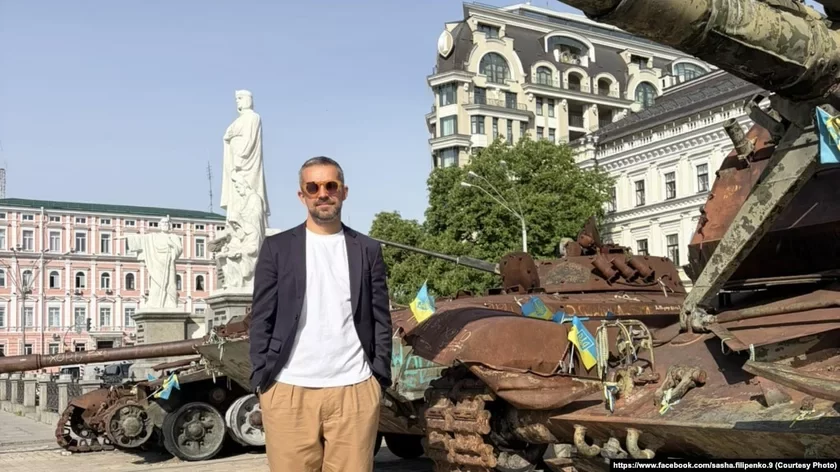
Sasha Filipenka in Kyiv, writer's Facebook photo
— How did you end up in the delegation? Were you invited or did you ask yourself?
— Let's just say I asked myself. I'm currently writing a book that also features events happening in Ukraine. These are important events for us because our warriors are there, because many Belarusians are there, because what is happening in Ukraine is important for our history. It seemed important for me to be there. Firstly, it was an important visit, a historical event of sorts. And in that sense, there were many reasons to be there.
— You said in one interview that you once wrote jokes for Volodymyr Zelenskyy and his team. Can you remember what those jokes were?
— That was a very long time ago. It was during the "New Wave" festival. They always had their own authors and screenwriters, but there were some concerts that we wrote together. The last time was, I think, in 2012. And since then, I became a famous writer, and he also found a normal job.
— Volodymyr Zelenskyy joked about Alexander Lukashenka, who said it was time to meet with the presidents of Ukraine and Belarus, and now Sviatlana Tsikhanouskaya is actually in Kyiv. What do you think, was that his own joke or a prepared remark?
— I think it was a written joke. Firstly, this joke was already uttered a day before — someone from Ukrainian politicians had already used it. And then Zelenskyy repeated it. But, like a good host, he "sold" that joke very well to the audience. Everyone laughed. It was clear that he hadn't lost that skill of "selling" jokes.
— Did you manage to talk to Volodymyr Zelenskyy, even briefly?
— Of course not. During that huge conference, his every second was scheduled. We didn't talk — there was no time or opportunity. All this time there were air raids, difficult security situations. It's hard to imagine that Zelenskyy now has the opportunity to talk about literature. I think he's not quite up to that right now.
— And what would you say to him if you had two to four minutes?
— Probably, we would talk about how incredible life can be. About where we were ten years ago and where we all ended up now. It seems to me that when you meet such people, who are so tired during this time, the best thing to do is not to talk at all and give the person at least four minutes of rest. I signed him my book "The Elephant" and wished him victory. Probably, that's the main thing I wanted to say.
— I can't help but ask about your new book. I understand there will be Belarusian volunteers there? Will Sviatlana Tsikhanouskaya be there?
— I won't reveal anything about the new book, because I'm still writing it and I don't even know myself what will be in it. I think it will contain Belarusian history, what is happening to us now, the point we find ourselves in. But it's hard to talk about it, because the process of writing a book is like this: you think you know where you're going, but you never know where you'll end up. But it's not a political novel and not a book about how Tsikhanouskaya's headquarters or Belarusian politicians work. Perhaps it will be a bit similar to "Former Son" — about our life now.
— This isn't your first time accompanying Sviatlana Tsikhanouskaya during her visits. I remember your very vivid speech at the Council of Europe. How do you view her as a writer? What is your impression?
— I have a very good impression. For example, we were together in Geneva, speaking with Ales Bialiatski. And, it seems, that was his last speech before returning to Belarus and being arrested.
The first thing I said to Sviatlana Tsikhanouskaya when we met was: I don't really like politicians and I believe all politicians are scumbags. She looked at me and said: "I think so too."
And after that, it became easier to talk. We don't see each other often — maybe once every few months. But I am very pleased to observe that Sviatlana Tsikhanouskaya remains the same person I saw in 2020. She remains simple, reacts to jokes. I don't work with her every day, but to me, she remains very humane.
— Many call Sviatlana Tsikhanouskaya's visit to Ukraine historical. What is your assessment?
— It seems to me that it was a very important and influential visit. I was in the hall during Zelenskyy's speech. He spoke about representatives of various countries — Switzerland, Poland, Germany — and specifically named Sviatlana Tsikhanouskaya. She was the only politician whose name he singled out. When he joked about the president of Belarus, everyone already understood he was talking about Tsikhanouskaya. And I think this is very important. Because there is an understanding that Belarusians have their own president, who did not become president only because that opportunity was stolen from her. This was a very important signal for Minsk. And, of course, a historical event. Although, in my opinion, it should have happened back in 2020, not now.


Comments