


Angel of Death. The story of a Belarusian woman who informs the relatives of fallen Kalinouski fighters about their death
Since February 24, 2022, more than 60 Belarusians fighting on Kyiv's side have died in Ukraine. The exact number is unknown. Due to the danger from the Belarusian authorities, even their relatives often do not know that a person is at war.
The Kastuś Kalinouski Regiment was created in Ukraine in the spring of 2022 from Belarusian volunteers. Today, it is the largest Belarusian formation there. After the Kalinouski Regiment, several other military units composed of Belarusians fighting on Kyiv's side appeared. Periodically, reports of their deaths at the front surface in the media. To date, at least 63 such cases are known. The names of most Belarusians who died in Ukraine are not disclosed. According to representatives of Belarusian formations, this is done for the safety of their relatives who remain in Belarus.
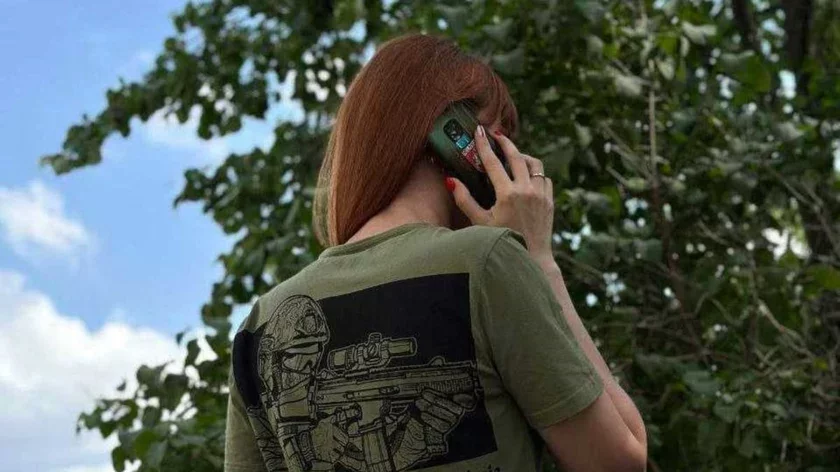
A volunteer, who has been serving in the Kalinouski Regiment since the summer of 2022, is responsible for communication with relatives of those killed, missing in action, and prisoners. In an interview with "Svaboda," she reveals for the first time what her work entails.
Tenderness and Compassion
Our interlocutor has the call sign "Nočka" (Nightie). She says she joined the Kalinouski Regiment in the summer of 2022. When Russia's full-scale invasion of Ukraine began, "Nočka" was living in Kyiv. The reason for her relocation was her participation in the 2020 protests, for which a criminal case was opened against her.
"My whole life has been imbued with the feeling that I am trying to give Belarus back to Belarus. Because what was happening in the country never satisfied me from the point of view of national history, ideas, attitude towards people, human rights and freedom. Therefore, when a new story emerged for us (the creation of the Kalinouski Regiment. — RFE/RL), where there was hope that we could do something, influence something, how could I stay aside?" the Belarusian woman explains her reasons for joining the Kalinouski Regiment.
"Nočka" says that when she joined the regiment and settled in, she realized that more attention should be paid to the relatives of fallen soldiers.
"Due to my empathy, intuition, and human attitude towards people. Due to the fact that male and female approaches differ, I offered to take on this task. It seemed to me that I could handle it, because at that moment I was at my maximum resource. Including emotional and physical. It always seemed to me that I was strong. Especially emotionally. And yet, I feel tenderness and compassion for people. That's why it happened that the next relatives were already my responsibility," the interlocutor recounts how she began to communicate with the relatives of the deceased.
The first time "Nočka" had to deliver tragic news to relatives was that same summer of 2022. Before that, she spoke with Ukrainian military psychologists who work with relatives of those killed in the war. She asked how it was possible to present this information more gently. She also shared her own vision of how to do it.
Ukrainian experts told "Nočka" that there is no algorithm for such things. That death is always death, and no matter how gently you present it, a person will always experience pain and shock.
"They told me that my vision, as I articulated it to them, was acceptable. So I try to first ask the person if I can call. Stating where I'm from, but not yet saying what happened. Then I connect with relatives, trying to do so via video call. Because when a person sees another person in front of them, it's probably better than if you wrote about it or said it aloud. Because no matter what right words you choose, it's terrible news," says "Nočka."
According to the interlocutor, the Kalinouski Regiment does not use Viber – this messenger is forbidden and considered unreliable. This approach adds to the problems, as Belarusians often do not use other messengers.
"We try to find the person on Signal, if they're there. If not, then on Telegram, and if that's impossible, then on WhatsApp – that's a last resort. We don't use other messengers," the interlocutor shares.
The volunteer says that every Belarusian soldier, when filling out the application for admission to the regiment, indicates a contact person. It is this person who should be notified if something happens to them.
Then, through this contact person, they find the contact details of the deceased's relatives and get in touch with them. Not all soldiers leave contacts for close relatives. Some only provide information about friends.
"Perhaps emotionally it's easier for them so that this news is not heard first by parents, for example, or a wife. But we try to make sure that the news doesn't come to relatives from somewhere else, but that we inform them. Because that's, again, the human way," says "Nočka."
"Several hours to mentally prepare"
"Nočka" returns in conversation to the first case. She says it was difficult not only because it was the first. The deceased's relatives didn't even know he was fighting.
"It took me two days just to convince people that I'm not a fraudster, that I'm not trying to extort money from them. People living in Belarus are wary of everything. And that's normal now, unfortunately – in this state our country is in. In a state of terror, in a state where you can be exploited by fraudsters, and all the rest. So, such thoughts were possible. Secondly, they really didn't know where their loved one was. So, when someone calls and says: 'Hello, we have sad news for you,' and so on, you don't want to perceive that information as true. People went through all these stages: denial, rejection, depression, and acceptance. Then they said: 'We saved your contact as 'Angel of Death'.' Well, that's, of course, a 'wonderful start'," says "Nočka."
According to her, those "first" people accepted the information only on the second day. She assures that, despite the very sad news she brought, the relatives of the fallen fighters often turn out to be incredible people.
"They are genuine, they are strong, they are the kind of people I would like to meet in person - but not under such circumstances.
I stay in touch with most of them. Firstly, the regiment is a family. And the families of our fallen are now also our family. They can always turn to us for help or for anything else. This is normal and understandable, how else could it be. So we maintain contacts with most of them. We are cautious with those in Belarus. With those abroad, the contacts are a bit closer," says the interlocutor.
"Nočka" admits that before calling the relatives of the deceased, she mentally prepares for several hours.
"We all go through this shock first. Because we've lost someone who was a part of us. It's difficult for us too. It's not a simple thing – as if we're told someone died, and we're like: 'Okay' – and just get to work and everyone follows their algorithm. No, it doesn't happen that way. You still process your own shock. I can't say that I'm immediately able to take a contact and calmly make a call. No.
It's never easy. It's always like the first time. It's not the first time in my life, but every time it's difficult. And every time you try to find "those words," but there are no "right" words anyway," explains the interlocutor.
The blow of death
"Nočka" says that there are no words to soften the blow of death. She uses specific "introductions," but they don't help much.
"Unfortunately, something unpleasant has happened, I wish I didn't have to report this, please accept my condolences" - these are the most you can say, but at that moment, they simply aren't heard. If people know that their loved one is in the regiment, they understand immediately. If they receive a message from the regiment that a conversation is needed, they understand that no one would just write to them for no reason... I can't just barge into a person's life. They might be at work, busy with something, or driving. These are stories where you simply won't remain calm at that moment. A person still needs a little time to realize that the call isn't just for nothing. I understand that hope remains until the last moment. That perhaps something else happened. But that's how it is," the volunteer explains.
The interlocutor reiterates that death is always death, but when comrades cannot retrieve bodies and the relatives of the deceased don't even have the opportunity to say goodbye, it adds a special burden.
"Most likely, I won't be able to tell relatives anything for a very long time. Like, 'yes, we retrieved the body and you can come.' I won't be able to say that for a long time. Because those rose-tinted glasses are gone, that 'when the territory is liberated, we'll do everything there.' The territory isn't being liberated. The battles that were happening there are still happening. And there's simply no way to get there, to find anything. Almost two years have passed since the situation with the death of 'Brest' and his comrades (Belarusians 'Brest,' 'Papik,' 'Siabro,' and 'Atom' died near Lysychansk in June 2022. Their bodies could not be recovered from the battlefield. — RFE/RL)," "Nočka" recounts.
She admits that it is emotionally very difficult to work with the relatives of those Belarusians who were captured.
"The situation there is even worse. On the one hand, there is hope, on the other hand, it drags on for so long. And what to say, how, what to encourage them with? And the relatives understand everything. I understand that they understand. They need to be supported somehow, but there's nothing to do. We are just as confused, only they hurt even more than we do. We are fighting out of desperation because we cannot find and bring back the fighters. It's even harder for their loved ones. We are here in our constant situations, but for them, this story is unique," says the volunteer.
"Until I see the body, he's alive"
According to "Nočka," sometimes people don't believe that their loved one died in the war. Especially if there is no body.
"You explain that in the situation they found themselves in, and what happened there, it's impossible to survive. But the person will live by 'until I see it with my own eyes, it means he's alive.' That's very difficult to work with. Because at some point, you run out of words to explain clear, sad things. Because you're speaking from a logical point of view, from the fact that there were witnesses, and the person refuses to accept it," says the interlocutor.
According to her, the regiment periodically receives reproaches from the relatives of the deceased, who say that their person is alive, and the regiment is simply not looking for him.
"And we understand that, firstly, the territory is again under shelling and we cannot get close to clear the rubble, because it cannot be cleared by hand. Secondly, we are absolutely sure that, unfortunately, there is no chance. That's it," adds "Nočka."
She says that she often has long conversations with relatives of those who are considered missing. Some people don't believe any words or testimonies. Once, relatives of one of the missing told Alesya that they had gone to a fortune teller with a photo of the soldier, and she told them that the person was alive.
"Two months passed since that conversation. And the relatives of the missing person reproach us, saying that we simply aren't doing anything to save him. They say they will go to the front line themselves and clear the rubble by hand. And you simply don't know what to say to the person at that moment. Because there are only emotions there. And you don't want to offend the person, and you're so tired of repeating the same thing. I understand that it's difficult to accept the news of death. But there are laws of biology: a person cannot survive under rubble for two months," says the interlocutor.
Currently, the Kalinouski Regiment cannot publicly talk about fallen soldiers whose relatives live in Belarus. The girl says she is additionally concerned about this circumstance.
"People are heroes. All of this (publishing their stories. — RFE/RL) is postponed for some distant future. It will come. They will be heroes, and they will be talked about loudly from all sides. And streets will be named. Because they laid down the most valuable thing for freedom. Everything is clear. But for now, unfortunately, without names. Even without call signs. It's sad," says the volunteer.
"The deceased's mother went to the Investigative Committee and gave them my contact"
"Nočka" recalls how one of the fallen soldiers, shortly before his death, spoke about not very good relations with his mother. The volunteer understood the reason for this after his death. The deceased's mother turned out to be a supporter of Lukashenka. Alesya had to call her, even though the woman lived in Belarus and did not know that her son was fighting in Ukraine against Russia.
"I was completely unprepared for such a situation. Although, it would seem, why shouldn't such a thing happen? Because I have a similar story in my personal life. But for some reason, I wasn't ready. Simply not ready for the mother to go and file a statement with the Investigative Committee of Belarus about her son being missing," "Nočka" recounts.
The interlocutor adds that she tried to reach the mother of the fallen Kalinouski fighter for 7 hours, but the woman simply didn't pick up. Then the girl sent a text message. The recipient read it and didn't reply.
"She went to the Investigative Committee and reported everything to them. Probably my contact too. As it is. She decided that Lukashenka's police would help her find him. Because she is firmly convinced that Lukashenka is the best president in the world and will solve all issues, and that she is simply being deceived, her son just disappeared, and so on," the interlocutor recounts. Details were later reported to her by other relatives of the deceased.
Later, "Nočka" still managed to talk to the woman. She called Ukraine "Nazi," Ukrainians "Banderites," and her deceased son a traitor. Such a case during "Nočka's" work has been the only one so far, she says.
The interlocutor admits that when several Belarusian soldiers died on the same day, she felt the need to just be alone for a few days. Without any news stories and without other people.
"To be within my family, to hug my cat, and just disconnect from this world. I needed my own vacuum in which I needed to come to my senses," says the Belarusian woman.
She says she hasn't seen a psychologist yet. She believes she still has the resources that allow her to recover on her own. She talks about the support of family and friends whom she can call and talk to. Perhaps partially share her emotions or talk about other topics to simply clear her mind.
"Emotionally, I am still strong. Perhaps still so focused on Belarus and everything connected with it. This is what helps me stay conscious, sane, and not stop doing what I'm doing. Because this is not my only function, but probably the most difficult," she adds.
"Nočka" says that Belarusians in Ukraine went to fight inspired. With thoughts that victory was just around the corner. Now she calls this naive. She believes that in this way, most psychologically protected their own mentality. Including herself. The interlocutor says that six months after the start of the full-scale war, most volunteers came to the realization that the war would not last for one year, or even two.
"And it pains us greatly that this is a marathon. Because the longer all this drags on, the longer our country remains in a concentration camp. Belarus pains me. When I learn that someone else has died, been arrested, or there was a raid, it hurts me. I understand what I am staying here for, why I need to keep going. Because what is happening in my country, unfortunately, depends on the victory in this war. Therefore, if I can help achieve this victory and do something to make it happen, I will do it. Because there are thousands of hostages at home, thousands of people who live in unfreedom. And it's not as scary at war as it is at home, in Belarus now – that's what's scary," the volunteer shares.
Death certificate as a danger to loved ones
All expenses for the burial of fallen fighters of the Kalinouski Regiment are covered by the regiment itself. It also provides material assistance to relatives within its capabilities.
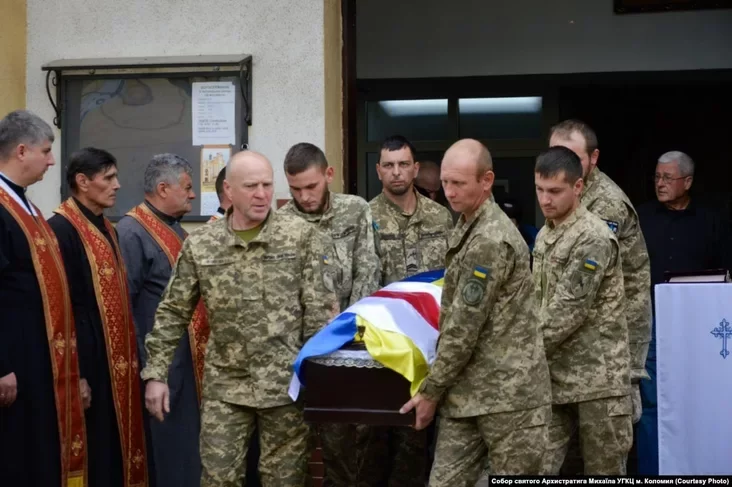
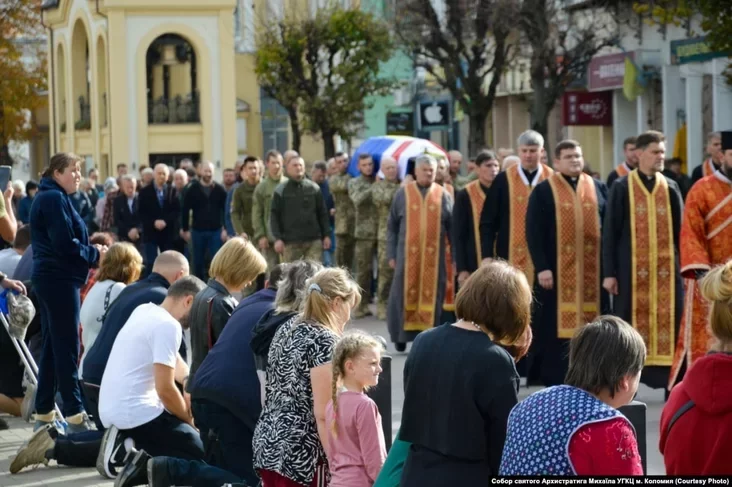
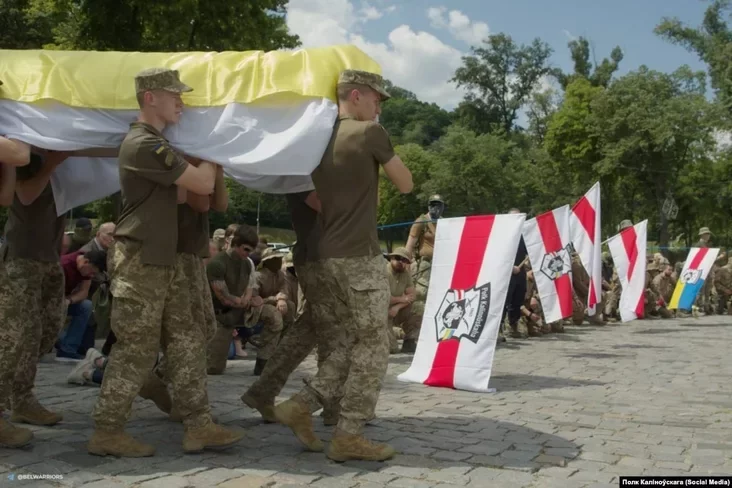
"In saying goodbye to the fighters, we put all our maximum respect and soul into it, because they are part of us, we cannot do otherwise. Even not for the relatives, but for the person who was our brother-in-arms, we do it. None of the relatives ever said that they didn't like something. At the same time, we take into account all the family's wishes," "Nočka" says about the procedure for saying goodbye to fallen soldiers.
The interlocutor adds that the regiment is raising the issue of providing payments to the relatives of deceased Belarusians (referring to payments from the Ministry of Defense of Ukraine, which are received by relatives of deceased Ukrainian soldiers. Citizens of other countries, not only Belarus, who fight on the side of Ukraine, receive a monthly salary. The issue of payments to their families in the event of death at the front is under discussion. — RFE/RL).
"Because it's simply unfair that a person with a Belarusian passport fights in Ukraine, but if they die, the story ends there. They are as much a participant and a hero as Ukrainians. Therefore, we have been trying to work on this issue all this time. Something, it seems, is beginning to move," adds the volunteer.
"Nočka" admits that once, the relatives of a fallen soldier demanded that his body be brought to Belarus for burial.
"People ask: 'Can the body be transported?' — 'No, it can't.' — 'Can the ashes be transported?' — 'No, it can't.' How would that happen? Who would undertake to do this if the person's death certificate indicates where he died? And again, Belarusian law enforcement agencies would figure out in a flash where this person was and how he died. And everyone would simply fall under articles," says the Belarusian woman.
According to her, relatives of fallen volunteers periodically ask for a death certificate to receive survivor benefits or to inherit property. This creates additional risks.
"There is a possibility to issue such a certificate. But that, again, is a red cross on the family. I explain many, many times why it will be dangerous and why the benefit they might try to get from it is not worth it. Persecution of this family will begin. All this will go through state institutions. It will reach those institutions it wouldn't want to reach. And that's it. It will all end there. There will be no payments. Or maybe there will be, but for the loss of two breadwinners. Because the wife will most likely go to prison. And the children will go to an orphanage," explains the volunteer.
"I don't want to have such an experience again"
"Nočka" says that it's one thing when one or two fighters die. It's another when five don't return from a mission.
"When we have several casualties at once, the impact on my psyche is, of course, very significant. It's incredibly difficult when you have to empathetically split yourself among five families. I don't want to have such an experience again. I recovered for a very long time afterwards. For me, it was maximally, terribly difficult," says the volunteer (one of the cases of mass death of Belarusian volunteers in Ukraine occurred in May 2023 near Bakhmut, when Miroslav Lazovsky also died. — RFE/RL).
"Nočka" says that until recently, no one could replace her or take over some of her sad duties. But now, Belarusian female psychologists have appeared in the regiment, who sometimes get involved in negotiations with relatives and take on some families themselves.
"There are a lot of organizational moments related to funerals and everything else, a large number of people, a team, are involved in this. And I don't think about it. And that's also a lot of work. Well, for example, these people who deal with funerals, it's emotionally difficult for them to get involved in someone else's grief. But thank God, it's not emotionally difficult for them to do something else. I, for example, cannot go into the morgue. I can't, I just can't do it. The first time I went into the morgue was our last time, because one of the deceased was my friend and it was the last chance to see him. That was the only time I could go in," says "Nočka."
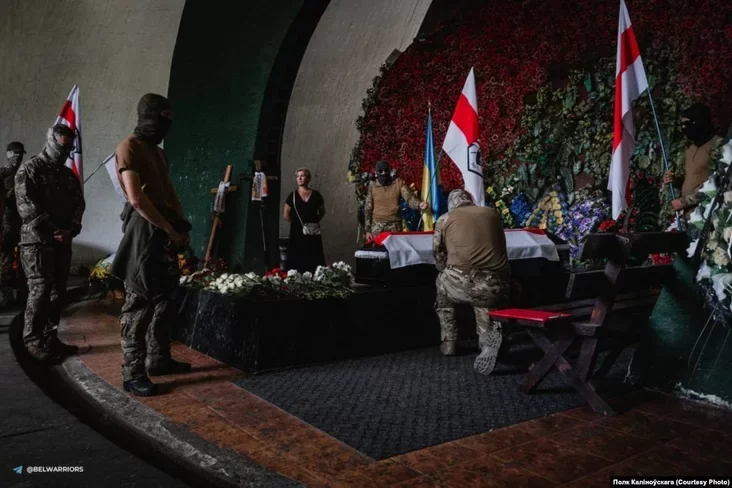
"When the guys go on a mission, I keep my fingers crossed every time"
The volunteer says that not all relatives have the opportunity and strength to come to Ukraine for the funeral of their fallen loved ones.
"Everyone chooses according to their resilience, capabilities – emotional and all others. It's not like if someone didn't come, we would say, for example: 'Oh, what kind of relatives are these.' Everyone is 'that kind,' we understand everything. If they don't have the opportunity to find the strength to do it this way, then so be it. Most still come. We do everything to make this journey as simple and safe as possible, but it's still not simple and dangerous. But we try, we build logistics. So that a person on this journey doesn't have to think about ordinary things – how they will travel, where they will travel, and so on. We take this story on ourselves as well," the interlocutor explains.
She adds that the regiment does everything possible for a person who wants to attend the farewell ceremony for a fallen soldier in Ukraine to do so.
"Because we understand, when a person says: 'I want to be present,' how important it is for them. There are people who said goodbye and returned to Belarus. And that's why we always ask all media to be very careful with the information they have about the fallen. Because their loved ones return to Belarus. In most cases," says the interlocutor.
"Nočka" adds that the safety of relatives is what the regiment primarily cares about. "Simply humanly – to bear the burden of responsibility that we didn't do everything possible to ensure the safety of a soldier's loved ones, and the person was 'taken' – that would probably be even harder. The person died fighting alongside us, and we are not to blame for that, because it is war. But if we couldn't maintain data security and it somehow affected the relatives later..." "Nočka" muses.
She adds that she does not feel "survivor's guilt" towards the relatives of the deceased.
"I am a goal-oriented person, I realize that everyone who chose their place to be here, they chose it consciously. All sorts of cases happened. There were those who believed that victory would come in three months and they needed to participate in it. Those who remain now, and those who arrive, they understand where and why they are going. It's impossible for a person not to understand why they are here after two years. Yes, there is fatigue, there is burnout. Because the conditions around are extreme. But when people stay, they know why they are doing it. Therefore, there is no 'survivor's guilt.' Because at any moment anything can happen to any of us," the interlocutor admits.
"Nočka" says it's difficult to predict when and how this war will end. In her opinion, many factors influence events in Ukraine.
"Ukraine is holding on. Ukraine is fighting on sheer human spirit and desire for freedom and independence of the country. Ukraine is doing miracles. But miracles, as we Belarusians know, are poorly done with bare hands. If there is no timely help, it will all take a very long time. And not everything depends on Ukraine. Unfortunately. We want to believe that it will be quick. But no one will give predictions. Everyone does what they can," says the volunteer.


A grandmother with little money was treated contemptuously in a cafe — a Minsk resident paid for her lunch. "Panski Dranik" has its own version of events

A grandmother with little money was treated contemptuously in a cafe — a Minsk resident paid for her lunch. "Panski Dranik" has its own version of events


Belarus is no longer just about political prisoners. What Sviatlana Tsikhanouskaya brought to one of the main security forums in the USA and what Siarhei Tsikhanouski was doing there


Comments
сьвятая