


And about real bandits, and about clumsy Kostya the tiler, and about sex on a train. A journalist from Gomel wrote a book — it's scary and funny to read
Her characters are installers, homeless people, chance fellow travelers, hospital patients, priests, sinners, and the author herself: annoyed, ironic, and imperfect.
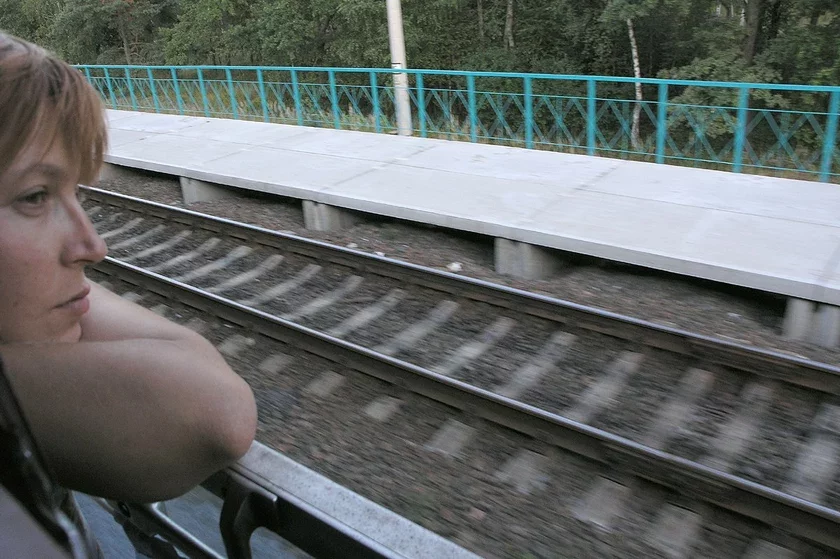
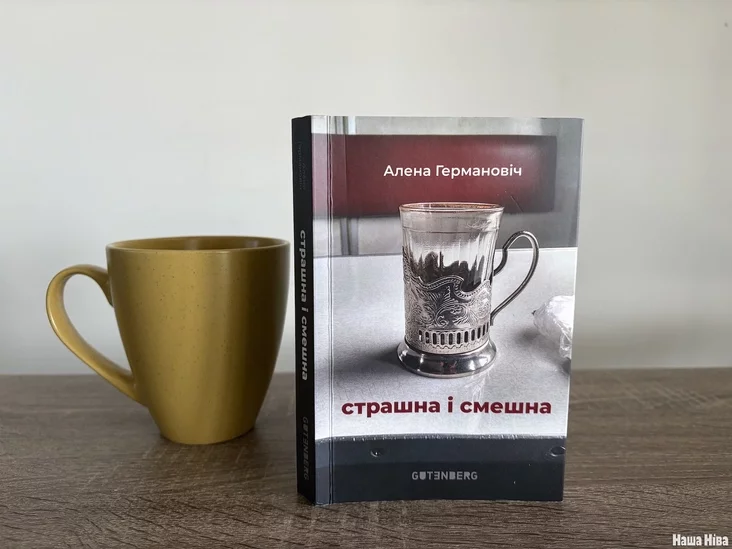
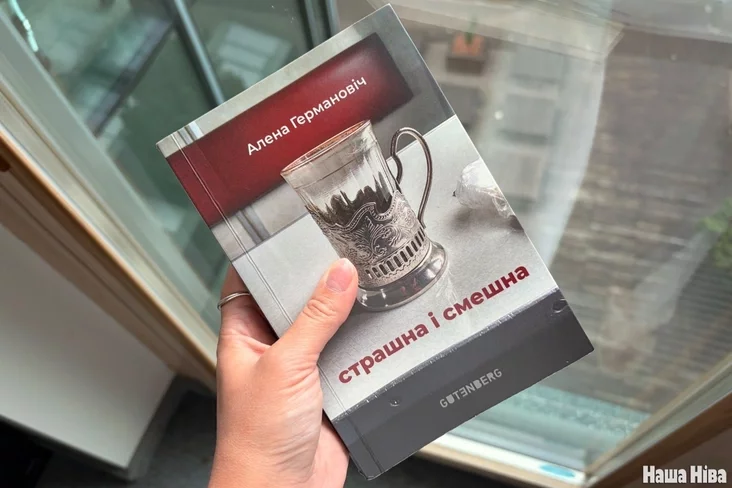
Journalist Alena Hermanovich worked for BelaPAN for fifteen years: she wrote about courts, crimes, stories of happiness and misfortune. After the agency's crackdown and her departure from Belarus, she collected her observations, memories, and previously published texts into her debut book "Scary and Funny," which was published by Gutenberg Publishers.
Her characters are installers, homeless people, chance fellow travelers, hospital patients, priests, sinners, and the author herself: annoyed, ironic, and imperfect. We spoke with Alena about people who are usually overlooked, laughter as a way to cope with the terrible, faith without solemnity, and Belarus, which from a distance no longer seems funny at all.
"I'll write an exposé and think: God, what have I done again?"
— Alena, back in 2017 you said: "I'm dying of boredom. And if I write a sharp or an exposé article — I'm dying of fear." Did the title "Scary and Funny" grow out of that phrase nine years later?
— Most likely, yes, from it. In fact, it's a rephrased thought of writer Kurt Vonnegut: he said that people die either of boredom or of fear. That's very close to me.
For example, I'm afraid of heights, but I started rock climbing. At first it was scary, but without it, it would have been boring. Fitness, Pilates, running — not my thing at all, but in rock climbing, I found myself, albeit not as an athlete, but as a sportswoman.
It was the same with journalism. I'd write some investigation — and after its publication, panic attacks would start. I'd think: "God, I'll never expose anyone again. I'll write about culture, music, and theater." Time passes — it becomes unbearably boring. And I dive into some acute story again.
I remember a piece about hazing in a military unit in Brest. I went there, didn't introduce myself as a journalist, talked to the guys, took pictures of their bruised hands and feet. I wrote everything down, sent it to BelaPAN, and immediately thought: "What have I done again? Tomorrow the unit commander will come and kill me." This combination of fear and the inability to live without risk, probably, also remained in the book's title.
— For many years you wrote about courts, people in trouble. What did such work do to your perception of human beings?
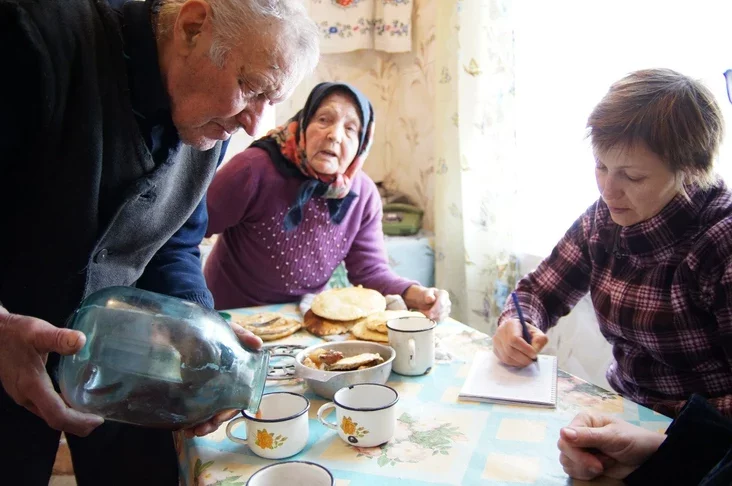
— People have always been interesting to me. Especially random ones. You go to Rechytsa or Vitebsk, get on a train — and old women come in, some people who are a bit out of their minds. A person can talk for two hours about what they ate: first an apple, then lard, carrots, sausage. What's interesting about that, it would seem? But I like to listen to how a person builds their life from these details.
When I lived in Gomel, I sometimes left the house not for groceries, but for observations. It was impossible to just go for milk or sausages. Once I saw a man lying drunk near the road. I thought he had been hit by a car, so I ran to help him up. And then a drunk woman lunged at me: she started insulting me, grabbing my jacket, shouting that I was bothering her man and that she would pull my hair out. I went out for milk — and came back with a story.
I noted such things for a long time. It seemed to me: "Who am I to publish this?" There was a strong imposter syndrome.
— And what helped you overcome it?
— I don't know if I've overcome it. It's just that there were people around me who constantly said that I needed to publish a book: Sviatlana Kurs, my husband, a close Spanish friend. All conversations with them eventually boiled down to one thing: "You need to make a book." When I was temporarily out of work and had free time, I decided to put the texts together. If only to finally get them off my back.
— Some of these texts were previously published on your "Radio Svaboda" blog and on social media, right?
— When I worked as a journalist, I didn't have time to sit down, review everything, and compile it. The texts lay on the computer in fragments. Yes, some texts were published earlier. But I don't see that as an obstacle. I wrote them, which means I have the right to take them back and make a book out of them.
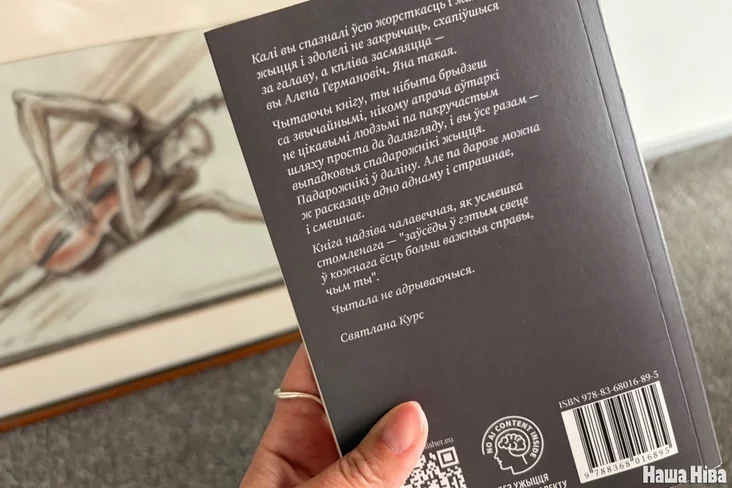
— On the cover, Sviatlana Kurs reviewed the book and gave a portrait of the author: "If you have experienced all the cruelty and horrors of life and managed not to scream, clutching your head, but to laugh mockingly — you are Alena Hermanovich. She is like that." Did you recognize yourself in this description?
— Yes. We knew each other well, visited each other, talked a lot. I think Sviatlana understood my skeptical, even dark view of the world well.
Somehow I told Sviatlana that I would like to be something like Pablo Escobar. Of course, not in the sense of killing people; I was more attracted by the hooligan, bandit romance. Perhaps because I grew up in the nineties. She said that she didn't want to be Pablo Escobar, but wanted to honestly go to work and honestly earn her small money.
When Sviatlana read the book, she was already ill. She said she was roaring with laughter, thanked me.
"Ordinary people don't interest me"
— Did you change the real circumstances of the stories you write about for dramatic effect? How truthful, in general, is everything written?
— It seems to me that everything there is true. Memory might have failed somewhere, something might not have remained entirely accurate, but all these stories happened.
I wondered if I could write a novel, and I realized probably not. I don't have imagination. I can only write about what I saw and felt.
— Which story from the book is the funniest for you, and which is the scariest?
— The funniest, probably, is about Kostya, who laid tiles crookedly in the kitchen, but was sure he would go to heaven because he hadn't done anything bad. I looked at those tiles and thought: "You couldn't even lay them properly and you're already going to heaven?" Besides, he wanted to steal a pipe and make a moonshine still out of it.
The scariest is about the funeral of a little girl who was killed by a thirteen-year-old girl. I was thirteen myself then, and I couldn't understand how a child could plan a murder, hide a body and traces. Many years later, I accidentally came across the story of the daughter of that killer girl. This strange return of the past greatly impressed me.
— Your characters are not fictional. They traveled with you in a coupe, lay in the hospital, did renovations, met in the village. How do you think they would react to becoming characters in your book?
— It's unlikely these people read books. Especially since the book is not sold in Belarus. This doesn't bother me much, as I didn't provide their personal data.
I considered the story of the girl's murder important also because it remained nowhere. I searched for names, surnames — found nothing. It wasn't written about in criminology textbooks, nor on the internet. It seemed unfair to me that such a story disappeared.
As for the others: it's unlikely that the installer who traveled with me on the train reads books in Belarusian. And if Kostya recognizes himself — let him recognize himself. The tiles should have been laid better.
— But doesn't that sound condescending: as if, my characters don't read books anyway, so I can write about them?
— I don't think I look down on them. On the contrary, I felt sympathy for such people. I'm not interested in writing about stars or people with great achievements. I'm captivated by those who do or say something unexpected.
Homeless people always gathered near the church in Gomel. I knew them, and they knew me. Once I was sitting in a summer cafe with a theater director. We were discussing a play, metaphors, epithets — and then two drunk homeless men approached: "Alenka, hello!" I felt terribly awkward.
And they took out broken earrings, rings, some watches from their bags and started offering: "Alenka, take something for yourself, we tried for you." I'm sitting there thinking: "God, who did they rob?" But at the same time, it was touching: a homeless person came and brought you a gift.
I wrote about people who caught my attention. I don't want this to sound arrogant, but ordinary people really don't interest me. Sometimes you meet a person and you already understand that you don't want to meet them a second time. But these people always said or did something unexpected.
Perhaps my focus is skewed. Perhaps through it, Belarus looks like a country of absurdity, misfortune, and oddities. But I see it that way, and I'm not going to be ashamed that I didn't show stars, politicians, or exemplary heroes in the book.
I mostly dealt with politics for work. When friends come to me and start talking about Lukashenka or Putin, I say: "No, not in my house. Tell me rather about your wife, how your daughter went to school." For some reason, it's easier for people to ponder Lukashenka for hours than to talk about their own child. And it's precisely this private life that interests me.
— In the story about the psychiatric hospital, irony arises alongside someone else's illness and vulnerability. Are there people and topics that cannot be ironized or laughed at?
— Of course, there are. But in the hospital story, I primarily wrote about myself. I didn't separate myself from other patients: I didn't think my illness was "normal" and theirs were "abnormal." We were all in the same situation, all enduring nurses, people in white coats, and hospital rules.
We even staged a small revolution because they didn't allow us to smoke. We walked around shouting: "We're nervous! We need to smoke!" They offered us four outings a day; we demanded six — and got six. I remembered it as something funny. I'm not laughing at people, but at the absurdity of the situation I'm in with them.
"My laughter is a defense"
— You state that the book is dedicated to people no one notices. But the further you read, the more you understand: its main character is Alena Hermanovich. Was it difficult to show yourself annoyed, angry, and not at all heroic?
— No. That's how I feel. Once I was walking from church after confession, very angry — at myself, at God, at the priest, at the whole world. I walked down the street crying. Then I thought: "God, an old lady is walking and wailing, people are looking." And then I got angry at that thought and told myself: "How good it is that I am me, and not someone else."
At that moment, I seemingly accepted myself: with disorder in my head, sins, weaknesses, good and bad traits. I thought: "It's good that I am me, and not someone else." Then I wrote my "Psalm." I published it on Facebook, and many liked it because there was self-irony. Not a story about me standing in a white coat, with everyone else being guilty.
— In the book, laughter seems to be your main weapon. Who is it aimed at?
— For me, laughter is not a weapon, but a defense. The world was incomprehensible to me since childhood. I didn't understand many things, and there was no one to ask. Now, the longer I live, the less I understand.
When something hurts, offends, or frightens, I start to joke. It's irony and self-irony, a way to protect my psyche. Lately, there's been too much grief: news comes that a friend died in Ukraine, someone passed away, someone else is gone. Of death itself, of course, I don't laugh. But sometimes without black humor, it's impossible to endure everything that's happening around. Moreover, I didn't include the harshest jokes in the book.
You can order the book "Scary and Funny" here. An electronic version of the publication is also available
God, a maple leaf, and "nasty sex" on a train
— In the book, you ironize about the church, priests, and your own faith. Yet, God for you is very familiar: you can quarrel with him, talk about candies and tomatoes. Is this the faith you grew up with in Radniki?
— No, it formed later. I started going to church when I was eleven or twelve. We were taught prayers in Polish, as there were no Belarusian priests. We had to learn about fifty catechism questions. Children weren't necessarily deeply religious — often they just went with friends. My parents didn't go to church, but I did because I wanted to be with my friends.
Then for fifteen or twenty years, I didn't go at all. I returned when I met a good priest who could accept my irony, laugh and argue with me. Before that, I often had conflicts with Belarusian priests; it seemed to me they didn't like me.
Once I left the church very angry at the priest and at God. I walked and thought with the words of Anatol Sys from his poem: "What kind of God is it then, if the servants are beasts?" At that moment, a perfect maple leaf simply fell into my hand. I examined its veins and suddenly realized that this was the answer. Who could have conceived and made such a perfect thing?
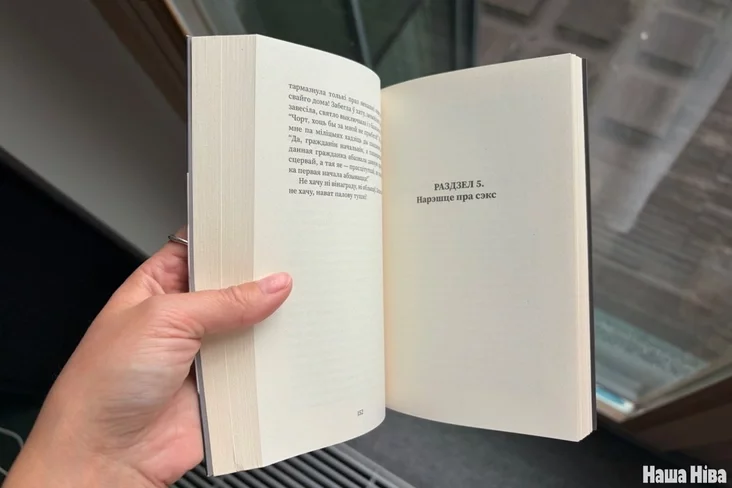
— In the book's preface, you tease the reader with a promise that there will be only one "nasty sex on the train on the lower bunk," and then you name an entire chapter "Finally about sex." Why did this story captivate you so much?
— I didn't understand how one could do such things in a public place. When I returned from the trip and wrote about it on Facebook, many started condemning me: saying, you're still young, but you act like a nun, so what — you haven't seen sex.
This made me even angrier, and I wrote a detailed story. I didn't call the conductress, didn't start screaming and demanding that they separate. I just poured water on them and said it was my urine.
"No one throws fish in your face — and I'm bored"
— You met the characters of your book in different times and spaces, but all of them are from before 2020. Could there be a continuation about Belarusians in emigration? Do you also want to eavesdrop on people in queues, trains, and churches in Poland?
— Unfortunately, my life in Poland is very boring now. I won't say that people here are bad, it's just not my thing — just like life in Spain isn't my thing.
I live in a small town where everything is standard. You come to the shop: "Good day," "thank you," "you're welcome." No one gets angry, no one throws fish in your face. No adventure.
I recently read in a local group that a terrible rude woman works in a village shop nearby. We immediately got in the car and drove there. I go in, and she smiles: "Good day, you're welcome." I think: "Darn it, another letdown."
— Who is "Scary and Funny" written for?
— I wrote the book for myself. I am a selfish person, and I do everything primarily for myself. Even when I help the poor, I understand that I do this for myself, because it's important for me to do something good. However, I can also do something bad — write something nasty when I feel bad.
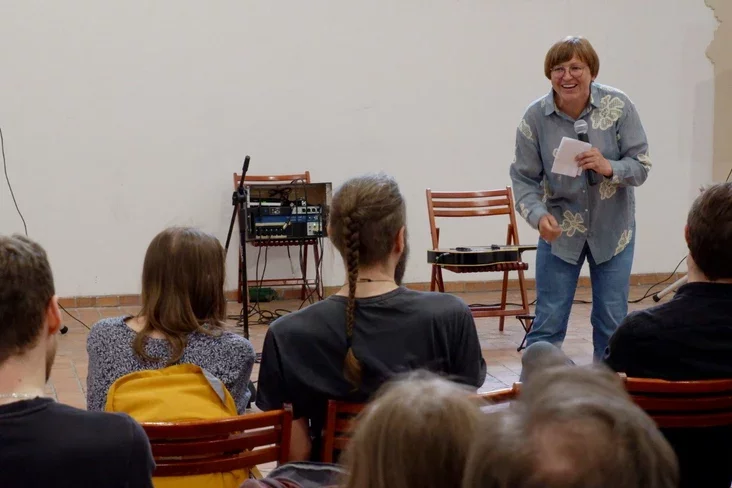
But there are readers. About fifty people came to the presentation in Warsaw, books were bought, then good reviews appeared. I wanted the book to be easy to read, to have more entertainment in it. There is already enough grief in Belarusian life.
Some called the book fearless. I don't know why.
— Perhaps because you showed yourself in it as you are?
— Maybe.
— In the book, you invite the reader to a "scary-funny club for insiders." Who are these "insiders"?
— Belarusians. And now, primarily Belarusians in emigration. I cannot return to Belarus: there is a criminal case against me there. In recent years, so many Belarusians have stayed in my house that I can't count them all. Someone needed to spend the night, someone was left without work, money, or housing. I said: "Come, you can stay with me." People came, and we became friends.
After the start of the full-scale war, many people also lived with me. Now we are like a family: we celebrate New Year together, go to the mountains, invite each other for holidays. People know that they can come to me and relax.
— How does Belarus look today from a distance: scarier or funnier?
— Scarier. Repressions don't stop, people are in prisons, they are fired from their jobs. There's a war going on: some Belarusians fight for Ukraine, others for Russia, and everyone dies.
I see a young, beautiful woman who has been waiting for her husband from prison for six years. She doesn't even think about finding another person. All the time: "Dima, Dima, Dima" — letters, waiting, visits. For me, such people are saints.
Someone has four or five children, the person was fired, forced to work as a cleaner. Such difficult stories are scattered throughout society. Therefore, I can no longer say that Belarus is funny now.
— Do you miss laughter in Belarusian literature?
— There are authors who write funny. But, for example, Baharevich is a brilliant writer, however, personally, he drives me into depression. His talent simply kills me. After "Alindarka's Children," I had such severe depression that I didn't want to go outside. And after "Dogs of Europe," I was completely in a daze — it's very difficult literature for my psyche.
I read in Baharevich about how the Muscovites took Belarusians, and I thought: "God, how did he come up with all this?" And recently, an acquaintance called me and started telling me what is happening in various Belarusian villages: how guys go to war in Ukraine, fight for Russia, how they are killed there, and the promised payments don't come.
And I recalled Baharevich again, thinking: how did he foresee that even today Belarusians would lay down their lives for Russia and not return? It's very close and very painful. That's why I wanted to write a book after which a person would not feel even worse.
— How should you be correctly introduced — as a journalist or a writer?
— As a Belarusian journalist. I worked for BelaPAN for fifteen years until it was crushed by the Chekists, I wrote for "Radio Svaboda."
And whether I can be called a writer — I don't know. Sviatlana Kurs is a writer. Aliaksandr Charnukha is a writer. And what I wrote... I'm still more of a journalist.
Order Alena Hermanovich's book "Scary and Funny" on the Gutenberg Publishers website


Comments
У адным з артыкулаў яна акрэслiла свой характар як "пушчанскi", то бок з Налiбоцкай пушчы, мае продкi па бацькавай галiне таксама адтуль (з паўночнай Стаўпеччыны), i так, мне вядомы гэты характар - сумная самаiронiя, але разам з там i маральны стрыжань веры.