


"And then I hear the controller's shout: 'Pushkin, are you out of your mind?' Mikalai Dzyadok recounted the last days of Ales Pushkin in prison"
July 11 marks the third anniversary of the artist's death.
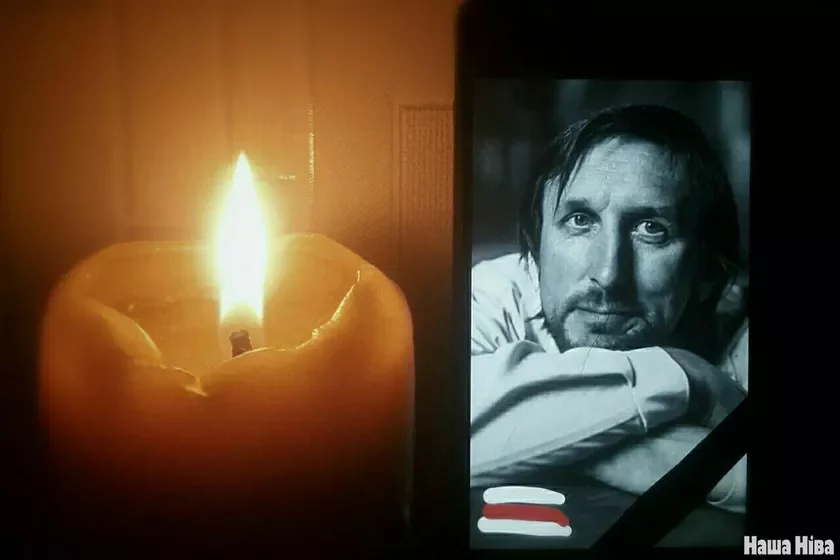
Former political prisoner and journalist Mikalai Dzyadok said that he met artist Ales Pushkin during a "walk in the courtyard" of Grodno Prison No. 1, which is called "krytka" (a colloquial term for a high-security prison), writes Radio Svaboda.
"In Grodno, the courtyards are enclosed by walls. To talk to a neighbor in the courtyard, you hit the wall, knock, and ask who is walking. And once I went out like that in the morning, it was, as I remember now, January. I tapped on the wall, asked who was walking, and they told me: 'six-six'. My first question immediately was – are there any political prisoners? They said yes, there are. And a person starts to communicate. I hear that he speaks Belarusian. I understand that this is our person, and he says: 'I am Ales Pushkin'," Mikalai Dzyadok recalled in one of his earlier streams on his YouTube channel.
The political prisoner added that he immediately and gladly switched to the Belarusian language and spoke with the artist. Then, according to him, they further crossed paths in this way during walks, and then two more times when they were on the same floor in cells — Ales Pushkin in a punishment cell (SHIZO), and Mikalai Dzyadok in solitary confinement.
"And that's when we talked. He was locked up then, in my opinion, for May 9, because there is such a 'craze' (or 'punishment cell policy') in the administration of Grodno Prison, that on May 9 all 'extremists' must be imprisoned. For some reason, I wasn't. Pushkin and several other people were imprisoned, because we are fascists to them. He was given five or seven days. For Grodno, that's generally not much. He didn't give the impression of a broken person or someone with poor health. He said: 'I am here, like Branislau Tarashkevich, on a creative business trip,' and Branislau Tarashkevich, the first creator of Belarusian grammar, also served time in Grodno Prison," said the former political prisoner.
According to Mikalai Dzyadok, Ales Pushkin was somehow convinced that he would be "spun" (charged) under Article 411 ("malicious disobedience to the demands of the administration of a correctional institution") and would never be released.
"We talked about various things. He is a creative, peculiar person, and talking to him was a bit… problematic to talk to him… It was so disheartening to observe, he was very unadapted to prison life. And yet, as far as I know, rumors reached us that everything was fine in his cell," said the former political prisoner.
According to Mikalai Dzyadok, Ales Pushkin was somehow convinced that he would be "spun" (charged) under Article 411 ("malicious disobedience to the requirements of the administration of a correctional institution." — RS) and would never be released.
Mikalai Dzyadok added that he was transferred from cell to cell, and Ales Pushkin sat with different people. A fight occurred in one of his cells.
"The fight wasn't that serious. It consisted of a person hitting Pushkin in the face. I don't think it was a police setup, because there was a problematic person there who conflicted with everyone. He pushed Pushkin, and they 'separated,' but what's interesting, as far as I know, Pushkin didn't go to the punishment cell (SHIZO), only that other person went. For Grodno, this is a unique case. They have a policy there that if you participate in a conflict, even if five people kicked you, you are still guilty and still go to the SHIZO. But Pushkin didn't go to the SHIZO. I don't know if this is a manifestation of some adequacy on the part of the cops or what," Mikalai Dzyadok recalled.
According to him, a few days before Ales Pushkin's death, they found themselves in adjacent solitary cells.
"He is in cell 87, and I was in cell 86. He is sitting through the wall. I know that he drew a lot for other inmates. He even received orders for drawings from other cells, and everyone was delighted with his artistic talent. He had pencils, sharpeners, everything in the world there. The cops gave him the 'green light' to draw, as far as I know," he said.
"One day I hear. Morning. The food cart comes at the same time. And Pushkin's 'cell' (literally 'house') is right before mine, meaning food is brought to him first, and then to me. I hear that breakfast is very much delayed. That is, this cart stopped near him and didn't move on. And it continued for a minute, two, and then I hear the controller's shout: 'Pushkin, are you out of your mind?!'," Mikalai Dzyadok reported.
After that, according to him, a commotion began, and prison staff gathered.
"After some time, the cart moved on and reached me. I 'signal' to Pushkin through the wall, he doesn't answer. He hadn't answered before either. That same day I go for a walk, I see the doors of his cell open. And there his rolled-up 'blanket' (or 'mattress') is standing. A day or two later, or perhaps on the same day, he was brought back. He was talking to someone again, as if everything was normal. I heard his voice, how he spoke with the cops. Later I concluded that he was taken to the 'infirmary.' To which one — the prison one, or if an ambulance took him, or if he was taken somewhere else, I don't know that, but he was taken somewhere," he noted.
After this incident, Dzyadok was transferred to another cell, but this time opposite the one where Ales Pushkin was located.
"I was relocated, and one day I hear — the same thing is repeated: breakfast is delayed in front of his cell, and some commotion begins. Something is happening there, the controller calls him: 'Pushkin, Pushkin,' but I didn't hear the details, because I was a little further away.
This was approximately 6:30—6:40 in the morning. Afterwards, I go for a walk. His cell door was still closed. I return from the walk, around 9:45 — 10 o'clock, I see the head of the medical unit of Grodno Prison, Lutsev, coming towards me. From this, I conclude that he most likely went to Pushkin. I return, the doors are still closed. And perhaps half an hour later, perhaps 15 minutes later, I hear his groan. They (prison staff) open the doors again, and I hear him groan — long, prolonged, and then the groan fades away," Dzyadok recounted.
According to him, it seemed that Ales Pushkin was being carried out on a stretcher, and the head of the medical unit came to sanction the possibility of his removal from the prison.
"I understood that he was taken out with some serious illness, because usually they don't just take people out for no reason. Many people die in the Grodno 'krytka' because they are not treated. And a few weeks later I found out that Ales Pushkin died, as reported, from a perforated ulcer in intensive care," Mikalai Dzyadok said.
"And on that day, when I heard his groan and how he was being carried out of the cell, at approximately 12 midnight, I suddenly woke up in my solitary cell. I don't know why I woke up. But a few seconds later I heard voices, as the food dispenser was writing something down, and the controller dictated to him: mattress — 1 unit, sheet — 1 unit, cup — 1 unit. I concluded that they were collecting Pushkin's belongings to hand them over to the warehouse. At that moment I thought he was in the hospital. Now I understand that they were handed over to the warehouse for a different reason," the former political prisoner recounted.
Mikalai Dzyadok is convinced that the head of the medical unit of Grodno Prison is to blame for Ales Pushkin's death, as timely medical assistance was not provided.
"And in a broader sense — the system is to blame, because Grodno Prison has such a policy regarding all prisoners in general, not just political ones," he emphasized.
***
Ales Pushkin died three years ago, on July 11, 2023, at the age of 57.
He was detained on March 30, 2021, in a case concerning alleged rehabilitation of Nazism: an exhibition in Grodno featured a portrait of anti-Soviet partisan Auhen Zhykhar. Pushkin was charged under Part 3 of Art. 130 of the Criminal Code (rehabilitation of Nazism), and also under Art. 370 of the Criminal Code (desecration of state symbols).
On March 30, 2022, Ales Pushkin was sentenced to five years of imprisonment in a strict-regime penal colony. In the spring of 2023, he was transferred to Grodno Prison.
Now reading


We told you: "Don't think this is small change"! Data revealed on how much income tax Belarusians in Lithuania transferred to various public structures


Comments
як сапраўдны Мастак і Чалавек
дзякуй, Мікола, што падзяліліся