


Wagner mercenaries on Russia's "shadow fleet" — not just for cargo security. Results of a new investigation
An international investigation has revealed that "guards" on ships actually have much broader powers.
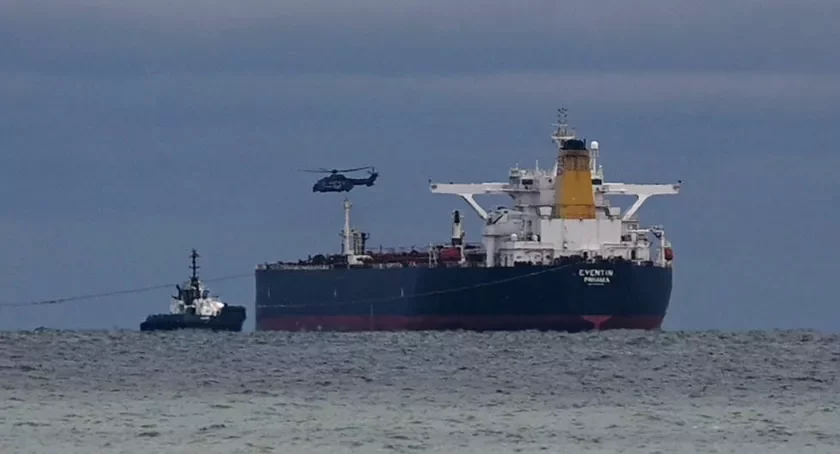
Russian tanker Eventin, part of Russia's "shadow fleet", off the coast of Rügen Island in the Baltic Sea. April 2025. Photo: Stefan Sauer / picture alliance via Getty Images
A joint investigation by Süddeutsche Zeitung, the broadcasting company Norddeutscher Rundfunk (NDR), the Dossier Center, and the Follow the Money platform has uncovered a large-scale scheme involving the use of Russian mercenaries on ships of the so-called "shadow fleet".
While working on the material, journalists posed as potential employees of a Russian oil company and, under the guise of job interviews, managed to speak with four guards.
In total, the investigation identified 83 individuals — security personnel who were on board tankers between July 2023 and April 2026.
Journalists found that at least 18 of them had previously fought as part of the "Wagner" group in Syria or Ukraine. Five people had experience working in the GRU or FSB. Another 14 were linked to Moran Security Group or "Redut". The latter is accused of war crimes in Ukraine. Moran specializes in maritime security and has close ties to the Russian Ministry of Defense, for which it has been sanctioned by the EU.
Data shows that Russia began deploying guards more frequently on routes through Europe since spring 2025. This occurred after a series of incidents in the Baltic Sea when countries in the region began detaining suspicious tankers. For example, on Christmas 2024, Finland arrested the Eagle S after damage to an underwater cable. In April 2025, Estonia, with the help of helicopters, stopped the tanker Kiwala, which was sailing without a flag.

Tanker Kiwala. Photo: Eero Vabamägi
A month later, Estonians tried to detain the tanker Jaguar, but the captain refused to stop. Russia then scrambled a fighter jet to escort the vessel. The aircraft even violated Estonian airspace.
Wagner mercenaries control both the ship's captain and crew
Officially, these individuals are listed on ships as technicians or auxiliary personnel, as they do not have the necessary maritime qualification certificates. However, their real function on board was to control the captain and crew.
One of the guards told journalists that they were placed on the ships precisely so that captains "would not succumb to provocations" and would not allow vessels to deviate from their course. In addition, he filed reports twice a day, detailing the ship's location, speed, direction of movement, and the situation on board.
Another security officer confirmed that his direct duties included "observing the crew, the captain, and the first mate." According to him, before working on shadow fleet tankers, he led a personal security group in one of the private military companies in Syria for several years. On the ships, he was engaged in identifying people who transmitted information ashore, finding out whose interests they were acting in and what specific information they were leaking about the ship.
According to the interviewee, no guard left the captain's bridge during his shift. Especially in the English Channel, where countless patrol vessels were encountered and constant requests came from coastal states.
"All of this needs to be monitored very carefully, because one of the officers might accidentally blurt out something superfluous," the publication quoted one of the guards as saying.
Another Russian guard confirmed these words. According to him, when Western authorities contacted captains by radio, demanding information about the cargo or the vessel itself, "we demanded that the duty officer categorically refuse to provide such information."
An analysis of the crew lists of Russian shadow fleet tankers, conducted by journalists, shows that they are very international. About 60 percent of the sailors are not Russian. They come from India, the Philippines, China, and Myanmar. On those voyages where Russian guards were present, 66 percent of the captains were citizens of other countries, not Russia.
It was precisely because of this personnel structure that the Russian authorities deemed the presence of "overseers" necessary, so that the sanctions evasion system would not collapse due to crew disloyalty.
From Suez to Ust-Luga with bedbugs
According to the investigation's findings, the modus operandi always remained the same. Security personnel boarded after the vessel passed through the Suez Canal in Egypt and remained there during the voyage through the Mediterranean Sea, the Atlantic Ocean, the North Sea, and the Baltic Sea to the Russian oil ports of Ust-Luga or Primorsk.
There, the tankers were loaded with oil and sent on the return journey along the same route. Near the Suez Canal, the guards would leave the vessel and wait for the next shadow fleet tanker returning empty after delivering oil to refineries in India.
According to the information received, there were usually two guards on board, working in eight-hour shifts. One of the Asian sailors who worked with them said that the guards behaved like "masters of the ship" and even ate separately from the crew.
One of the guards, in turn, claimed that the Asian crew members had to be constantly "spurred on" to perform their watch instead of sleeping. Furthermore, he disliked the overly spicy dishes prepared by the ship's cook. But the worst thing on board, he said, was bedbugs.
Recently, Russia's strategy has begun to change. Since early 2026, the number of private guards on board has been decreasing, but at the same time, there is a rapid "Russification" of the fleet. While previously only half of the captains were Russian, this figure has now reached 90%, and vessels are increasingly switching to the Russian flag and being escorted by the Russian Navy. Most of these ships transport oil for Rosneft, which, however, denies any connection to the hiring of guards.


Comments
–––—
:) Проста няма слоў. Дэбілы. Там жа, у Ла-Маншы, звычайныя рыпортынг пойнты, дзе ўсе судны павінны выклікаць адпаведную службу кантролю трафіку й даць інфармацыю стандартнага фармату. Калі гэта ня робяць, дык бераг сам выклікае. Невыкананьне можа выліцца ў штраф суднаўладальніку. Але ж на борце дэбілы ...
Акром таго для танкераў вялікага танажу (VLCC) прадугледжана абавязковая лоцманская праводка ў выпадку, калі капітан не праходзіў той пратокай цягам апошніх 6 месяцаў,.. а тут на борце дэбілы, і што рабіць ? :))