


Many venomous jellyfish-like creatures have appeared on Europe's Atlantic beaches
A large number of physalias, or Portuguese man-o'-wars — marine organisms resembling jellyfish with long venomous tentacles — are again being observed on the beaches of the Bay of Biscay in France and Spain this year, writes Financial Times.
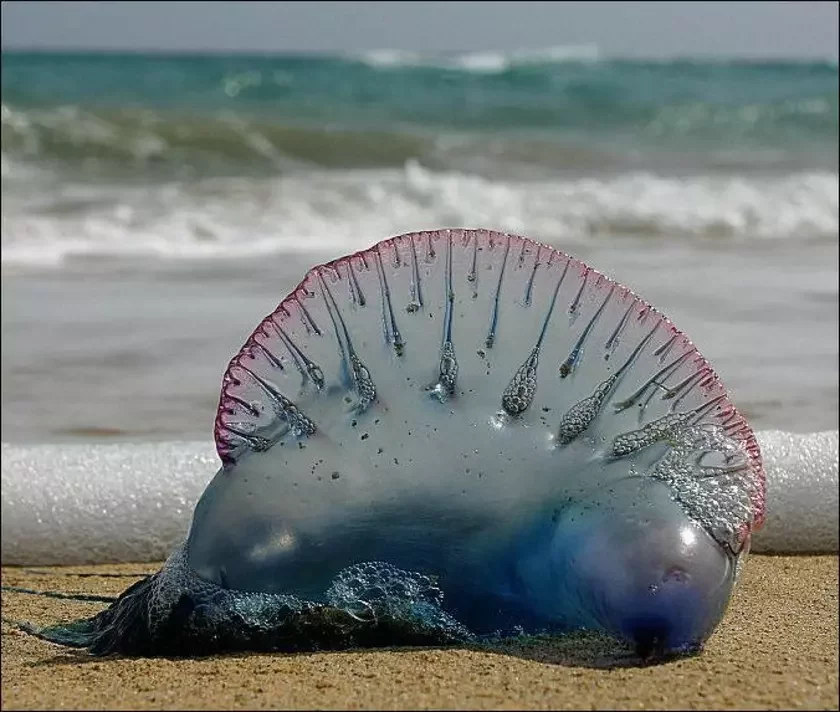
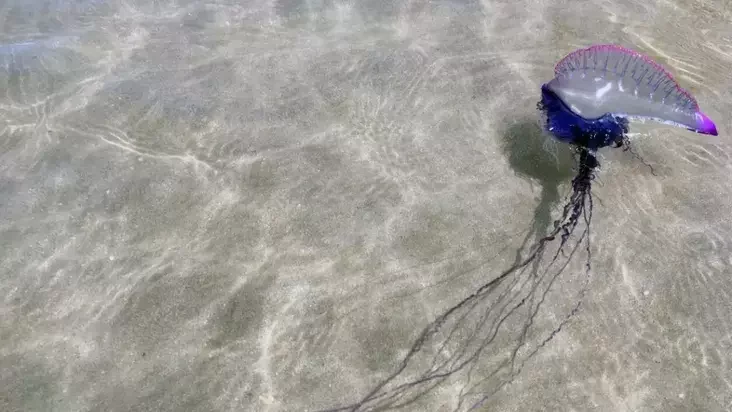
These creatures got their name due to their unusual appearance: their inflated transparent crests of blue, purple, or pink resemble the sails of 18th-century Portuguese warships. The tentacles of these creatures can extend into the water to a depth of up to 30 meters.
In recent weeks, authorities in regions along the Atlantic coasts of France and Spain have warned of their appearance. Portuguese man-o'-wars usually live in tropical waters, but now they are increasingly found near European beaches.
Elvira Antadjian, a researcher at the state oceanographic institute Ifremer, notes that these creatures previously appeared along the French Atlantic coast about once every 7-8 years, but now they are observed annually and in increasing numbers. Over the past two years, mass invasions of small individuals, likely young Portuguese man-o'-wars, have also been recorded.
Scientists believe that rising temperatures in the North Atlantic and the Bay of Biscay may contribute to their reproduction and expansion.
In early August, swimming was briefly banned on the main beach of Arcachon, France, after Portuguese man-o'-wars were discovered there. And on the French Basque coast, over 1000 cases of stings and bites have been recorded in the past two weeks.
Warnings have also been issued by authorities in San Sebastian in northern Spain and the French region of Atlantic Pyrenees. On some beaches, white flags with purple symbols have been raised to warn vacationers of the danger.
A Portuguese man-o'-war sting is usually not fatal, but approximately 10% of victims require medical attention at a hospital. Among those affected this summer was a young woman who was left with scars on her face after contact. In another case, an experienced lifeguard had to be rescued by colleagues after encountering such a creature during his morning swim.
The Portuguese man-o'-war is not a single animal, but a colony of genetically identical organisms, each performing its own function: some ensure buoyancy, others catch prey, and still others participate in reproduction. Sometimes they move in groups that can number over a thousand individuals.
In recent years, Portuguese man-o'-wars have also been spotted in the UK, quite far north – as far as Cumbria.
Thus, the warming of the North Atlantic may contribute to the increasing appearance of marine organisms dangerous to humans near European coasts.


Comments