


"The main thing is not to forget to recharge not only your phone, but also yourself." How a Ukrainian soldier lives with two electrostimulators. And what about his sex life?
A 12.7 mm caliber bullet hit the armor plate of Ukrainian paratrooper Mykhailo "Myaus" Damaskin. The armor held, but the impact severely damaged his spine and spinal cord. After the injury, doctors estimated the soldier's chances of recovery at only one percent. Today, he not only walks again but also runs, plays sports, and dreams of returning to service. This became possible thanks to an experimental neurostimulation technique. And what about sex and, excuse me, going to the toilet for both needs? The soldier shared his story in an interview with the YouTube channel "Vid dushi v dushu" (From soul to soul).
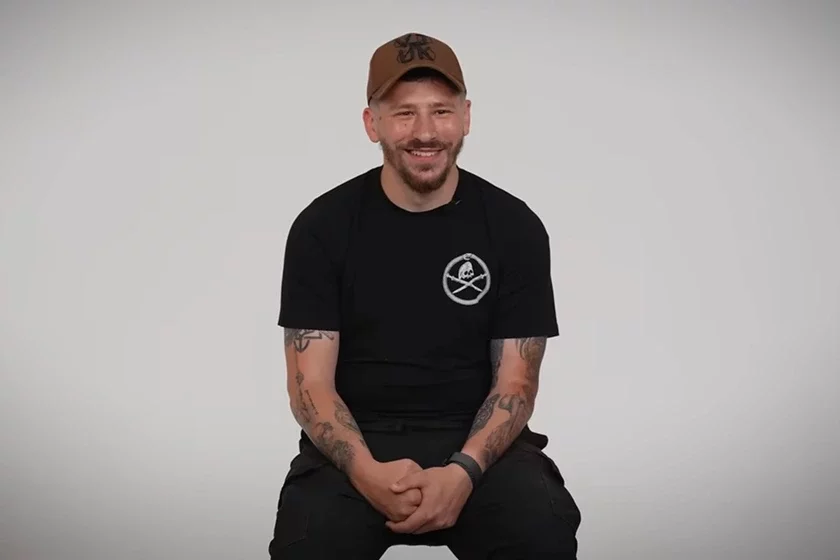
Mykhailo Damaskin joined the service in 2019, signing a contract with the Air Assault Forces of Ukraine. Even before the start of the full-scale war, he became one of the first Ukrainian servicemen to systematically implement drone aviation in the army. He underwent training in Turkey as a Bayraktar operator and participated in the development of this new direction of reconnaissance at the time.
It was through this activity that his name became known even beyond the front lines. According to Damaskin, already in 2020, Russian resources referred to him as a "particularly dangerous" Ukrainian serviceman.
Russia's full-scale invasion found him in the Kherson region. According to Damaskin, he sustained a severe injury during one of the assaults when the Ukrainian unit, after a battle, was forced to retreat to new positions. Mykhailo was the last in the column.
After another burst from an enemy combat vehicle, he ran to cross an open area. At that moment, a 12.7 mm caliber bullet hit the armor plate of his body armor. The armor was not penetrated, but the impact was at such an angle that the bullet's energy transmitted a powerful impulse to his spine.
Tetraparesis — a strange condition
As a result of the impact, Mykhailo sustained a severe spinal injury, which led to damage to the spinal cord in the cervical region. A neurosurgeon later explained to him that such injuries are possible even without direct penetration of the armor. According to Damaskin, if the bullet had hit him directly, there would have been no chance of survival.
As Mykhailo recalls, at first he didn't even realize how severe the injury was. Despite the pain, he independently got onto a tank, then transferred to a car, and walked into the hospital on his own feet. However, a short time later, he began to rapidly lose sensation in his arms and legs. During the examination, he could still move them, but he barely felt them.
The next day, doctors reported that as a result of spinal cord damage, he had developed tetraparesis (a condition where both arms and legs become weak). According to Mykhailo, his left leg retained mobility but almost completely lost sensation, while his right leg functions very limitedly. In the cervical region, the spinal cord suffered a severe impact, and below that, the damage was so severe that, according to doctors' estimates, only about 10% of the nerve fibers remained.
At first, Damaskin accepted the diagnosis calmly and even thought he would be able to return to the front within a few weeks. However, his condition did not improve: sensation did not return, and soon he could no longer move most of his body.
Instead of coming to terms with it, he fully focused on rehabilitation. Mykhailo spent long hours in the gym, strengthening his upper body muscles. The next stage was rehabilitation in Latvia, where robotic complexes and exoskeletons were used. There, he was taught to compensate for the absence of sensations using sight and conscious control of each movement. This allowed him to orient himself much better in his own body and restore some motor functions.
One percent chance of success
Later, Ukrainian neurosurgeons offered Mykhailo an experimental neurostimulation technique, estimating the chances of success at only about 1%.
Mykhailo was initially fitted with a Ukrainian-developed neurostimulator free of charge. However, it did not last long, after which it was replaced with an American-made system. According to Damaskin, the state paid for the operation itself, but not for the neurostimulator, which cost approximately 27 thousand dollars. For this, he used his own savings. Mykhailo said that even before the war, he had invested money in an IT company founded by his friend, which allowed him to receive passive income.
According to him, the Ukrainian neurostimulator had to be charged approximately every three hours. After replacing it with the American system, this interval increased to twelve hours.
Although the operation helped Mykhailo get back on his feet, this technique has not yet become a standard in Ukrainian medicine. According to him, the neurostimulation system is still in the testing phase. For it to be recognized as effective and widely used, more successful cases are needed.
Mykhailo claims that his result was unique. According to him, no other patient in the world has achieved such a pronounced effect from this system before. He himself considers this not only the merit of the doctors and years of rehabilitation but also great luck.
Life on charge requires adherence to algorithms
Mykhailo says that after the neurostimulator implantation, doctors did not give him detailed explanations about how the system might react to various electronic devices. However, he is aware of several important restrictions. It is forbidden to undergo magnetic resonance imaging on MRI machines with a 3 Tesla magnetic field, as this can damage the implanted system. An examination on a device with a 1.5 Tesla magnetic field, he claims, is permissible.
As for other potential risks, Mykhailo admits that he doesn't know all the answers. For instance, he is unsure how the use of a defibrillator might affect the neurostimulator's operation in case of resuscitation.
Mykhailo talks about life with a neurostimulator with humor. He jokes that he already has a real "charging queue": he needs to charge his phone, laptop, watch, power bank, the neurostimulator's remote control, and himself in time.
After his postoperative scars have fully healed, he even plans to get tattoos near the sensor connection points — on one side, a "220 V" sign, and on the other, "USB Type-C".
The implant, according to Mykhailo, did not restore his lost sensation but allowed him to keep his muscles in constant tone.
Even his left leg, which retained mobility after the injury, now functions differently. Mykhailo himself explains that he used to be able to move it only mechanically, constantly controlling each step with his eyes, as he didn't feel his foot touching the ground. After the operation, his muscles became stronger, but the need for constant visual control remained. He still doesn't feel the surface under his feet, so every step requires concentration.
Don't think it's good when you don't feel any pain at all
Damaskin says that after the injury, he practically doesn't feel temperature or pain. He cannot tell if an object is hot, which sometimes leads to dangerous situations.
During treatment, he would play on his laptop for eight to ten hours straight, not noticing how hot the device's casing was getting. As a result, he sustained a severe burn on his leg, the scar from which later had to be covered with a tattoo.
To avoid such incidents, Mykhailo developed his own safety rules. If in doubt, he asks other people to check the temperature of an object or water first. Before taking a shower, he first puts his head under the stream, as sensation is preserved there. That's how he understands if the water is too hot.
Mykhailo himself jokes that he is gradually becoming a "cyberpunk man." After a severe injury and several operations, he no longer perceives his body as he did before.
The man not only feels no pain but also no ordinary human fatigue. He admits that even before the injury, he hardly allowed himself to rest, and now that sensation has almost completely disappeared.
However, this feature also has a downside. A person who doesn't feel pain doesn't always understand when their body is already working at its limits.
He was reminded of this by a serious knee injury. During one movement, he turned awkwardly, and his ligaments could not withstand the load. As a result, three of the four main knee ligaments were torn. He felt almost no pain. He simply realized at some point that he could no longer put weight on his leg.
He understands that the charge is running out not by indicators, but by the condition of his own body. According to him, his legs become weaker, and his muscles no longer bear the load as they should.
One day, this led to a serious injury. After an intense training session, he went to the store, expecting that the charge would still last. However, his muscles relaxed earlier than he expected. He simply fell on the path and broke his leg in three places.
Mykhailo himself initially didn't even think it was a fracture. Due to the lack of pain, he decided he must have damaged ligaments. Lying right on the street, he took out his charger, connected the neurostimulator for a few minutes to get enough strength to get home, and then went to the trauma department. There, an X-ray showed a fracture of the fibula in three places. According to him, he was lucky because the main load during walking falls on the tibia.
A second neurostimulator — for toilet urges
Damaskin recounts that after his spinal cord injury, he lost the ability to feel natural urges for urination and bowel movements. Therefore, he agreed to another operation during which a second neurostimulator was implanted to help control the functions of his pelvic organs.
He says that he now carefully monitors his diet and has developed a strict daily routine. He determines the need to visit the toilet not by sensation, but by indirect signs and with the help of self-control. According to him, this system allows him to lead an independent life without significant everyday difficulties.
Mykhailo also speaks openly about how the injury affected his intimate life. According to him, erection was preserved, but he almost completely lost physical sensation. Damaskin admits that he now perceives intimacy primarily through emotions, sight, and a soulful connection with his partner.
The neurostimulator that helps him walk also requires constant monitoring. Mykhailo says that recently the system has started working unstably: sometimes his legs can unexpectedly weaken, and the stimulation process, instead of the usual thirty minutes, stretches for several hours and is accompanied by strong discomfort in the spinal region.
Doctors suggest that some elements might have been damaged because after the operation, he not only walks but also runs, engages in strength training, plays sports, and is preparing to return to military service.
In this regard, he will probably need another operation, during which doctors will determine if a system replacement is necessary. According to Mykhailo's estimate, the cost of a new neurostimulator along with the necessary components for his back and knee could be around 11 thousand dollars.
The war taught to live for today
Reflecting on the future, Mykhailo admits that the war taught him to live for today. According to him, the past cannot be changed, and the future is not guaranteed, so the main thing is to value the present moment.
He doesn't make distant plans, but he still has a few simple dreams. He wants to live to see the day when he can take his youngest daughter to kindergarten, then to school, and when she finishes her studies, to dance with her at her graduation.
Damaskin names returning to military service as his main goal. According to him, he wants to serve again so that his children can live in a safe and independent Ukraine.


Comments