


Political prisoner married his pen pal love — divorced two months after release
Anton Sotnikau from Brest served 4.5 years for protests in a penal colony where Ashurak and Shtermer died. He left prison married to a pen pal — but the marriage quickly fell apart. The guy told "Nasha Niva" about the circumstances of his imprisonment.

Photo: interlocutor's archive
"For all 4.5 years, I waited for my release to go to my grandmother's grave and apologize for everything that happened."
Anton Sotnikau was arrested in 2021 when he was 28 years old. The Brest native lived in his hometown for most of his life — with the exception of a few years in the late 2010s when he moved to Poland for work.
The guy was raised by his grandmother. Anton's mother left the country when he was a preschooler; she is now in the Czech Republic with his sisters. As for his father, he lives his own life in Brest.
"I studied in Brest to be a construction engineer but was expelled from the university for truancy. I dodged the army, then in 2018, I was drafted to serve in the 38th brigade in Brest. I served there for a year and a half in military intelligence, where I was a senior scout-sniper.

Photo: interlocutor's archive
In November 2019, I was discharged and went to Europe to my family. When COVID started, I went to Brest because of document issues. When the presidential elections were held on August 9, I didn't stand aside, because I had sworn an oath to the Constitution and the people, with whom I remained until the end. I started defending my people and the Constitution; I believe I am not a traitor to the Motherland, but a patriot," the guy describes his life.
Anton was among the protesters who came out to defend the election results on the evenings of August 9 and 10, 2020. On the first evening, he got into a clash while trying to defend a woman. She approached the security forces standing with shields and asked them to put away their shields, for which she was struck in the face. The security forces dragged the woman towards them, and the Brest residents rushed to defend her — Anton was among them.
On August 11, biker Henadz Shutau was killed near Anton's home. The guy recalls that near the tragedy site, he saw a traffic police patrol and riot police officers, and he threw brilliant green (zelenka) at the traffic police car.

Henadz Shutau. Photo: tut.by
Anton was detained in February 2021, and in August, his sentence was announced.
"During the trials, my grandmother died. Of course, it was difficult. I was given 4.5 years in prison; I still haven't admitted guilt. In 2024, they came to the colony and asked me to write a petition for pardon; I said I wouldn't. I had 7-8 months left.
For all 4.5 years, I waited for my release to go to my grandmother's grave and apologize for everything that happened."
It was important for the guy not to lose his humanity behind bars:
"It was difficult both morally and physically, but I coped. I served my time with dignity, did nothing bad to anyone; on the contrary, I supported all our 'extremist' guys. I explained briefly and as accurately as possible how to behave so that they wouldn't end up in that 'refrigerator' in the colony — SHIZA and PKT (Anton calls it a refrigerator because those rooms usually have poor heating — NN).
My task was to explain to the new convict: you must preserve your health, your mind, and remain a human being here. And trust no one, because you cannot trust people here, especially those who work for the staff."
"Shtermer fell, so they kicked him in the chest — 'get up, what are you pretending?'"
Anton found himself in the Shklov colony in November 2021 — half a year after Vitold Ashurak died there. At that time, the guy recalls, checks regarding that case were still ongoing in the colony. Sotnikau names the security forces who, according to rumors among prisoners, were involved in Ashurak's death: these are the former head of the colony's regime department, Siarhei Karcheuski, and Aliaksei Maskaliou, deputy head of the colony for regime and operational work.
Anton says that Karcheuski has since been promoted. He is now the deputy director of RUP-17, meaning the industrial zone of the colony.
Another political prisoner who never returned home from Penal Colony No. 17 is Valiantsin Shtermer from Homiel. He died in the colony in early 2025.
Anton remembers him well:
"They would drive him to the industrial zone, and he could barely walk; they constantly put psychological pressure on him. Once, they were leading him and me to SHIZA — he walked ahead, and I was taken behind him in a 'swallow' position. He fell, so they kicked him in the chest — 'get up, what are you pretending?'
A harmless man, he could do no harm to anyone."
Valiantsin Shtermer died when he was around 60 years old. But Anton recalls that he looked 10 years older — hunched, exhausted, and in need of hospitalization. Shtermer was constantly set up, slandered, and conditions were created for him to end up in SHIZA.
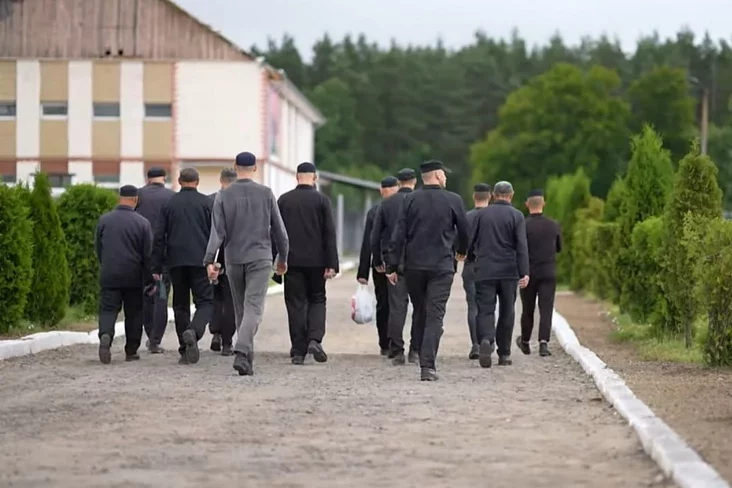
According to Anton, Shtermer was a target for informants. For example, a prisoner named Skavysh, who is imprisoned for murder, or another criminal-informant, Palianski.
Sotnikau describes the worldview of the informants there:
"The main thing is that a denunciation is made, and the person will be 'dealt with' regardless, guilty or not, because we are 'extremists.' It doesn't matter what they do, the main thing is that we suffer, and they benefit. They pretend to work for the staff to be encouraged."
In the industrial zone, Anton was assigned to work in the woodworking shop. There, prisoners made crates for "Grad" shells, which eventually ended up in Russia. Anton spoke with the local drivers, and they told him the further journey of those crates:
"They made more than 2000 crates monthly. All of this was transported somewhere near Minsk to warehouses, where everything was assembled and then weapons were taken to Russia, because the customer was the Russian Federation.
In the colony, they also made crates for mines. They processed Mazovian rubber, ferrous scrap metal, and the sewing workshop practically worked for the Ministry of Defense."
"Many of my acquaintances among former political prisoners are already divorced because their wives don't understand them and don't want to understand them."
At the time of the trial, Anton had a girlfriend. But when it became clear that the case would end in a prison term, the relationship came to an end.
"Her choice is her choice, and my choice was obvious, and we no longer communicate. She believed that I acted incorrectly then, condemning me for doing the right things as a man, a citizen, and a serviceman. Like, I should have stayed home," the guy says about that relationship.
However, he didn't have to be alone for long. Anton received many letters behind bars from concerned Belarusians, and among them were letters from a girl with whom he developed a particularly heartfelt correspondence.
"She sent me a postcard with a kind word, and I replied. Somehow everything came together; we corresponded for half a year and decided to try to get married. He recalls they wrote about everything in the world, even simply about how blue the sky was that day.
"Where did the love begin? There was no love, there were different feelings, emotions. I wanted to see her as soon as possible. You spend so much time in isolation with other convicts, and a woman is something completely different. Especially when she's at a distance, she attracts, and certain feelings open up. You tell her things you haven't told anyone else; trust appears.

I waited for her letter like crazy, and I simply melted into it. I would fall asleep with a smile, then wake up and read that letter," Anton recalls.
It was he who proposed marriage. He first saw the girl in a photo she had sent earlier, and at the wedding, they met in person — and the guy cannot find words to describe his feelings at that moment.
The bride wore a white dress and brought Anton a suit. They were given 10 minutes to talk — like, "will you go down this path or not?" The girl trembled with excitement; Anton hugged her and promised he wouldn't hurt her. Then came the signing and a two-day visit.
"Most likely, there was sincerity, a desire to continue and see what would come of it. She is a kind and sweet person who met me halfway, helped me, and I don't forget that even today," the guy reflects.
For the next few years, the husband and wife only saw each other via video calls, as Anton was not granted any visits in the colony. They only managed to talk offline after his release, when he was met by his loved ones:
"When they met me, my eyes were wild. I had a huge fight with the colony staff then — they said they could detain me for another 72 hours, and I told them to release me from there.
At the checkpoint, when there was only one last door to pass, an officer told me — 'forget all this,' he said. And I looked at him with bloodshot eyes and said: "Forget this? I have such a wound in my heart that I will not forget it."

After his release, Anton got a tattoo in memory of his grandmother. Photo: interlocutor's archive
For a couple of months, they tried to build a new life. But then Anton decided to go abroad because the security forces started pressuring him — the guy wasn't going back to prison. It became clear that he would leave the country alone.
"I couldn't do it. They started not understanding me, and I said I couldn't live like that," he says about the reasons for the divorce.
And he doesn't keep silent about his role:
"Perhaps, although I was released then, in my thoughts I still lived in prison and couldn't get used to family life, to peace. I always thought about the guys who are still there, about those for whom everything is just beginning, who are being detained and going through interrogations and investigations.
And I still think about them. Today I wake up, drink a cup of coffee, I feel so good, and immediately another picture comes to mind — the guys sitting in SHIZA, waiting to meet their relatives. My mood drops, so I try to switch my thoughts."
Correspondence with political prisoners, as well as relationships with them, is often romanticized. Is it possible to transfer such relationships, like Anton's behind bars, into real life?
"People come out of prison completely different, psychologically broken, with a different worldview and different values. They don't want anything, they don't want a family; they want to live for themselves. There are people with strong characters who try to keep this pain inside, but their soul still hurts.
Many of my acquaintances among former political prisoners are already divorced because their wives don't understand them and don't want to understand them. But there are also many whose wives supported them after their release, and they continue together," says Anton.

Anton after his release. Photo: interlocutor's archive
Now the guy lives in Warsaw and works with other political prisoners from Brest, making wooden buildings. He awaits his friends who are still behind bars, especially those who chose the path of armed resistance — as Anton says, "those who defended our country not with words, but with deeds."
Friendship with other former political prisoners helps not to lose hope:
"I fell into depression very often; the last time was absolutely insane. But there are people who helped me get out of it. Everything just piled up, so in February, I was already ready to go to the Belarusian border — like, 'just put me in prison already, I'd rather sit there.' But I still managed.
Probably, reliable friends helped. It was so morally difficult that I was ready, if not to Belarus, then to go to Ukraine to fight."
«Nasha Niva» — the bastion of Belarus
SUPPORT US-
35-year-old Belarusian truck driver suddenly died in China. He was the husband of Belarus' most decorated judoka
-
Next to Tolstoy and Dostoevsky: Books about the "SVO" to be included in the Russian school literature curriculum
-
Catholic Festival in Budslau Held for the First Time with Participation of Head of BPC and Russian Ambassador


Comments
Хрысціянскія сямейныя традыцыі сцёрты лукашыстамі і іхным гаспадаром.