


A rare phenomenon — currency exchange rates in bureaus differ from the National Bank by almost 5%
Usually, the selling rate is higher than the National Bank's. But now, the buying rate has also jumped higher than the benchmark.
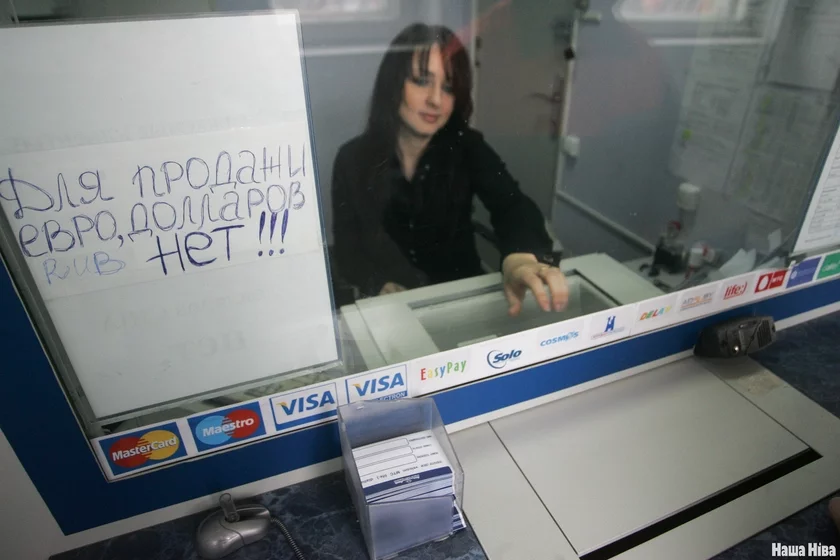
Exchange Rate Anomaly
Usually, dollars or euros can be bought or sold at an exchange office at a rate very close to that set by the National Bank.
This was the case a month ago, when, with the National Bank's rate at 2.82 per dollar, it could be sold for a maximum of 2.83 rubles, and bought for a minimum of 2.84 rubles.
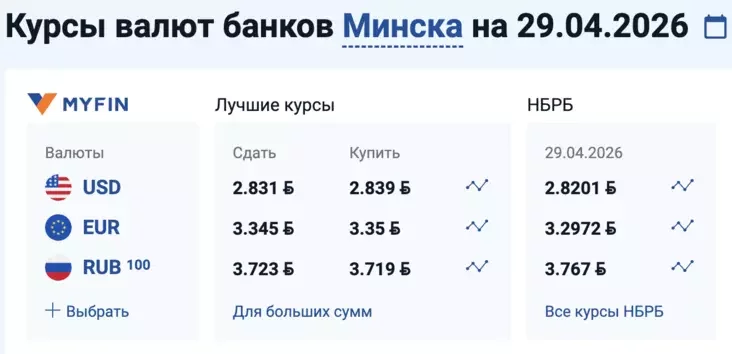
Photo: screenshot of rates on 29.04.2026 from myfin.by
But from mid-May, the situation began to change. Currency in exchange offices became more expensive than at the National Bank. Towards the end of the month, the difference increased.
So, on May 29, with the National Bank's rate at 2.76, the cheapest dollar could be bought for 2.884 rubles, and sold for 2.872. That is, the difference with the National Bank is now about 4-4.5%.
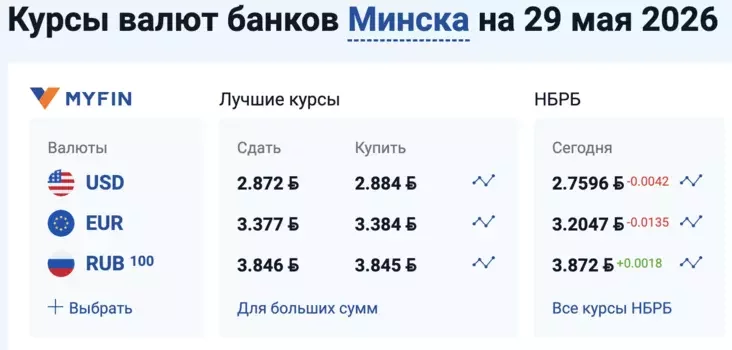
Photo: screenshot of rates on 29.05.2026 from myfin.by
What does this mean for people and business?
In some cases, such an exchange rate difference benefits both small businesses, which exchange currency at an exchange office rather than through the stock exchange, and ordinary citizens. For example, when it comes to paying customs duties, which are calculated in euros.
Cars, for instance, are cleared at a rate fixed in euros, but payment must be made in Belarusian rubles precisely at the National Bank's rate.
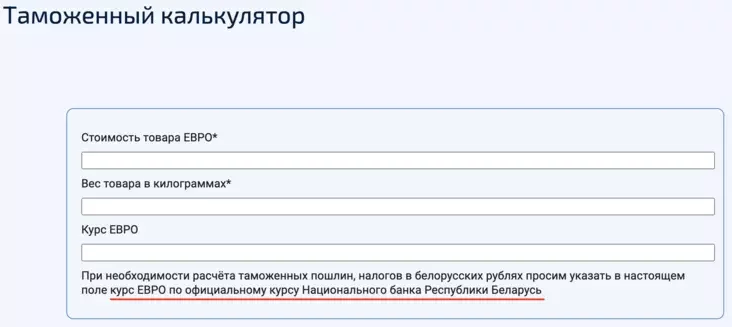
Photo: screenshot from customs.gov.by
For example, if you clear a popular car for import, older than 5 years, with an engine volume of 1.6 liters, under a preferential scheme, the duty will be 2800 euros, which equals 8973 rubles according to the National Bank.
But if you recalculate at the maximum rate for which euros can be sold, it turns out that you need to bring not 2800 euros to the exchange office, but 2657 euros. A saving of 143 euros is achieved precisely due to the exchange rate difference.
At the same time, such an exchange rate difference sometimes leads to confusion, for example, if the price for a product or service in the contract is specified with a reference to the National Bank's rate on the day of payment.
A buyer who exchanges currency for payment will be at an advantage, while the service provider will be at a disadvantage.
What could such a trend indicate?
First of all, it indicates that banks may not trust the official rate set by the National Bank based on trading results, amidst the strengthening of the Russian, and consequently, the Belarusian ruble.
-
«Santa Bremor» wants to sue for brand rights from a well-known Russian manufacturer recognized as extremist for supporting the Armed Forces of Ukraine
-
Buildings of the former Jewish ghetto in Novogrudok sold to American owner of "Sula" park, a native of Belarus
-
Governor of Russia's Primorsky Krai revealed the status of the Belarusian port construction there


Comments