


A Year in Orbit for a Flag on the Moon. Beijing Enters a New Stage of the Space Race with the USA
China has sent three taikonauts to its orbital station on a record-breaking year-long mission. This step is not just a scientific experiment, but another demonstration of technological prowess amidst American delays. While NASA postpones its Moon landing dates, Beijing is developing technologies for building its own permanent base and integrating political symbols into its space program.
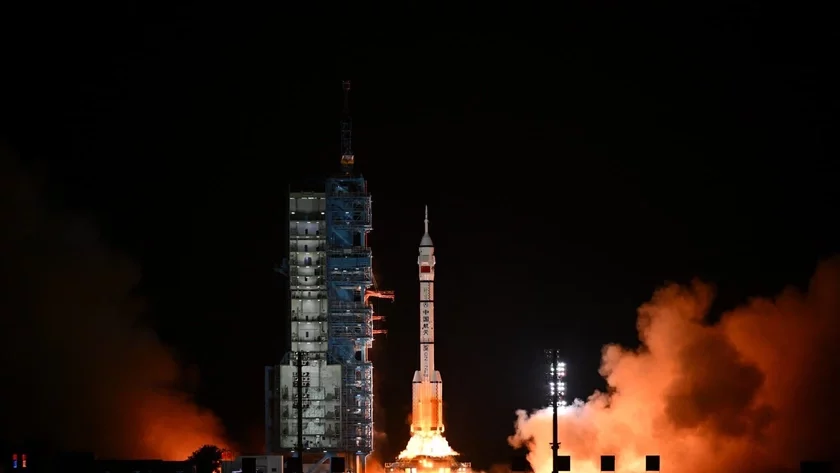
Launch of the Shenzhou-23 spacecraft
The launch of the Shenzhou-23 (Divine Vessel - 23) spacecraft to the Tiangong orbital station took place on the evening of May 24, 2026. As reported by The Insider, citing Reuters, the Long March-2F carrier rocket successfully launched from the Jiuquan Satellite Launch Center, marking the start of the longest crewed mission in the history of Chinese cosmonautics and the 11th for the station itself.
Crew Composition: From Veteran to Police Inspector
For the first time in the history of Chinese cosmonautics, the crew consists entirely of representatives from the third and fourth generations of taikonauts. The mission is commanded by 39-year-old Zhu Yangzhu, who already has flight experience on Shenzhou-16. His peer Zhang Yuanzhi, for whom this is the first launch, serves as pilot.

Taikonaut Li Jiaying from Hong Kong. Photo: Wikimedia Commons
However, the main sensation was the appointment of 43-year-old Li Jiaying as a payload specialist. She is a former chief police inspector of Hong Kong and the first representative of this special administrative region in space. Li's appointment is a clear political gesture by Beijing, aimed at demonstrating Hong Kong's full integration into the Chinese system.
Another intrigue of the mission lies in its duration. Initially, standard flights to Tiangong lasted six months, but this time one of the crew members will remain on the station for a full year. The leadership will decide later who exactly will have this honor, based on physical and psychological tests conducted in orbit. This year-long record will free up one seat on the return flight of the Shenzhou-24 spacecraft, to accommodate the first taikonaut from Pakistan in history (candidates Muhammad Zeeshan Ali or Khurram Daud are being considered) for a short-term mission lasting about a week.
Technological Breakthrough and a New Generation of Spacecraft
Shenzhou-23 is the first crewed launch of an upgraded generation of spacecraft. The first vehicle of the new series (Shenzhou-22) was sent into space in uncrewed mode through an early launch.
The new spacecraft has received several fundamental improvements. Its payload capacity has increased two to three times, allowing for more cargo. The dashboard interface has become more modern, and the docking system is equipped with a controlled dampening buffer, which increases its reliability. Additionally, the spacecraft has been reinforced for enhanced safety: the portholes received an additional heat-shielding layer of glass (following damage recorded on the Shenzhou-20 mission), and the vehicle itself is now compatible with interfaces for international cooperation.
This mission also has important scientific significance. Chinese specialists will test automatic docking technologies necessary for the future lunar program. In parallel, scientists will continue to study the effects of long-duration spaceflight on the human body, including radiation exposure, bone mass loss, and psychological stress — all this data is critically important for preparing for interplanetary travel.
Space Race 2.0
The record-breaking Chinese mission takes place against the backdrop of intensifying competition with the USA for humanity's return to the Moon. As early as April 2026, NASA successfully completed the Artemis-2 mission — the first crewed lunar flyby in over half a century. Four astronauts spent about ten days in space.
However, further American plans have encountered technical difficulties. In February, NASA was forced to postpone the first astronaut landing on the surface of Earth's satellite from 2027 to 2028 due to problems with the Space Launch System rocket.
China, on the other hand, demonstrates enviable stability. Beijing expects to conduct its own crewed landing by 2030, and by 2035, to establish a permanent International Lunar Research Station jointly with Russia.
Symbolically, even on the emblem of the Shenzhou-23 mission, in addition to traditional Chinese patterns, a character from the Dunhuang frescoes, and the bauhinia flower (symbol of Hong Kong), the path to future ambitions is depicted.


Comments