


Navumchyk on the Consequences of 2020: A Tragedy of National Scale
«The 2020 revolution was stifled at its outset. And there's a point here that I personally consider crucial and that we need to realize». Siarhei Navumchyk disagreed with Aliaksandr Fiaduta, who disagreed with Mariya Kalesnikava in evaluating the essence of the summer 2020 protests.
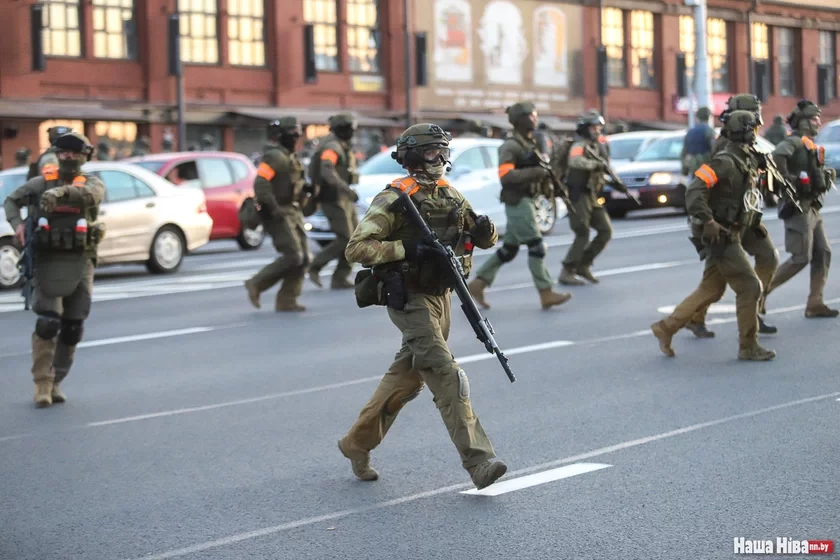
«I disagree with Aliaksandr Fiaduta that supposedly no one cares what Mariya Kalesnikava fought for in 2020. I'm not even talking about historians who will study the processes of that time and the motivation of their leaders — it concerns everyone for whom the word Belarus is not an empty sound. Because the result of the so-called election campaign and participation in it was a national tragedy of a scale that the Belarusian people have not experienced in their recent history — thousands imprisoned, beaten, and tortured, hundreds of thousands in forced emigration (the consequences of this will be felt for decades).
And so I dispute the opinion, including that of some of my very well-known and deservedly authoritative friends, that in 2020 the political formation of the nation finally took place. And it's not even that the history of the nation didn't begin now. In 2020, the nation trusted people who didn't even raise the question of abrogating union treaties with Russia (which Mariya Kalesnikava stated at, or almost at, the first press conference of the Coordination Council). An alliance with a country that, over recent centuries, has been and remains a threat to the existence of Belarusians as an ethnic group. Where, then, is the awareness of political interests?..
I would call the events of 2020 a revolution. Or, more accurately, an attempted revolution. And, to be completely precise, an unprepared attempted revolution. And revolutions sometimes suffer defeat. And much more often than they win.
One could recall the last wave of national Revival, the peak of which was August 25, 1991 — three years after its apogee, this wave was violently suppressed (not without Moscow's involvement, by the way). But the comparison would be erroneous: during those three years, the foundation of the state was created, its institutions were formed — the army, customs, border service, financial system, diplomatic missions abroad were opened. Lukashenka, in this sense, effectively came to a ready-made situation — and as a deputy, he usually did not vote for the formation of such structures.
The result of those years is Belarusian statehood, which still remains, no matter how Lukashenka might exchange it piece by piece with the Kremlin for his own survival.
The 2020 revolution, however, was stifled at its outset.
And here there is a point that I personally consider principal and that we need to realize.
One must distinguish between the concepts of guilt and responsibility. In everything that happened after August 9, 2020, the people from the headquarters who promised an easy victory are not to blame. They undoubtedly bear responsibility, but the guilt is not theirs. Lukashenka and his entourage, who usurped power and initiated repression against the people, are to blame.
All of us need to finally draw conclusions. One of them is: enough with naively trusting those who suddenly appear out of nowhere (although the concepts of "suddenly" and "out of nowhere" can be relative. It could be "from somewhere" and "not suddenly" at all). This is how Lukashenka was believed in 1994, and how those were believed in 2020 who said that elections couldn't be rigged, that repression was a myth, and that "an paddy wagon is just a car".
As a friend of mine says: «If you've been fooled once (to use a literary form) — that's bad, but not terrible: it happens to everyone. If you've been fooled a second time — that's a reason to seriously think about what's wrong with you. If you've been fooled a third time — you might as well not even think: you're an idiot».
There should not be a third time; the cost of a mistake could turn out to be not just tragic, but fatal for the nation», Siarhei Navumchyk wrote in his Telegram channel.
-
Barkouski: Sometimes there is a desire to ask the European Commission to cut subsidies for independent media
-
Statkevich urged "deeply respected Nasha Niva" not to use the word "labuda," and Tsikhanouski not to complain about the media
-
Liabedzka: Would it have been better if Kebich had defeated Lukashenka in 1994? No!
Now reading


In Gomel, the head of an association that searches for the remains of victims of war and Stalinist repression, and his nurse wife, were sentenced for political reasons


Comments
А каму ўвогуле цікава канцэпцыя ВІНЫ? Гэта пра эмацыйнасць, пры рэакцыю ахвяры. Каб перамагчы, трэба быць не ахвярамі, а адказнымі людзьмі, апірацца не на нейкаю там віну, а на свой розум і моц