


Many remember the story of Dzmitry Tsimashkou. Together with his daughter Liliya, who has cerebral palsy and whose rehabilitation he took upon himself, he participated in races. And in 2018, his son, who attacked his father with a knife, was unexpectedly arrested.
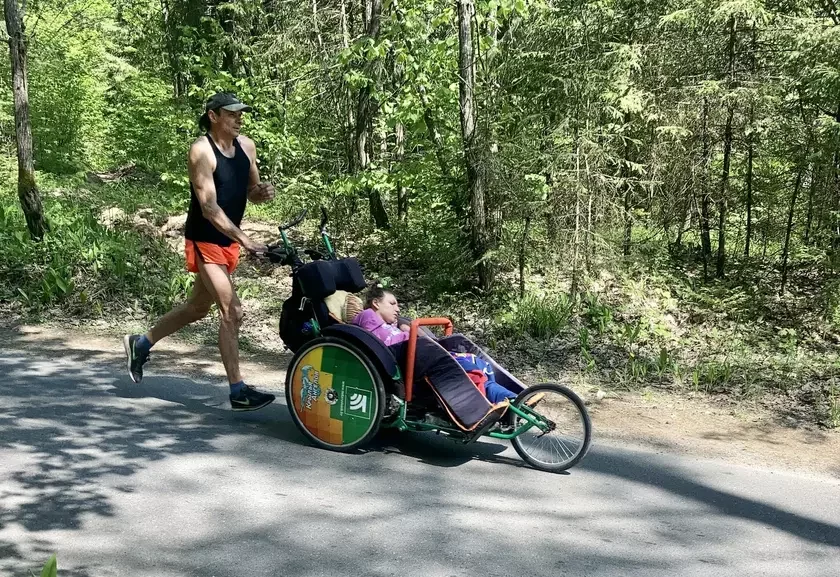
Dzmitry Tsimashkou with his daughter Liliya. Photo from Tsimashkou's Facebook page
Fifteen to twenty years ago, Dzmitry Tsimashkou seemed like a person one would call a successful Minsk resident. A family, children, his own business, an apartment, a car, a clear life trajectory. He himself later wrote with irony that by thirty, he already had two children, a second apartment, and "a house on the seashore, even if it was the Minsk Sea."
But everything changed. First, due to his daughter's severe illness. Then, due to the breakdown of his family. Then, due to the story with his son: fourteen-year-old Siarhei attacked his father with a knife and inflicted six stab wounds. How did the family's story unfold after that?
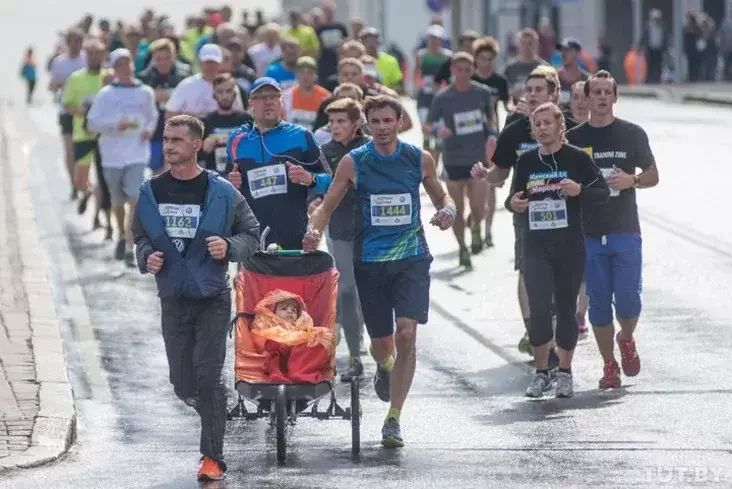
Dzmitry Tsimashkou with his daughter during the Minsk Half Marathon in 2015. Photo: Tut.by
Who is Dzmitry Tsimashkou
Dzmitry Tsimashkou was born and grew up in Minsk; he has an older brother and sister. In his youth, he was involved in sports — he attended rowing lessons at school. After the army, he worked in various fields, and by the mid-2000s, he already owned a small business — a shop that "fed the family."
Tsimashkou was married several times. From his first marriage, he has an adult son (now about 40 years old) and a daughter Liza (about 28 years old). Liza Tsimashkova maintains a relationship with her father and his other children.
His second wife was Volha, approximately 10 years his junior. In 2004, their son Siarhei was born, and two years later, their daughter Liliya, who was diagnosed with a severe form of cerebral palsy. Tsimashkou later said that he noticed problems very early — in the first months of the child's life.
After this, the family's life shifted to an entirely different mode. Following his daughter's diagnosis, Tsimashkou dedicated himself to finding rehabilitation methods. He studied the methodologies of Glenn Doman Institutes (USA) and twice traveled with his daughter for wellness programs, collecting donations. Later, he developed his own home program, which includes physical activity, hardening, sensory stimulation exercises, and other elements.
Photo: Tut.by
In this new reality, the business began to decline. Tsimashkou himself described it this way: while he dedicated himself to his daughter and her rehabilitation, the business withered, partners began operating in a gray area, and then one "beautiful April morning, the shop burned down to ashes." Creditors quickly took what was left.
At the same time, the family was also falling apart. Volha had been a housewife for a long time, and then started working as a saleswoman. According to Tsimashkou, the constant care for their severely ill daughter, isolation, and endless stress led the woman to depression and alcohol problems.
They divorced in 2016-2017. After the divorce, the children stayed with their father; the mother occasionally helped, but the main burden of care fell on Dzmitry.
In an interview, Tsimashkou said that the loss of his business, lack of money, and his daughter's severe illness drove him to despair, but he "took a paper and a pen instead of a rope" and started writing a blog to draw attention to the problem.
The Son Who Grew Up in the Shadows
According to his father's descriptions, his son Siarhei grew up in an intellectual environment. Dzmitry recounted that the boy attended a specialized kindergarten, then one of Minsk's best gymnasiums, and was reading serious literature (Kurt Vonnegut, Saul Bellow) already at 14 years old. Difficulties began after Liliya's birth: in a home where all life revolved around the girl's rehabilitation, the son gradually became secondary.
Tsimashkou himself later openly admitted: he paid little attention to Siarhei, used physical punishments, and burdened him with household duties. The son, in turn, perceived his father as a harsh and distant man. This alienation gradually grew within the family until it erupted in September 2018. Then, fourteen-year-old Siarhei attacked his father with a knife and inflicted six stab wounds.
The story immediately became public and caused a stir. In January 2019, the court sentenced Siarhei to six years in a correctional colony.
The Book About Six Stab Wounds and the "Embrace of Satan"
While the investigation was ongoing, Tsimashkou wrote a book with one of the most unusual titles in Belarusian non-fiction: "Six Stab Wounds to the Back, or the Story of Whether One Can Free a Child from the Embrace of Satan and Survive Oneself."
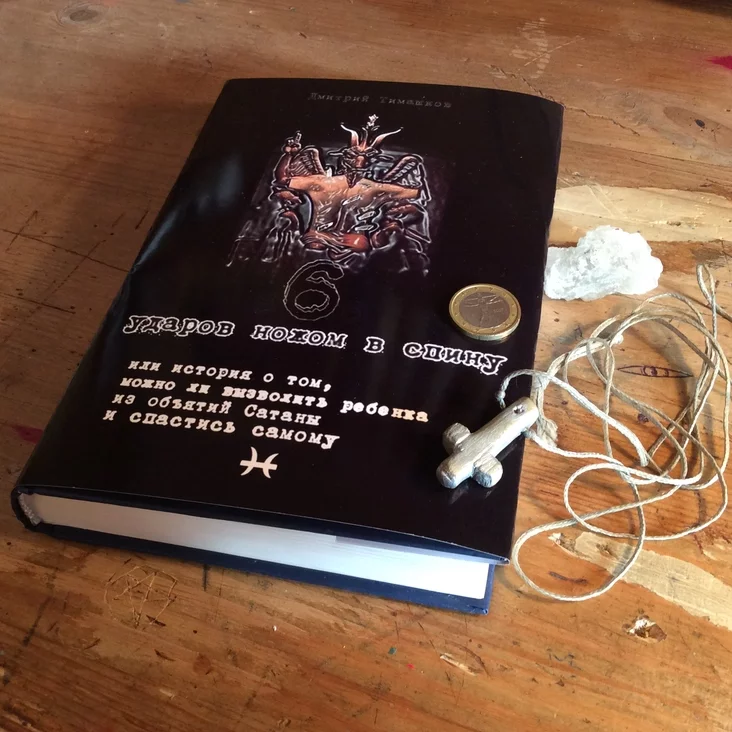
Photo: lilkindad.livejournal.com
Tsimashkou tried to interpret his son's attack not only as a story of family breakdown but also as some kind of "dark third party" that supposedly intervened in the teenager's life. The book features occult motifs, discussions of Satanism, "horrific rituals," and mystical plots. At the same time, the author himself emphasized that the book is a literary non-fiction work, containing fiction, and the characters only resemble real people.
Some saw this book as a person's attempt not to go insane after a personal catastrophe. Others saw it as an unwillingness to admit that the cause of the tragedy might have been the family environment, not "Satan."
Parental Days in the Colony
In his blog, Tsimashkou described his trips to Babruysk to visit his son in the colony and his attempt to understand who his son had become behind bars.
Tsimashkou engaged in a long struggle for a reduced sentence, a review of the case, and a pardon. He called it "yet another bitter experience."
His texts about the colony contain many everyday observations. It is a very specific world with gates, metallic clatter, passes, bags of food, and parents queuing.
Tsimashkou emphasizes that for a father, the main question in the colony is very simple: is your child being fed properly there? During a visit to the new canteen, he, with almost painful attentiveness, lists soup, mashed potatoes, a roulade, vinaigrette, and compote.
During one such parental day, he writes that he and Siarhei walked to the canteen, "holding hands," and that it was "for the first time, probably in two years."
In 2020, the Supreme Court reduced the boy's sentence to four years. And on January 6, 2021, Siarhei was released on pardon. Tsimashkou wrote that on that day, he received a call from the colony, and they simply said: "Your son has been pardoned. Come pick him up."
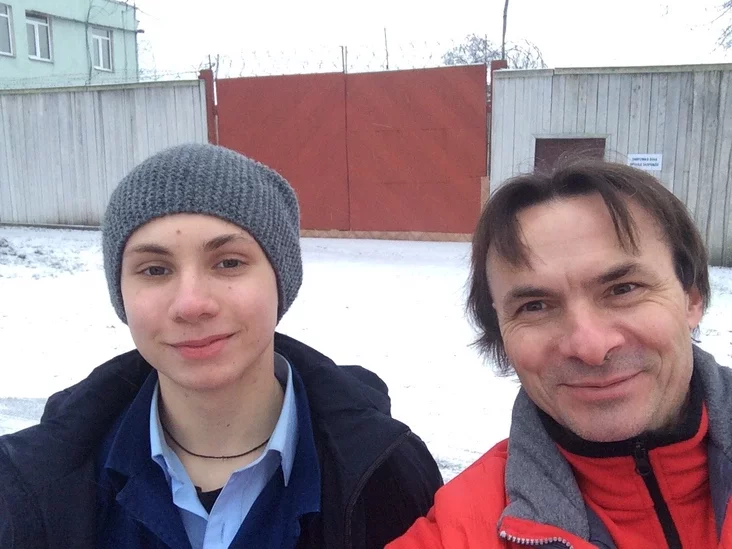
Dzmitry Tsimashkou (right) picks up his son Siarhei from the colony in Babruysk. Photo: lilkindad.livejournal.com
Tsimashkou recounted that Siarhei had changed in the colony. He started reading a lot, drawing, studying, writing. His letters to his father, according to Tsimashkou, reached twelve pages and were no longer childish notes but almost literary texts.
What About Siarhei Now?
From available sources, it is clear that Siarhei (now 21 years old) joined the running community "Wings of Angels" and participated in races.
The young man is studying in the European Union. It is known that he maintains good relations with his father and participates in his activities.
"Wings of Angels"
Even before the knife incident, Tsimashkou began to build an entire world around his daughter and her rehabilitation. He ran a lot and gradually came to the idea that sport could be a form of inclusion in the lives of children with disabilities.
In 2015, Tsimashkou ran the Minsk Half Marathon, pushing a wheelchair with Liliya. Later, the initiative grew into an entire community: thus, "Wings of Angels" emerged. The idea was simple: there are "angels" — children with severe diagnoses, and there are "wings" — people who run with them, push them in wheelchairs, making them participants in events rather than observers.
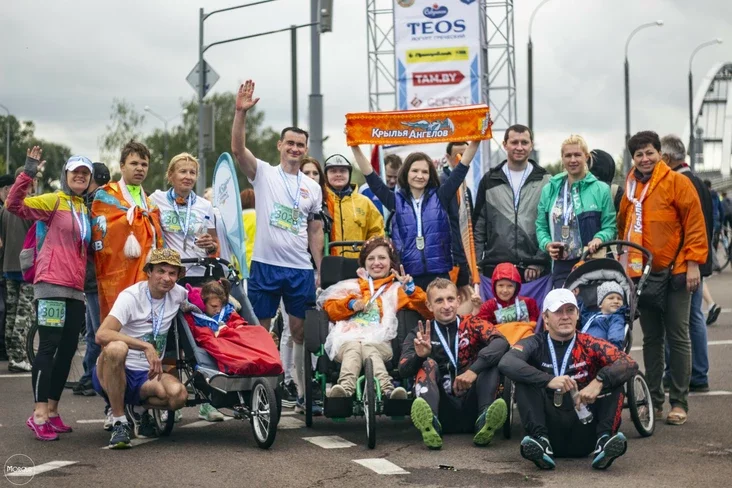
Brest Half Marathon-2018. Photo: wingsangels.livejournal.com
Over six years, the "Wings of Angels" initiative grew from a parents' circle into a full-fledged public organization: the team participated in marathons, organized "RunParks" (inclusive family runs), and gathered numerous volunteers around itself. Tsimashkou became the face of this organization.
Running Instead of Quarantine
During the COVID-19 pandemic, Dzmitry Tsimashkou took a skeptical stance. In his blog, he criticized the general panic, fear, and people's behavior. He ironically called the situation "corona-fuss" and claimed that the hype around the virus was inflated by "people who intended to live forever."
But he did not deny precautionary measures. He formulated his life plan during the pandemic with ten points, including, for example, minimizing contacts, creating a stock of food and medicines to avoid unnecessary trips to the store, and moving elderly parents to the dacha away from crowds.
Tsimashkou urged people not to give up running. He claimed that his many years of experience with social isolation (due to caring for his daughter with a severe form of cerebral palsy) helped him cope with the coronavirus, and he criticized those who demanded quarantine, masks, and tests.
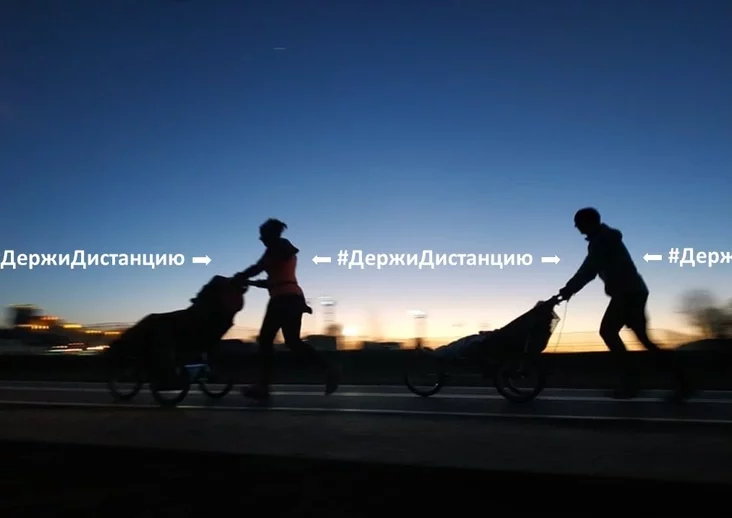
In 2020, he, together with his team, conducted a series of charity runs called "PandaMia." Each event was timed to a specific date (Cosmonautics Day, Children's Protection Day, etc.). Tsimashkou's organization also arranged other runs: inclusive partner runs, "social Tuesdays" at the 9th beach, offering inclusive training sessions and picnics.
Liquidation and Relaunch
In 2021, the authorities liquidated the "Wings of Angels" organization. This happened against the backdrop of the mass destruction of Belarusian non-governmental organizations and initiatives — from human rights to social ones.
Tsimashkou said that he learned about the liquidation virtually by accident: he found an entry in the Ministry of Justice register stating that the organization was subject to liquidation. He emphasized that the team had not previously received any claims from the authorities. Later, he learned that the Minsk City Executive Committee decided to liquidate the organization based on a list compiled by the police. The reason for the liquidation was not communicated to him.
For the project, this meant losing its legal status, the ability to conduct official events, and receive funding. But for Tsimashkou himself, it was not the end. He relaunched the activities in a different form — through the private enterprise "Abilitation and Leisure." It continued projects on inclusion and active recreation: sports, tourism, summer camps, equipment rental, rehabilitation.
Life on the Shore
In 2022, Tsimashkou moved to the shore of the Minsk Sea with Liliya. Initially, it looked like an experiment: to live in a tent, to understand if it was even possible. And later — as an entire philosophy.
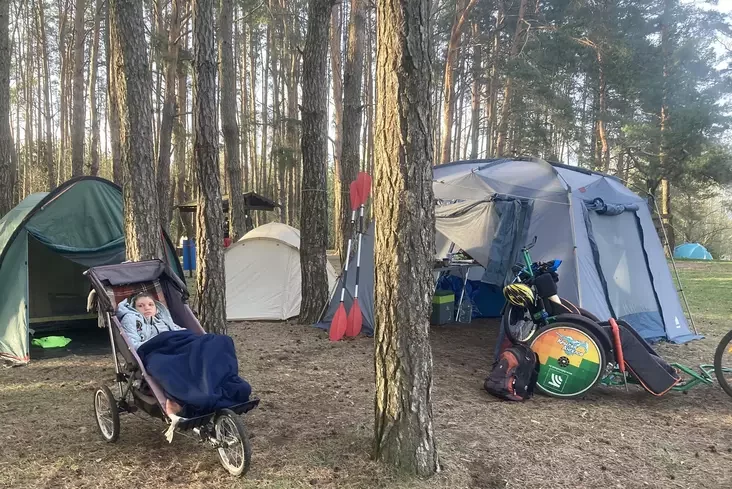
Photo: Dzmitry Tsimashkou's Facebook page
They spent months in the tent camp — from spring until the frosts, for several years. In winter, they moved to an apartment or dacha, and in spring, they returned.
In Dzmitry's posts, this is described as a "Robinsonade" and "Diogenes' life."
Tsimashkou emphasized that for living in nature, it's important to use resources wisely. In one of his posts, he wrote that he considers a daily water consumption norm of 100 liters a luxury; he and Liliya need 20 liters of water. Plus 4 liters of diesel fuel and 4 liters of gasoline per day for heating and lighting, as well as 4 bundles of firewood for a bonfire. A 5-liter gas cylinder lasts a week. Everything needed must be delivered by bicycle from the nearest gas station.
In his posts, he noted that life on the shore with Liliya became a true "school of life" — they learned to put up with mosquitoes, winds, rains, beavers, and seagulls and feel freedom despite the lack of usual comfort.
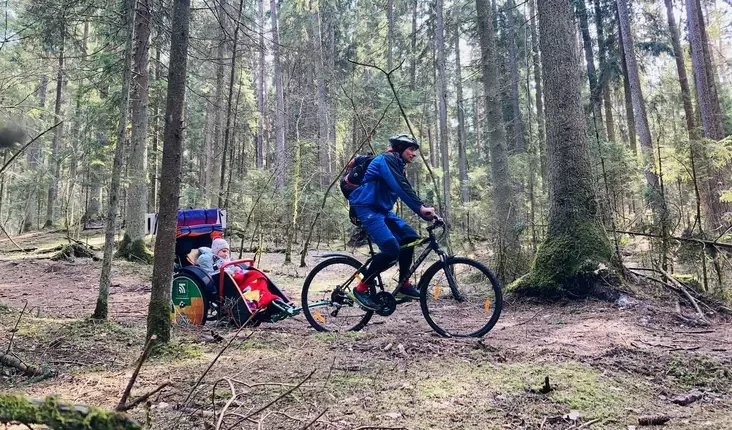
Photo: Dzmitry Tsimashkou's Facebook page
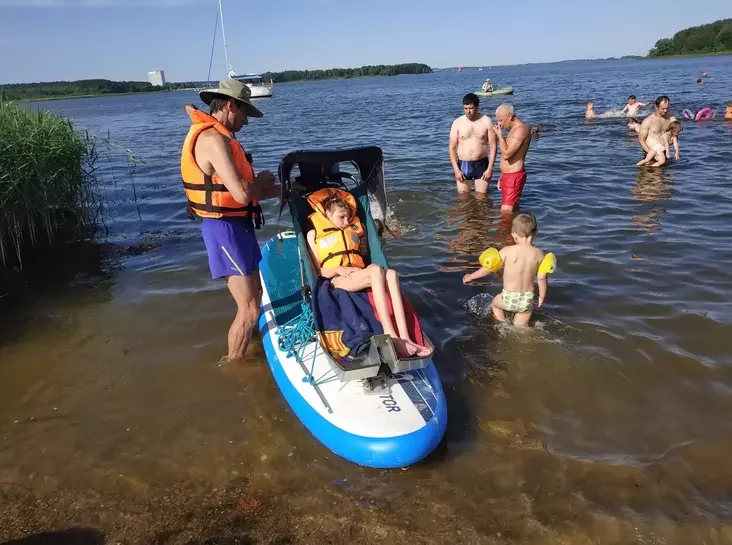
Gradually, an infrastructure grew around this life. A campsite appeared on the same beach, where one can rent tents, stand-up paddleboards, bicycles, trekking chairs, special wheelchairs for people with disabilities, children's quad bikes, and buggies. Summer camps, quad safaris, inclusive hikes, and picnics began to be held here.
The gazebo rental website states that on the 9th beach of the Minsk Sea, the "Wigwam Gazebo" is available for rent — an Indian tent with an area of 25 m², a bonfire, and electricity, next to which is a floating sauna on a pontoon — the "Fisherman's House," also available for rent. All of this belongs to Tsimashkou's legal entity.
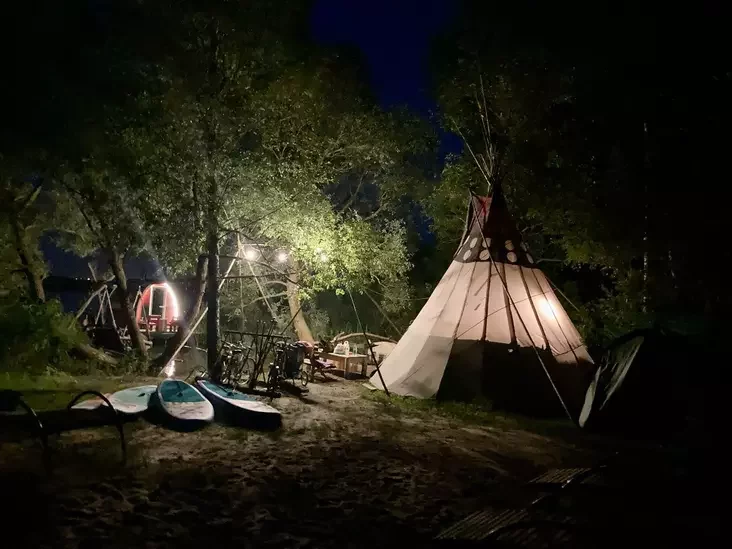
Indian tent

Floating sauna. Tsimashkou plunged into an ice-hole with Liliya. Photo: Dzmitry Tsimashkou's Facebook page
Dzmitry also wrote about other earnings. For example, that he works part-time as a lumberjack.
For the past two years, Dzmitry Tsimashkou has been less active on social media and his blog. He rarely talks about how he lives today, what is happening with him and Liliya, or whether the "Robinsonade" on the shore continues.
Tsimashkou's last activity online was searching for a caregiver for a disabled woman in Loshytsa. He distributed such an advertisement in metropolitan job search chats.
Now reading


A monument to pilots Nichyparchyk and Kukanenka was erected near St. Sophia in Polotsk. But not even a plane of the model on which they died, but a Stalin-era airplane


Comments