


Smolensk Residents Recall Their Unique Words. Their Russian Language Has Much More Belarusian Than the Russian Language in Belarus
A local blogger asked her non-local boyfriend to guess the meaning of Smolensk words — in the comments, Smolensk residents contributed a whole dictionary of unique vocabulary that they hadn't heard anywhere else in Russia. Some words are known throughout Belarus, but many can only be heard on its eastern fringes.

Photo: Wikimedia Commons, collage "Nasha Niva".
In the video, the blogger suggested guessing just five words: murlýchka (pub), turlý (remote outskirts), charópachka (container), hrúli (scattered items), and siorbats. The guy from Moscow guessed almost nothing, except for the word siorbats, which he had heard somewhere before. Belarusians, however, don't need it explained.
But the real discovery awaited in the comments. Smolensk residents, picking up on the theme, began to offer hundreds of their unique words that they had heard since childhood.
We analyzed over a hundred such units and compiled an impressive dictionary, which, to be honest, we hadn't even hoped for.
It turned out that what today's Smolensk residents consider their local Russian exoticism, for a Belarusian, is either a living Belarusian literary language or vocabulary well-known in Belarusian folk dialects, especially eastern ones — in the Vitebsk and Mogilev regions.
Why is there more Belarusian in the Russian language of Smolensk residents than in the Russian language of Belarusians in Belarus?
Embarking on writing about Smolensk's peculiarities, we by no means expected that the result would be a whole dictionary with over a hundred entries, in which the absolute majority of words are Belarusian vocabulary.
This fact makes one wonder: how have these words been preserved to our time in the speech of people who have lived in another state for a century and consider themselves Russian?
Belarusians in Belarus also have a number of their own peculiarities in the Russian language. Sometimes it's even suggested to distinguish a separate Belarusian variant of the Russian language. But compared to Smolensk residents, our "variant" looks very modest.
We have only a few Belarusianisms that everyone knows like the "Our Father": shufliádka, bús'ka, dziúbka, zhménia, baíka. This is too little for a separate linguistic variant — essentially, it's pure literary Russian with a dozen insertions.
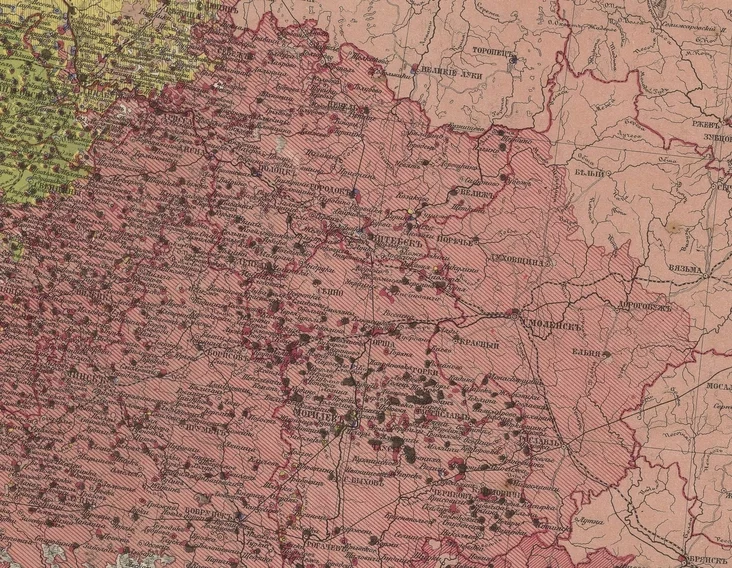
Belarusians occupied the entire western part of the Smolensk Governorate on the "Ethnographic Map of European Russia," compiled in 1875 by Russian cartographer Alexander Rittich based on materials from the all-Russian revision of 1858, lists of settlements from the 1860s, and other statistical data.
Why then can Smolensk residents recall many times more of their own words? It seems the answer lies in the fact that they consider themselves Russian, and their language and the language of their ancestors — Russian. Although ethnography suggests otherwise, they simply had no chance for another self-identification. After Smolensk was not returned to Soviet Belarus in the 1920s due to political and formal economic reasons, the beginnings of Belarusian affairs and schooling there were completely curtailed. From the mass of "locals" with an unclear national self-consciousness, "Russians" were easily molded with their special "Russian dialect."
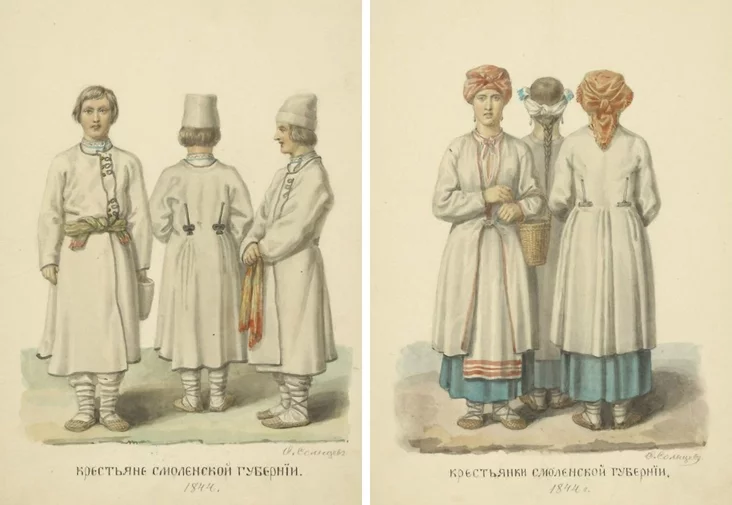
Peasants (male and female) of the Smolensk Governorate. "Clothes of the Russian State", 1844
If a hundred years ago, the same Belarusians lived on both sides of the border, now on one side live Russians, and on the other — Belarusians, who, in terms of Russification, have already caught up with their Smolensk brethren. But there is one fundamental difference.
Belarusians, however, know that they have two languages, and therefore, when using Russian, they carefully remove everything that seems Belarusian, so as not to be seen as collective farmers mixing two languages into trasianka (a Belarusian-Russian mixed language).
As a result, the Russian language of Belarusians has been purified to a sterile literary standard.
This same filter harms the Belarusian language too: we often discard ancient words from it because they seem similar to Russian ones. Fearing to be seen as ignorant, we replace them with Polonisms, Ukrainisms, Anglicisms, or neologisms, just to avoid letting an insidious (and often imaginary) Russicism into the Belarusian language.
Smolensk residents don't have this barrier. They sincerely believe that they have always had one language — Russian. This means that all these hanki, dranchuki, and torkats are also part of the Russian language, which doesn't need to be filtered in everyday life.
And so a strange situation arises: Belarusians in Belarus turned out to be more Russified than Smolensk residents, because they cleansed their main, Russian, language of all signs of Belarusian, which they know but rarely use. Meanwhile, in the Smolensk region, Belarusian vocabulary lives on under the guise of a local dialect, and no one shuns it.
Glossary
A
Abápal (written as obapol) — its meaning was not revealed in the comments (this note will be omitted in further such cases). A common Belarusian word meaning 'on both sides'. In Smolensk dialects, it can also mean 'edge, end of something'.
Abstrykácca / Abstrúkacca — in the comments, these words were explained as 'to be stung by nettles'. The word is known in dialects over most of Belarus, but for some reason it is not included in modern dictionaries; however, abstrykáts can be found in dialect dictionaries and in Baykou and Nekrashevich's pre-war dictionary (1925).
Adslínits (written as otslyunit') — its meaning was not revealed in the thread. This is an expressive colloquial Russian word meaning 'to count out (usually money), wetting fingers with saliva'.
Apliavúha — 'a slap on the cheek'. The word is known in both Belarusian and Russian.
Atkúl — the same as Belarusian adkúl 'from where'.
B
Biélmy — in Belarusian, bialmó is not only 'a whitish spot on the cornea of the eye', but in the form biélmy it can also denote 'eyes' in general: "vylupits bielmy" (to pop out one's eyes).
Bólka — 'a sore/wound'. In Belarusian, this is a literary word meaning 'a purulent or inflamed sore, ulcer, scab'.
Bómkats — commentators explain it as 'the speech of a drunken person'. The word is common to Eastern Slavs; in Belarusian, in a figurative sense, it means a close 'to mumble'.
Bruzhmiél — the Belarusian name for a bushy plant with fragrant multi-colored flowers, instead of the Russian zhímolost' (honeysuckle).
Búbka / Búbki — in the comments, they explain it as 'shelled sunflower seeds'. In literary Belarusian, the words búbka or bóbka also mean 'a single grain, seed'.
Bubniéts instead of the literary Russian bubnít'. In Belarusian, both variants — bubniéts and bubníts — are normative and synonymous.
Burák — instead of Russian svyokla (beetroot). The only name in Belarusian for this root vegetable, but such a variant is also found in Russian dialects.
V
Viaziónka — a dialectism in Russian, which is widely recorded in Belarusian dialects with the meanings 'knitted mitten (often fingerless)', 'knitted sweater', etc. The Belarusian literary viázanka means any knitted item. The word viaziónka is also known in the Bryansk region.
Výspiatak — a regional, but virtually literary Belarusian word meaning 'a kick'. "Dats vyspiatka" — 'to kick (strike) with the foot'.
H
Hálachki / Halýshki — in the comments, they explain it as 'potatoes boiled whole'. In Belarusian, hálachki is a diminutive of hálka, which means the same as halúshka — 'a dish in the form of dumplings made from grated potatoes or flour, boiled in broth or milk'.
However, the word halúshka is found in all neighboring Slavic languages, while hálka is only in Belarusian. In the Mstsislau region, adjacent to Smolensk, 'boiled whole potatoes' are also called hálkami.
Halén — 'a worn, bare broom; a twig'. In the meaning 'a whisk, broom', the word is known in the Mogilev and Vitebsk regions.
Hamaníts — in the comments, the word was explained as 'to talk', while there was a debate about whether it is exclusively Smolenskian. A literary Belarusian word meaning 'to speak, converse', and also 'to speak loudly (usually of many)'.
Hánki — in the Smolensk Regional Dictionary, compiled by Vladimir Dobrovolsky and published in 1914, this word is recorded with the meaning 'porch, steps'. There is a clear connection to the Belarusian word hának with the same meaning, which has been known in Old Belarusian written tradition since the 16th century.
Hlázy — in the Vitebsk region, the word hlazó is found, most often used in the form hlázy and meaning 'eye': "Hlaxy mnie vysciebaish" (You'll poke out my eyes), "Hlazy mae uzho nie hladziats" (My eyes no longer see).
Hréki — according to the Dictionary of Smolensk Dialects, these are rubber shoes (like galoshes) of homemade manufacture. The word is not recorded in Belarusian dictionaries.
Hrybý (with fricative "h") — in the comments, they explain it as 'lips': "Paidu hryby namazhu" (I'll go put on lipstick). This figurative, often jocular meaning, is well recorded in dialect dictionaries of northeastern Belarus, for example, in the "Vitebsk Regional Dictionary" (1927) and the "Regional Dictionary of Eastern Mogilev Region" (1970).
Such a substitution became possible due to historical processes in the Belarusian language: originally, mushrooms were called by the word huby (lips). Later, when the main name became hryby (mushrooms), a reverse transfer occurred: the new name for mushrooms began to be used to denote lips. Direct interchangeability is also visible in Belarusian phraseology, where expressions "naduts hryby" (to pout one's lips) and "razviesits hryby" (to hang one's lips open) exist.
Hukáts — in the comments, the word is noted as "Belarusian/borderline." A literary Belarusian word meaning 'to call, summon someone' or 'to speak loudly, shout'.
Hútarits — a literary Belarusian word meaning 'to converse, have a conversation'.
D
Dranchúk — 'scrambled eggs'. The word is well documented in dictionaries of Smolensk dialects, starting from V. Dobrovolsky's Smolensk Regional Dictionary (1914). It is specified that this is scrambled eggs prepared with lard or butter, often with added milk and flour. In Ya. Stankevich's Belarusian dictionary, it is given as a regional word with the meaning 'scrambled eggs in a pan'.
Z
Zahlumíts — used in the expression 'zahlymila halavu' (my head is 'overwhelmed') in the meaning of a state caused by a noisy, active child, from whom one's 'ears ring'. This meaning directly continues the sense recorded in I. Nasovich's Dictionary of Belarusian Speech (1870), where zahlumíts means 'to take away memory, to deprive of attention'.
Zahniótka — a dialectal name for the area in front of the mouth of a traditional stove; the literary Belarusian equivalent is prýpiechak (hearth bench). The name comes from the verb zahnestsi (to preserve embers), as hot coals were kept on the zahniótka to quickly rekindle the stove. The word is well recorded in dialect dictionaries of the Belarusian-Russian borderland, particularly in the dialects of the Vitebsk and Mogilev regions. The Vitebsk Regional Dictionary (1927) also records a figurative meaning — 'a stingy person'.
Zaklíoknutsa — in the dialects of the Bryansk region, the form zaklíoknuts means 'to harden, become dense' (about something liquid or viscous, e.g., porridge, fat). In literary Belarusian, zakliáknuts means 'to become numb, stiff' (about body parts from sitting too long or cold).
Zátauka — the Belarusian name for a seasoning (dressing) made from pork fat, which is usually pounded or finely chopped. The word comes from the verb zatauchí (from tauchí — 'to crush'). Also recorded in the Bryansk region.
Zaŭchóra — in the comments, the meaning was explained as 'yesterday', but in Belarusian, this word means 'the day before yesterday; two days ago'. The same meaning is recorded in the Dictionary of Smolensk Dialects.
Zbrez' — 'to the brim'. This word, meaning 'so full that it overflows', is recorded in Belarusian dialects of the Mstsislau region.
Zharóda — in the comments, it is explained as 'a large and clumsy (woman)'. This figurative meaning comes from the primary meaning in Belarusian — 'a fence, a palisade of poles'. Both meanings are well recorded in dialect dictionaries of both Smolensk and Vitebsk and Mogilev regions. V. Dobrovolsky's Smolensk Regional Dictionary (1914) also gives the word zharoda as both 'fence' and a derogatory word for an awkward, clumsy person.
I
Ispótki — 'mittens' (varezhki). The word is recorded in the Vitebsk, Mogilev, and central regions of Belarus. It comes from the phrase ispodniya rukavitsy (under-mittens), because originally it referred to knitted mittens worn under others, usually leather or sheepskin.
K
Kaziúlka — 'stool'. A dialectal Belarusian name for a small wooden bench, known in the Vitebsk region. The name likely comes from the word kaza (goat) due to external resemblance.
Karkúshki (in the expression "na karkúshkakh") — in Belarusian, the expression "niestsi na karkúshkakh" means 'to carry on one's shoulders'.
Kvakúkha — in Belarusian, kvakukha or kvaktukha is a hen that sits on eggs or leads chicks.
Kízhly — in Belarusian dialects, this is what legs are called: "Ledzve kizly z liesu pryciahla" (She barely dragged her legs from the forest).
Kórchyk — The word is recorded in V. Dobrovolsky's Smolensk Regional Dictionary (1914) and I. Nasovich's Dictionary of Belarusian Speech (1870) with the meaning of a diminutive of karéts. Karets is 'a scoop, a small vessel for bulk substances or liquids'.
Kósmy — in the comments, the word was used in the phrase "kosmy svaje zapliatsi" (braid your hair) meaning 'hair', usually with the nuance of 'unkempt, disheveled'. This is a literary Belarusian word meaning 'strands of hair, usually tangled, disheveled'.
Kukíshka — in the comments, it was noted that "many are surprised by this word." According to the Dictionary of Smolensk Dialects, it is 'hair gathered in a knot at the back of the head'. The word is not recorded in Belarusian.
Kúksa — 'a bun on the head'. A literary Belarusian word meaning 'a type of women's hairstyle: hair twisted into a roll at the back'.
Kurúkha — according to the Dictionary of Smolensk Dialects, the same as a hen-kvaktukha.
L
Lapéshka — according to the Dictionary of Smolensk Dialects, this is how a wooden scoop, bowl, or even a spade-like shovel is called. The word is also recorded in the Vitebsk region, with meanings 'part of a spoon without a handle'.
Lústa — in the comments, explained as 'food to take along, usually taken to the field'. A common Belarusian word, but exactly this meaning is recorded only in northwestern Belarusian dialects.
Lústachka — 'a piece of bread'. A Belarusian word, diminutive form of lústa.
Liásik — emoji explains the meaning of the word as 'bicycle'. This is a common colloquial Belarusian name for a bicycle.
M
Máltsy — 'boys'. It was especially noted in the comments that this word is paired with dziewki ("есть девки, а есть мальцы" - there are girls, and there are boys). A literary Belarusian word, especially common in northern dialects.
Mantúliki — in the dialects of the Homel region, the word mantúlik means 'cheesecake'. In general, mantuly in Belarusian dialects mean 'sweets, delicacies'. In the neighboring Bryansk region, the verb mantúlitsya is recorded — 'to love tasty food, to feast'.
Murlýchka — 'pub'. In the Dictionary of Smolensk Dialects, the word is recorded with the meaning 'a dirty, untidy room': "U mianie khata, kak murlychka kykaya…" (My house is like some murlychka...). Commentators confirm the explanation given by the video's author, clarifying that a murlychka can be any establishment where alcohol is served, and even a place where "dad and the guys drink," for example, a garage. The word is not found in Belarusian dictionaries.
Mýtka — in the Mogilev region, the word means 'a rag for washing dishes', and also 'a false, cunning woman'.
N
Nadýs' / nadóysia — 'recently, the other day'. Completely corresponds to usage in Belarusian dialects. In the Homel region, the word nadýs' can also mean 'now', and nadóyas' — 'yesterday'.
Namuliaváts (in the expression "namulyavats hryby") — 'to put on/paint lips'. An obvious variation of the Belarusian literary namaliaváts.
Nieŭkavýrnaya — a word widespread throughout Belarus, characterizing a person as stubborn, disobedient, and capricious.
Nietsialiópany — the word is formed, evidently, from the Belarusian literary tsialiapién', which refers to 'an awkward, clumsy person'. This word originated from the onomatopoeic root "tsialep/tsialop," which conveys the sound of falling.
Ní chápai — a variant of Belarusian nie chapai 'don't touch, don't take'.
Nikhái — a dialectal variant of the Belarusian particle niakhái ('let'). The form nikhái is recorded in the dialects of eastern Belarus, in the Mogilev and Mstsislau regions.
P
Padsóbka — its meaning was not revealed in the comments. Although this word can be understood in the general sense of 'utility room', this seems illogical. In Ya. Stankevich's dictionary, padsóba and its diminutive padsóbka are recorded with the meaning 'help'. In the Homel region, the expression "u padsóbku" means 'as help'. These words come from the completely literary padsóbits — 'to help a little'.
Palíohats — in the comments, explained as 'to try by weight', with the example "palíohai, yakaya sumka tiazhkaya" (try by weight, how heavy the bag is). In the dialects of the neighboring Mogilev region, palíohats means the same thing — 'to approximately weigh, by taking with hands'.
Partkí — although in literary Belarusian the normative form is pórtki 'trousers', the variant with stress on the second syllable — partkí — is widely used in colloquial speech throughout Belarus. The same form with stress on the last syllable (portkí) is also known in Russian.
Pasiekla — 'chopped up'. This meaning fully corresponds to one of the meanings of the literary Belarusian verb pasiachý — 'to chop into pieces, mince something'.
Pachápali (pochapali domoi) — in the comments, used in the meaning 'went', often with the nuance of 'slowly, unhurriedly'. The verb pachápats ('to walk slowly, with difficulty') is recorded in Belarusian dialect dictionaries, particularly in the Mstsislau and Mazyr regions. At the same time, the word is also present in colloquial Russian with the meaning 'to go, to set off somewhere'.
Pieshakhódnik — from the context, it is clear that this is a 'pedestrian crossing'. The commentator noted that the word is "quite modern" and causes confusion among residents of other regions. This is an original local formation, which exists neither in Russian nor in Belarusian. But it logically fits into the system of the Belarusian language, where the word khódnik ('sidewalk') exists, which is absent in literary Russian.
Práslav — 'a fence'. The word exists both in literary Belarusian, where it means 'a section, part of a fence or enclosure between two posts', and in Russian dialects.
Pratarkivats — not explained in the thread, but regional dictionaries explain it as 'to poke through'.
Prýtalka — a common Russian word meaning 'a lintel (crossbeam) between door jambs above a door'. The word is recorded in Belarusian dialect dictionaries, but the literary equivalent is — viarshník.
Pún'ka — 'pigsty'. In literary Belarusian, pún'ka is a diminutive form of púnia, which means 'a building for storing hay, a barn'.
R
Raháty — in the thread, the word was accompanied by an emoji indicating its meaning 'trolleybus'. Apparently, an original local formation.
Réli — 'swing'. Clear connection to the literary Belarusian word. In the form réli, the word is found in the dialects of eastern Belarus, particularly in the Mogilev and Vitebsk regions.
S
Sázhylka — a widespread form in Belarusian dialects of the literary word sázhalka, which means 'an artificial pond' or 'a fish pond'.
Sarakvásha — in Belarusian (also syrakvásha), this word denotes 'thick sour milk'.
Siéntsy / Siéni — in the comments, explained as 'a room before the entrance to the house'. The word is not unique; it exists in both literary Belarusian and Russian.
Sívy — 'blond'. The word is generally common Slavic, but in Russian, it is now rather bookish, while in Belarusian, it is the main word for designating white, silvery hair.
Skábka — a literary Belarusian word meaning 'splinter'.
Skaráda — 'a bore'. In Belarusian dialects, the word skaráda (or skáradz, skrénda) has the meaning 'a miser, a stingy person'.
Skíbka — a Belarusian literary word meaning 'a thin cut slice of bread'.
Skrýnka — a Belarusian literary word meaning 'a container, usually square, for storing something'. In Russian, the word is recorded in dictionaries but has become archaic.
Stadólishcha — the word is evidently formed from Belarusian stadóla ('a large stable, barn'). According to Belarusian word formation, such a form of the word can denote a place where a stable is or was located (compare with zamak (castle) — zamshchyshcha (ruins of a castle)). The name Stadólishcha is found as a toponym in the Vitebsk and Mogilev regions of Belarus.
Strykátsa — in Belarusian, nettles sting, burning the skin, and in a figurative sense, strykátsa can mean 'to say sharp words to someone'.
Stsirashka — 'eraser'. In Belarus, this school item is most often called stsiórka or stsírka.
Sudachok — 'container (for food)'. Diminutive of the word sudok, common to Belarusian and Russian, meaning a small vessel for dishes and sauces.
Súkaratki — in Belarusian, the word súkaratka refers to 'a twisted part of a thread, rope'.
Siónnya — a common Belarusian word meaning 'today'.
Siórbats — a literary Belarusian word meaning 'to eat liquid food or drink, slurping'.
T
Tavkáchyk — in Belarusian, this is the name for a short tool with a thickened round end, used to pound something.
Tórkats — in Belarusian, the word means 'to poke with short pushes', 'to tug on the reins, forcing a horse to go'. Words with similar meanings can also be found in Russian dictionaries, but with different markers.
Tórnuts — 'to plug a fork into a socket'. A Belarusian word, known over most of Belarus with the meaning 'to push, shove, poke'.
Trápila — 'it was lucky, fortunate'. Belarusian word trápits with the meaning 'to achieve something, to hit some target'.
Tróshki — a Belarusian word meaning 'a little, a bit, barely'.
Túiben' — in the form túieben', the word is common in the Mogilev and Mstsislau regions with the meanings 'fool, slacker, idler'. It may also be related to the word stúiben' 'fool, clumsy person', but the exact origin of the word is unclear.
Turlý — according to the Dictionary of Smolensk Dialects, the word has the meanings 'wilderness, uninhabited, remote place'. A synonym trúnda is also given. In Belarusian dictionaries, such a meaning is not recorded. The word turly and similar forms appear only as an onomatopoeia for the cooing of pigeons.
U
Urúchatsa — 'to get into, get stuck'. In the dialects of the Smolensk and Bryansk regions, the verb vryúkhatsya is used with the meanings 'to sit, lie down somewhere; to get into', and also figuratively — 'to fall head over heels in love'. In Belarusian folk vocabulary, urúchatsa is also known with the meaning 'to fall in love'.
H
Khaltymá / Khaltamá / Khaldá — in the comments, this word and its variants describe various aspects of untidiness and clumsiness. It was used in reference to an uncombed child ("yak khaltyma khodzish" - you walk like a mess), a very active, noisy child, or a scatterbrained, untidy woman. The word khalytamá is recorded in dialect dictionaries of northern Belarus, with the meanings 'an untidy, sloppy woman', 'a lazy person', and also 'a gossip'. The word khaldá has similar meanings: 'an untidy, crude woman'.
Khatúli / Khatúl — 'things, belongings'. "Khatuli sabrala?" (Have you gathered your things?). Commentators noted the Belarusian origin of the word and its prevalence even outside the region. In literary Belarusian, khatúl is 'a large bundle of things, tied in a handkerchief or sheet, carried on the shoulders'.
Khmýznik — a Belarusian dialectal word, found in the Mogilev and Vitebsk regions, a variant of the literary khmyzniák, which means 'thickets of bushes, small forest'.
Khrúli — 'scattered items'. The word has no direct equivalents in Belarusian dictionaries. However, a whole range of similar forms (khrul, khruli, khrulya) are recorded in Belarusian dialects, but with completely different meanings. At the same time, the words khrulli or khruli are also absent in the Dictionary of Smolensk Dialects. Instead, similar sounding and meaningful units are recorded there, for example, khrúny, khrunnyo — 'things', which are even known from Dal's dictionary, but not attested in Belarusian.
Commentators clarified that khrúli is the same as tranty and pliakhotski. The word pliakhotska is well known in the dialects of the Mogilev and Bryansk regions, where it refers to 'rags, tatters' and 'diapers'. The word tranty is common in Belarusian with approximately the same meaning.
Khústka — in the comments, it is noted that this is a Belarusian word. Indeed, for Belarusians, khustka is a generally accepted word that refers to a piece of fabric tied on the head, neck, or draped over the shoulders.
C
Tsikáts — a form of Belarusian tsiakáts 'to leave quickly, to run away'.
Tsubýlki / Tsyrbýlki / Tsyrbélki / Tsýbly (and other variants) — in the comments, a whole discussion unfolded around the meanings of this word cluster. Different forms have different, though sometimes similar, meanings depending on the locality and even family. Tsubýlki among Smolensk residents most often denoted 'plant stems', 'foliage, leaves removed' (e.g., potato haulm), in some — 'hard veins in cabbage leaves'.
All these words originate from the common root tsy-, which is associated with the concept of something long, thin, resembling a stick or a leg. This root and derived words were once dedicated a whole article in "Nasha Niva." In literary Belarusian, there is the word tsybúk ('stem'), and in dialects — a whole range of derivatives: tsybá ('long leg'), tsybáty ('long-legged'), tsybóŭie ('plant stems without leaves').
Tsukérka — in the comments, the meaning of this Belarusian word, which means a sweet confection, was explained by a direct translation into Russian.
Tsiúpki — 'a loaf in milk with sugar'. For Belarusians, tsiúpka is 'food made of kvass or milk and crumbled pieces of bread, crusts'.
Tsiurá (written as tyurya) — described analogously to tsiupki. For Belarusians, tsurá or tsiurá is a traditional dish made of crumbled bread in kvass or water with salt and onions.
Tselkavúkha — in the dialects of the Mogilev region, this is what scrambled eggs are called.
Ch
Chapók — 'lock, bolt' with the example "zakrytsa na chapok" (to lock oneself with a bolt). The word is common in eastern Belarusian dialects and refers to various types of simple locks: 'hook, latch', 'bolt hole in a latch'. In Old Belarusian, the word chepók could also mean a chain.
Charópachka — 'container'. It appears to be a transfer of historical meaning to a modern phenomenon. In Belarusian dictionaries, the word is well recorded, but with traditional meanings: charópachka is a diminutive form of charopka and means a small clay vessel, for example, a bowl, a cup, or a small pot.
Chkatsa — 'to wander, loiter on the street without purpose'. In the comments, it was noted that the word is also common in other regions and is not exclusively Smolenskian. This is likely a local phonetic variant of the verb níkats / níchkats, known in Belarusian dialects, with the meanings 'to hang around corners, walk aimlessly' and 'to wander idly', which completely coincide with the meaning of the Smolensk word.
Chúvai — 'bangs'. The word is not recorded in Belarusian literary or dialect dictionaries.
Chýslennik — 'calendar'. A dialectal name for a calendar, common in the dialects of the Vitebsk and Mogilev regions.
Sh
Shapórtatsa — a reflexive form of the Belarusian verb shapórtats — 'to create a rustle, a crackle, to rummage, search, sifting through things'. The word is onomatopoeic; it was formed to convey the sounds of rustling and crackling — shapor-shapor.
Sharókhatsa — a reflexive form of the Belarusian verb sharókhats — 'to stir, rake something out', 'to push, tug someone'.
Shkandýbats — a Belarusian word meaning 'to limp, walk with a limp'.
Shlun' (in the expression "nie trapi mae shlun'") — in the comments, the translation 'don't annoy me' is given. In the Dictionary of Smolensk Dialects, the word shlúnnya is recorded, meaning 'entrails'. The word shlúnnie has the same meaning in Belarusian dialects: "Tak vytsiaŭ, shto y shlunnie palioezla" (He hit so hard that his entrails came out).
Shlýndats — a Belarusian word meaning 'to wander, roam back and forth, from place to place without purpose, without a specific occupation'.
Shushláika — 'a small car'. Apparently, a modern neologism.
Yu
Yúshka — in Belarusian, the word has several meanings: 'a metal circle or square plate used to seal an opening in a chimney so that warm air does not escape', 'a dish of fresh fish with seasonings', 'gravy' or simply 'liquid in any dish'.
Ya
Yamshchyna — in the Dictionary of Smolensk Dialects, the word is explained as a place where coachmen (yamshchiki) lived. The word is not recorded in Belarusian dictionaries.
«Nasha Niva» — the bastion of Belarus
SUPPORT US


Comments
Пасля першых пар яе здзіўленне: дык гэта амаль тое як у нашай вёсцы гавораць!