


Ancient ground squirrels ate mammoth meat. Proof found in their droppings
In the permafrost of Canada's Yukon, scientists have found unexpected evidence of Ice Age life. Analysis of fossilized droppings from ancient ground squirrels showed that these small rodents fed not only on plants and seeds but also on the meat of mammoths, bison, and even saber-toothed cats.
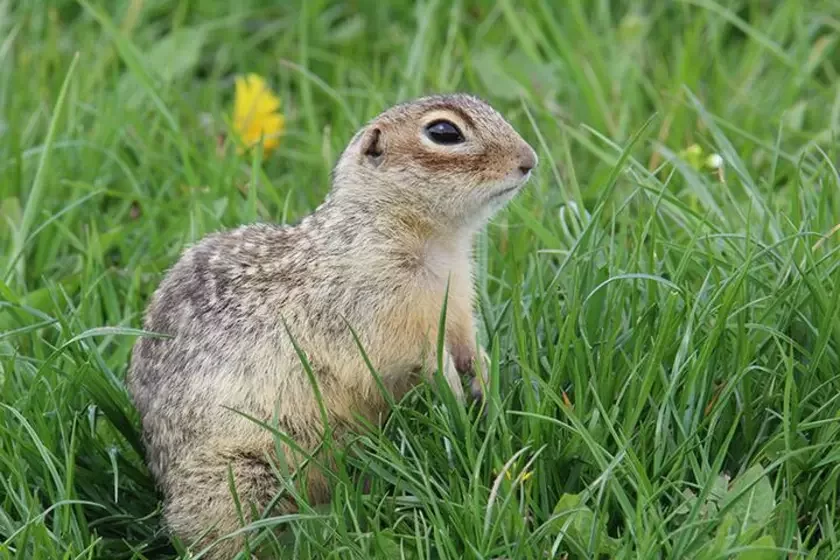
Spotted ground squirrel. Photo: Aliaksandr Vincheuski, wildlifebelarus.org
In the late 19th and early 20th centuries, when the Klondike region of Yukon, Canada, was gripped by the gold rush, prospectors constantly stumbled upon the remains of Ice Age animals in the frozen ground: tusks of woolly mammoths, bones of saber-toothed cats, and extinct giant bison.
However, among these impressive finds, other evidence of ancient life – the burrows and underground passages of ancient ground squirrels – remained almost unnoticed. Inside, thousands of pellets of frozen droppings were preserved. For decades, these deposits did not attract much attention, but they turned out to be a true treasure trove of information.
Today, with significant advancements in ancient DNA analysis technologies, researchers have been able to obtain unexpected data from these samples. *The New York Times* highlights the results of the work.
Obtaining genetic data from fossils is usually very difficult. Over time, DNA degrades, and many fossils undergo mineralization, where their original organic molecules are replaced by mineral deposits. Therefore, most ancient droppings, or coprolites, today resemble stone more than actual excrement.
But the ground squirrel burrows remained frozen and hermetically sealed for about 700,000 years. Thanks to this, their contents, including areas used as latrines, were preserved in unusually good condition.

Photo: research materials / nature.com
To extract samples, researchers had to use climbing equipment and pickaxes. From the icy slopes, they removed hundreds of pellets of droppings and delivered them to the ancient DNA Centre at McMaster University in Canada.
There, specialists dissolved the mineral and protein components of the samples to extract DNA remnants. As the authors mention, during chemical processing, samples hundreds of thousands of years old still had a characteristic, very intense odor.
But the main discovery awaited. Comparing the obtained genetic fragments with databases of modern and extinct species, scientists found DNA of plants, insects, and small mammals in the droppings. This was expected. However, alongside this, DNA of woolly mammoths, bison, reindeer, wolves, cougars, wild horses, and even saber-toothed cats was present.
Where could it have come from? Theoretically, ground squirrels could have eaten the droppings of other animals. But researchers consider another explanation more likely: the small rodents fed on the carcasses of dead animals, acting as scavengers.
While the image of a ground squirrel feeding on mammoth meat might seem strange, it's not such a surprise for biologists. Most rodents are not strict vegetarians. If seeds, nuts, or other plant foods are insufficient, they easily switch to animal food.
Modern Arctic ground squirrels are also known to scavenge. So, if a mammoth or bison carcass lay somewhere in the Ice Age tundra, small ground squirrels could use it as a valuable source of protein.
According to researchers, the study of coprolites allows for a much more complete view of the ancient ecosystem than animal skeletons alone. Bones tell who lived in that world, while analysis of droppings helps understand how these species interacted with each other and what they ate.
However, such evidence of the past may quickly disappear. Due to global warming, the permafrost of the North is gradually melting. Along with it, unique archives of ancient DNA, preserved in ice for millennia, are also being destroyed.
Therefore, scientists are in a true race against time, striving to collect as many samples as possible before the history of the Ice Age finally melts away.


Comments
гэта пісьменнае слова?