


In the XIII–XIV centuries, Navahrudak region figured in documents exclusively as "Ruthenian" or "Kryvichian" land, lying outside the borders of historical Lithuania. That Lithuania on the Neman, which Adam Mickiewicz would later immortalize in his poems centuries later, appeared here as a result of a massive resettlement of Lithuanian boyars, who brought their own law and became the main stronghold of Catholicism in this land.
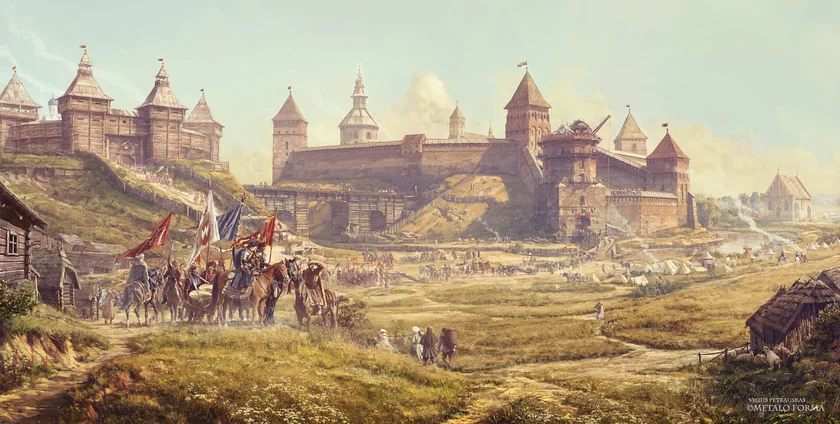
Reconstruction of Navahrudak castles according to Vilius Petrauskas. Photo: Metaloforma
The detailed history of this transformation was presented by Doctor of Historical Sciences Aliaksandr Hrusha. His open lecture, delivered in March 2026 in the Warsaw space "Rodzinna Europa", became the first video material on the newly created YouTube channel of the "Navahrastva" community. Relying on financial and judicial documents of the Grand Duchy of Lithuania, the researcher showed how exactly the Ruthenian land gradually became Lithuania.
From "Kryvichian Land" to Lithuanian Possessions
In documents in the Ruthenian language, as Hrusha rightly calls the Old Belarusian language, the city primarily figured as "Novhorodok", and its inhabitants identified themselves as "novhorodtsy".
In the second half of the XIII and in the XIV century, no sign of equality was placed between this territory and Lithuania. The historical concept of "Lithuanian Land" at that time was strictly limited to the interfluve of the Neman and the Vilija with political centers in Vilnius and Trakai. The southeastern border of this area ran along the line Vileyka – Maladzyechna – Valozhyn – Ivi︠e︡ni︠e︡ts – Stoŭbtsy, and the Neman itself served as the natural southern border. Navahrudak, located on the left, southern side of the river, remained outside this area.
The Ipatiev Chronicle directly separated these territories, mentioning the founding of a monastery by Vaišvilkas "on the river Neman, between Lithuania and Novhorodok". Peter of Dusburg, reporting on the Teutonic Order's campaign in 1314, Latinly records the direction of the attack as "ad terram Criwicie et civitatem illam, que parva Nogardia dicitur" (to the Kryvichian land and that city, which is called little Nagardia). For Lithuanians living on the right bank of the Neman, this was also "Ruthenian land", as confirmed by reports from the Sambian canon about the campaign "in fines Ruthenorum Criwicz".
Only from the last third of the XIV century did the designation "Lithuanian" begin to appear in relation to the city, primarily to distinguish it from Veliky Novgorod or Novgorod-Seversky.
But full integration of the region, or at least its northern part, is recorded later. A textbook example is a document from 1499, when the Grand Duke, considering a dispute of Lyubcha hunters, declared: "that throughout the Grand Duchy nowhere do noblemen's peasants have their hunts, and especially in Lithuania" (што ж па ўсім Вялікім Княстве нідзе панскія мужыкі ловаў сваіх не маюць, а найболей у Літве). And the discussion here was precisely about the territory subordinated to Navahrudak's Lyubcha.
Lithuanian Governance
The foundation of the new government was built on the economic and administrative subordination of the region. Integration began with the establishment and development of centers of governance for Lithuanian rulers – courts and manors – in the Navahrudak region from the second half of the XIII century. In the so-called Lithuanian road guide of the late XIV – early XV century, Dzyalyatsichy is mentioned (as the place where the Navahrudak land begins), and by 1401, the princely manors of Vialikaje Astashyna, Maloje Astashyna, Senna, and Raytsy are recorded.
It was through this network of state manors that the new tax system was implemented. Its main element was "dzyakla" (Lithuanian: doklas) – a rye and oat tribute that went to maintain the garrisons of local castles.
The researcher points out that this tribute was absolutely uncharacteristic for Ruthenian lands, and its long preservation of an exclusively Lithuanian name proves that it was established even before Lithuanian princes underwent significant acculturation by Ruthenian (Old Belarusian) culture.
Navahrudak region was drawn into a tax model that Lithuania had previously developed in Anishkiany, Astryna, Ashmyany, Biarštai, Vasilishki, Veliuona, Valkininkai, Vysoky Dvor, and other counties (before the reform of 1565–1566, the terms "volost" and "county" were often synonyms). Interestingly, over time, the Navahrudak region acquired its own tax specificity: only here was an elite wheat dzyakla also collected.
Import of Elites
Reflecting on the reasons why the Navahrudak land eventually came to be called Lithuania, Aliaksandr Hrusha links it to the resettlement of a significant mass of Lithuanian boyars who came here with Lithuanian princes. The number of these owners and their possessions actively grew during the times of Sigismund Kęstutaitis and Casimir.
The replacement of the elite occurred through the direct transfer of local lands to the ruler's confidants. As documents show, Jan Niamira, who held the position of koniuszy (master of the horse), already owned the Usielyub manor in 1422. In 1433, Grand Duke Sigismund Kęstutaitis re-gifted this same Usielyub, as well as Vieraslava, Charnikhava, and Liakhovichi, to his son Andrei. The process of large-scale redistribution was continuous: in 1434, Piotr Sienka Hiedyhołdavich received the Mir manor from the Grand Duke, and Piotr Rachak Stratsevich secured possessions in Palonka and Suliatsichy.
Many of the Lithuanian boyars settled in the Navahrudak region in compact groups. Their presence is still recorded in the names of settlements in modern Baranavichy and Karelichy districts: Vysadavičy, Tratsevičy, Juravičy, Petkavičy, Skrobava, Zadzieja. According to the 1528 Grand Duchy of Lithuania Army Census, representatives of Lithuanian Catholic families among small landowners here comprised about a quarter of all enumerated persons (at least 60 out of about 260 people).
Their origin is directly indicated by old Lithuanian, non-Christian names, patronymics, and nicknames: Voin, Yaksha, Hrytanavich, Zhybartovich, Vanibutavich, Liumantovich, Rymshych, Myzhaўlavich, Mastvilavich, Yuraha. The same origin is evidenced by forms of Christian names characteristic of Catholics: Jan, Patska, Yushka, Yakub, Stanka, Matskavich.
To the lands of these lords, a model of special law was transferred, to which these lords were subject and which was known from sources as "Lithuanian law". The local population and neighbors had to reckon with the exclusive rights and influence of the new elite. As a result, the Navahrudak land became, as it were, a continuation of the neighboring Lithuanian land.
Churches as Markers of Lithuania
The change in the ethnic composition of landowners naturally redrew the confessional map. Although some of the first Lithuanian boyars might have adopted Orthodoxy, a stable Lithuanian identity gained support after 1387, when Lithuania and Lithuanians adopted the Catholic faith. Already during Vytautas's reign, a parish church was founded in Navahrudak, where the wedding of Władysław Jagiełło and Sophia of Halshany took place.
The new Lithuanian aristocracy actively marked its presence by funding parish churches. A striking example is Palonka (now Palanechka), where in 1437, in the possessions of Rachka Stratsevich, a church was founded, which quickly acquired an exceptional status, becoming one of the most revered Catholic centers of the entire Navahrudak land by local Catholic boyars of Lithuanian origin.
The acts record an interesting phenomenon: large groups of boyars who made donations to this Catholic church or acted as witnesses bore names more characteristic of Orthodox individuals: Bahdan, Ivashka, Nekrash, Pron, Sienka, Khvedka, Khodka. However, Aliaksandr Hrusha emphasizes that these were unequivocally Lithuanian Catholics. Their patronymics and nicknames irrefutably attest to this.
The form of a name itself is not always a reliable marker in determining religious affiliation, and the presence of Slavic names should not obscure the fact that the Lithuanian boyar elite was precisely the stronghold of Catholic culture in the region.
«Nasha Niva» — the bastion of Belarus
SUPPORT USNow reading


On the day of the start of the St. Petersburg Economic Forum, the AFU launched a dozen strikes on an oil terminal in the city's port and the Baltic Fleet base in Kronstadt


Comments
Дзякла - доклас непераканаўча, я ведаю шмат словаў на "д".
Паўстае пытанне, колькі на той час ўвогуле было літоўцаў на усёй зямной кулі, каб не бракавала баярынаў засяліць, каланізаваць і набудаваць велічных касцёлаў?
Чаму паганскія імёны апрыёры сталі чыста літувіскімі?
Калі летувісы прынялі хрысціянства настолькі, каб баярыны забудоўвалі касцёламі іншыя землі?
І гд.
І гд.
І гд.
Кава астыне, пакуль распішаш відавочныя касякі.