


Belarusians Ironize over Interview of Former Head of Polish Intelligence
Piotr Krauchyk stated that Lukashenka is the guarantor of Belarus's independence and that negotiations are necessary with him. He also questioned whether the Nexta channel worked for Russia. And he recounted what the head of the Belarusian KGB told him in 2019.
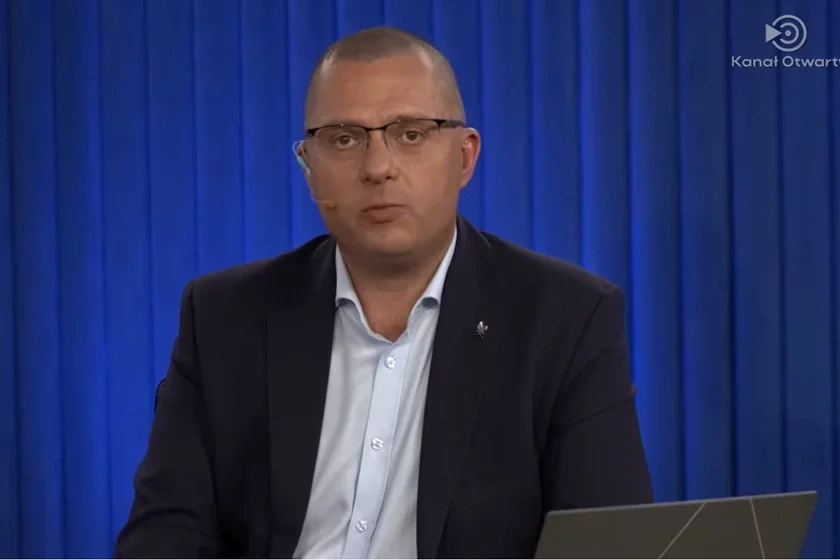
Colonel Piotr Krauchyk, who headed the Polish Intelligence Agency (Agencja Wywiadu, AW) from 2016 to 2022, recently launched his own blog, "Seventh Floor," on a Polish YouTube channel. The first episode was dedicated to Belarus.
At the very beginning, Krauchyk stated that the release of Andrei Pachobut "fits into a very long, already more than ten-year history of efforts that Poland, together with its allies, has made to increase Minsk's room for maneuver in relation to Russia."
The former head of Polish intelligence argues that the process began in 2010, when former Foreign Minister Radosław Sikorski, together with the then-head of Polish intelligence General Maciej Hunia, "carried out various actions that were intended to lead to the expansion of Belarusian sovereignty, so that it would become somewhat larger in relation to Russia, at least to some extent."
However, these efforts "did not bring full success" in the first years. The situation, according to the colonel, changed after 2016, when Russia introduced a tax maneuver, which led to an increase in hydrocarbon prices for Belarus.
According to him, since 2017, the leadership of Belarus "began to open up more and more to contacts with the West, including with Poland." The USA was also successfully brought into the dialogue in 2017-2018.
"Belarus is a sovereign state, regardless of the fact that President Lukashenka, who currently guarantees this sovereignty, uses it to strengthen his own position and, of course, to enrich the people around him. But still, it is President Lukashenka, regardless of what we think of him and how we treat him, who is the guarantor of Belarusian sovereignty in the form in which it currently exists," —
the colonel expresses his opinion and lists facts that, in his view, indicate that Belarus was genuinely moving towards the West for several years before the 2020 elections.
For example, in February 2020, KGB head Valer Vakulchyk attended the Munich Security Conference. And in June and July 2020, two shipments of American oil were delivered to Belarus via Klaipėda, in which the Polish company Unimot also participated.
"Thanks to this oil, we created a prospect whereby Belarus could become less dependent on Russian oil," Krauchyk argues.
The 2020 Elections
However, according to the colonel, "the August 2020 elections came," which "Lukashenka could have won without falsifications, albeit at a much lower level." But "after the elections, hundreds of thousands of people took to the streets of Belarusian cities, towns, and villages." As a result, in Belarus, "the dialogue with the West collapsed, and the entire dynamic completely changed." According to Krauchyk, Russia was behind the protests.
"I want you to understand: the Belarusians with whom we were in contact in 2019 and earlier already knew in March 2019 that the Russians would try to disrupt this dialogue between Belarus and the West.
In March 2019, my Belarusian colleague, the head of the KGB, openly stated that, according to their assessments, the Russians were preparing to provoke protests during the 2020 elections that could lead to bloodshed.
The Belarusians told us that this spilled Belarusian blood, which they did not want, could severely interrupt this dialogue. They tried very hard to prevent bloodshed."
The former head of Polish intelligence claims that "part of the protest manipulations came from Poland," but the special services did not notice them. He draws attention to the Nexta channel:
"At a certain point, this channel began transmitting non-public information that originated from many Belarusian institutions: from the army, from the police, from various security structures — about how Lukashenka's regime intended to suppress possible protests after the 2020 elections.
I pose the question, as I have no direct evidence that these young people were connected with Russian special services, but I ask: could the Russians not have deliberately transmitted this information to them in order to create certain tension, to build a certain anxiety among Belarusians?"
According to Krauchyk, even under conditions of frozen dialogue between Minsk and the West, contacts between Polish and Belarusian special services were maintained. Thanks to them, three arrested Polish language teachers were released in May 2021. But before that, in March, Andrei Pachobut was imprisoned.
As Krauchyk claims, around the same time, the Belarusian side offered to hand over the journalist to Poland on the condition that he would not return to Belarus. However, Pachobut refused.
"On the one hand, this is a very heroic stance, but on the other hand, Belarusians also realized that the presence of Andrei Pachobut, a symbol of Polishness and Polish-Belarusian relations, in a Belarusian prison would be an element that severely deteriorates Polish-Belarusian relations. Their desire to transfer Pachobut to Poland, it seems, was dictated precisely by this understanding," Krauchyk explains.
Krauchyk then reflects on the migration crisis, when migrants from Africa and the Middle East stormed the Polish border. He agrees that the crisis was initiated by the Belarusian authorities, but immediately finds an justification for it: allegedly, Belarusian oppositionists were in Poland who publicly spoke about their desire to overthrow Lukashenka.
"Belarus is not a closed topic. Belarus is a task for the Republic of Poland, for Polish politicians, Polish special services, Polish institutions, and Polish diplomacy. We must continue to strive for Belarus to be as independent as possible and to have as wide a field of maneuver as possible in relation to Russia," —
Krauchyk argues, and cites the 2020 protests and Lukashenka's refusal to send the Belarusian army into Ukraine as examples of the striving for independence.
Separately, the former head of Polish intelligence mentions the late Uladzimir Makey, who "died under unclear circumstances." Krauchyk himself believes that "these were not entirely natural circumstances."
According to Krauchyk, there are many people like Makey in Belarus, but "it is still too early to name all the names."
Belarusians Skeptically Received Piotr Krauchyk's Video
"This is an absolute sensation," ironizes Dzmitry Hurnevich, a journalist for Radio "Svaboda," regarding the statements of the former head of Polish intelligence. "There are wonderful people who have illusions that even after 32 years of Lukashenka's pro-Russian policy, it will be possible to pull him away from Russia."
Regarding the suspicions expressed by the Polish colonel towards Nexta, Hurnevich scoffs:
"One wants to ask Krauchyk himself, who led Polish intelligence during the protest year in Belarus: couldn't you have checked this yourself? The Nexta editorial office was in Warsaw at an address known to everyone who knows how to use the internet. Did Polish intelligence really not know it?"
Former Belarusian diplomat Pavel Sliunkin also sarcastically remarks: "It turns out that the Belarusian authorities were more afraid of allowing Andrei Pachobut to stay in Belarus than of the country's further absorption by Russia."
IT specialist Jury Sidun notes that the former head of Polish intelligence's reasoning lacks a conclusion within his own logic: "They wanted to give us Pachobut to avoid spoiling relations with Poland. But Pachobut was against it. Therefore, Pachobut worked for Russia."
Blogger and former political prisoner Ihar Losik briefly remarks: "I have bad news regarding the competence of this head of Polish intelligence."
Belsat journalist Zmitser Mitskevich commented even more sharply: "If such a 'cake' (meaning 'dude' or 'idiot' in this context) headed a special service for SIX YEARS, then I have very bad news for Poland."
Natalia Kalegova spoke about helping Belarusian refugees, her family, her attitude towards Tsikhanouskaya. And explained who "beavers" and "hares" are

Natalia Kalegova spoke about helping Belarusian refugees, her family, her attitude towards Tsikhanouskaya. And explained who "beavers" and "hares" are


Back to pen and paper and smartphone ban: universities are forced to change the format of classes and tests, otherwise AI prevents both teaching and assessment


Comments