


Five days, 60 participants, sauna, billiards and shouting at each other. We tell you how the closed "Matskevich's game" went
Knyrovich was "crucified," but he says he enjoyed it.

Uladzimir Matskevich
Five days in an expensive hotel in the Polish Tatras, more than sixty participants, working groups, plenary sessions, lectures by Uladzimir Matskevich, heated arguments, evening talks in the bar, sauna, billiards — and a big question at the end: did "Matskevich's game" become the beginning of a new strategy for Belarusian democratic forces or simply an expensive retreat?
On May 2, the five-day organizational-activity game, initiated by methodologist and former political prisoner Uladzimir Matskevich, ended. Some participants shared enthusiastic impressions on social media, but to the simple question "what exactly happened?" and what were the results, they answered vaguely and mysteriously: "it's hard to explain," "those who didn't play probably won't understand."
Uladzimir Matskevich speaks cautiously but confidently about the result: the game "is already working." The participants we spoke with are more reserved. They talk about the benefits for themselves, new contacts, and the fact that people finally got to talk face-to-face, not on Facebook where everyone insults each other. But the main thing that was expected from outside — a common strategy or action plan — is not there after the game.
Everyone says something happened. But what? We figure it out with those who were there.
Not a conference, not a seminar, and perhaps not even a game
Formally, it was called an organizational-activity game. Its stated topic was the search for a strategy to launch and manage transformation processes in Belarus. But the participants themselves say: there was almost no "game" there.
The practical part of the game was built around group work. Initially, according to Matskevich, the groups were formed according to his plan: for three days, participants worked in assigned roles and frameworks to "enter the problem field."
Blogger and activist Mikalai Dziadok describes the format as a mix of brainstorming, seminars, discussions, and lectures.

Mikalai Dziadok in Vilnius, September 14, 2025. Photo: spring96.org
"More than 60 of us gathered, and everyone broke into groups. First, these were groups discussing the theoretical framework of the problem: some acted as stakeholders, others as beneficiaries, and still others as evaluators. Each group had a game technician who set the framework for the discussion. Group work alternated with Matskevich's lectures and general sessions where everyone presented their reports," Dziadok recounts.
He adds that he didn't particularly see a game element; rather, it was intensive group work where people tried to understand where everyone was heading.
Anton Radniankou, chairman of the board of the Center for New Ideas, describes the game as a five-day strategic session in a broad format. According to him, it's difficult to briefly describe the program of such an event: it constantly consisted of alternating group work and general discussions.
"First, a list of groups was offered — for example, a group of analysts. If you consider yourself an analyst, you go to the group of analysts. Then group work alternated with plenary sessions: groups came out and presented what they had developed. Essentially, five days passed in this rhythm: talked in a group, went to a plenary, returned to the group — and so on until the very end," Radniankou recounts.
Businessman and former representative of the Coordination Council, Aliaksandr Knyrovich, says the format was non-standard. Not a conference, not training, not a seminar with one leader and a ready topic, but "creating a common framework" for the work of sixty people who are subordinate to no one.
"The first three days were spent simply on understanding each other and tuning into each other. For such a large collective, where there are no bosses and subordinates, this seems to be a necessary process," Knyrovich says.
After the first three days, the initial groups were disbanded, and participants began to unite on their own — around people who had their own proposals and vision for further actions.
"They created their own working groups. They formed around people who had substantial proposals and recruited those with whom to continue working for the next two days," Matskevich explains.
One of those he specifically noted was sociologist Hienadz Korshunau. According to Matskevich, Korshunau became the most noticeable figure among those associated with Sviatlana Tsikhanouskaya's Office, although the Office was not officially represented at the game.
"Hienadz Korshunau brought a very constructive flow to the game. And, it seems, after the game he will also use what was developed. He even wants to continue the work of his formed working group," Matskevich said.
What exactly this group will do and around what topic it formed is still unclear. Matskevich himself says that after the game, some participants continue to discuss something in separate chats and communities, but not everything happens through him and not everything he knows.
Who was there and who was not
Matskevich himself calls the game a "panopticon," a place where everything is visible. According to him, almost all currents of Belarusian thought and civil society were represented there — not always by leaders, but by people from different circles.
"This caused a very emotional explosion among participants in the first days. Emotional tension persisted throughout all days of work," he says.
According to participants, Matskevich tried to make the composition as broad as possible. But it turned out to be not a complete picture of the democratic movement, but a large, yet fragmented, cross-section of it.
Dziadok estimates the representation at approximately 60-70%.
"The Babaryka faction was best represented. I got the impression that they came in full force and were very active," he says.
According to Matskevich, Viktar Babaryka and Maryia Kalesnikava were at the game. They missed one day due to a trip to Cyprus, but participated in the work the rest of the time. Ivan Krautsou was present, as were representatives of various public and political groups, representatives of structures related to military and paramilitary directions.

Viktar Babaryka. Photo: Nasha Niva
Matskevich specifically emphasizes: alongside well-known participants, there were also people without status at the game — from political prisoner communities, as well as those currently facing survival problems in emigration.
"That is, the voice of the beneficiaries of political programs was present and heard at the game," Matskevich says.
According to him, a separate group was even created for this purpose, and it influenced the course of discussions throughout all five days.
Anton Radniankou emphasizes that the participants were very diverse, with different experiences and different value positions.
"It seems to me that the organizers and Matskevich himself tried to invite as wide a circle as possible, not just their supporters. During reflections, it was often said that people came with doubts. This is evidence to me that not Matskevich's fanatics came — at least, not all of them," he says.
Sviatlana Tsikhanouskaya did not participate in person, but sent a 21-minute video greeting. According to Matskevich, in it she outlined six problems for discussion. Siarhei Tsikhanouski, who was previously named among possible participants, did not come. Paval Latushka and his associates were also absent. But from the United Transitional Cabinet, Volha Zazulinskaya and Vadzim Kabančuk were present. According to Dziadok, "Belpol" was also absent. And it was the absence of some key players that became one of the arguments for criticism of the game.
Uladzimir Zhyhar, a representative of "Belpol" who was invited but did not go, explained it this way: the composition of the participants itself already called the event into question.
"When the participants include Babaryka's headquarters, Prokopyev-Yahorau's bloc, and the 'Coalition for the Release of Political Prisoners,' talking about a 'joint strategy' is completely unserious. And spending a week on something like that is also not very desirable," Zhyhar said.
What they argued about
The game discussed the current state and future strategies of the democratic sector, relations with the regime, sanctions, national dialogue, the war, 2020, the role of various structures, and the future of Belarus after Lukashenka.
According to participants, the game was not an attempt to quickly reconcile everyone, but rather the opposite — to bring conflicts to the surface. Uladzimir Matskevich names the question of attitude towards 2020 as one of the fundamental conflicts.
"I had a public conflict with Ivan Krautsou: what to do with the legacy of 2020? Turn the page and forget about the contradictions? Or should we still dig into their depths and only after that resolve these issues?" Matskevich says.
Another big topic is whether it is possible to build a new Belarus by excluding from this process those with whom one does not want to deal.
"The desire to exclude someone is present in almost everyone today. We will not work with some, we will not work with others. And with whom will we remain? Building Belarus for a small community of like-minded people is impossible," Matskevich explains.
He calls one of the main results of the game a shift "from scattering different currents to inclusiveness," when participants began to take into account those they previously excluded from their field of activity.
But this methodology was not comfortable for everyone. Mikalai Dziadok says there were many arguments, and, in his opinion, Matskevich deliberately fueled them.
"There were raised voices, insults, shouting, conversations in raised tones. This did not lead to a big scandal, but I personally don't like it. I believe that we need to work on increasing the culture of discussion, not decreasing it," Dziadok says.
At the same time, he admits: some old conflicts indeed began to smooth over.
"People who seemed incompatible began to interact. Even I joined working groups with people who hold more compromising positions, and I saw that I don't have as many contradictions with them as it seems when you read media headlines," he says.
"Kabančuk and Kalesnikava spent an hour resolving contradictions"
Matskevich calls the conversation between Vadzim Kabančuk and Maryia Kalesnikava the most striking example of unexpected rapprochement.
"Kabančuk and Kalesnikava spent an hour resolving contradictions and reaching an agreement in front of their working group. I consider this a good result," Matskevich says.
However, what exactly they agreed on and whether it will turn into something more concrete is still unknown. And Matskevich himself admits: emotions may subside, but time will tell whether anything else remains.
Knyrovich was "crucified". He says it was useful
Aliaksandr Knyrovich came to the game without great expectations. Andrei Yahorau invited him, and Knyrovich says he went out of trust, saying that this person "wouldn't advise nonsense."
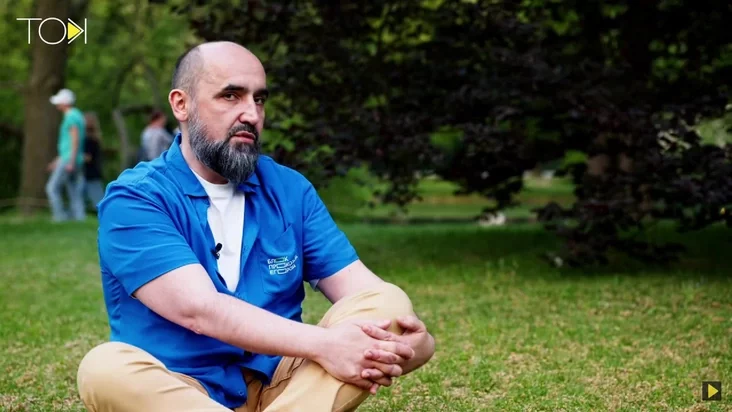
Aliaksandr Knyrovich. Video screenshot: TOK_talk / YouTube
At the game, he acted as a visionary — a person who tries to talk not only about how to remove Lukashenka, but also about what Belarus could be like after him.
"Simply overthrowing Lukashenka, waiting for his death, or sending him to The Hague — that's too little for today's conversation with Belarusians. We need to talk about what the country will be like afterwards," Knyrovich says.
He raised the topic of a new language for talking with Belarusians. According to him, the current political and journalistic language often reflects the split of 2020, although it is now 2026, and the situation is different. In one of the working groups, the word "mutual approach" appeared as an antithesis to division.
A separate episode — his speech in the role of an "conditional politician."
"I said: let's consider me a conditional politician. And I honestly offered: I'm ready to be crucified, let's practice on me. As a result, I received an hour and a half of criticism. I felt like a boxer who was collectively beaten up," Knyrovich says.
But, according to him, it was useful: both for him and for others, because it created a "safe opportunity to tell each other the truth."
Matskevich describes this episode even more theatrically: Knyrovich was "killed as a politician in a game scenario," and the next day he "resurrected" with different approaches.
What's the result?
The main question after the game is simple: what was achieved?
To answer bureaucratically — nothing concrete or final. There is no common strategy, no signed document, no distributed roles and deadlines. And Dziadok calls this a secret of Polichinelle.
"No common strategy, binding for everyone, was developed. And it's unlikely to be possible today," he says.
Knyrovich also believes that expecting a 50-page document with 60 signatures would be an inflated expectation.
"It's impossible to develop one strategy, find resources for it, and distribute roles among 60 independent people in these days. That would be impossible. But the maximum of what was possible happened: people heard and understood each other," he says.
According to him, most participants understand that it is necessary to move not towards "finishing off, stifling, bending the regime," but towards de-escalation, national dialogue, and future reconciliation. At the same time, Knyrovich emphasizes: this does not mean that everyone became "hobbits with their eyes closed" and wants to "be friends again." The game also discussed the risk of war and the need to have strength to hedge against dangerous scenarios.
According to him, the ideal scenario would have been if representatives of all socio-political structures had attended the game. Then the process might have been more difficult, but the result would have been of higher quality. As it is, Knyrovich says, a semantic division is already emerging between those who participated and those who chose not to go.
The discussions, according to Anton Radniankou, were sometimes tough and very direct. But the main thing he saw was not conflicts, but confusion within the sector.
"Many in the sector are confused, there is a loss of understanding of who is doing what. But the fact that so many people came for a week, for me, is evidence that in our democratic sector there is a desire to think and talk about a common strategy," Radniankou says.
According to him, there have been almost no similar attempts to gather a broad strategic session in the last two to three years.
As for the effectiveness of the game, Anton Radniankou evaluates it cautiously. He did not expect a common strategy for everyone to emerge in five days.
"We are all quite different. I did not expect there to be some joint strategy. But I fulfilled my tasks — rather professional ones, networking, the opportunity to talk to people and synchronize," he says.
At the same time, he noted that some participants left the game inspired.
"If at the beginning most had low energy and plans that didn't seem particularly effective, then by the end, part of the group's energy increased," Radniankou says.
Matskevich, however, expects more from the game. He says that after it, a "framework for an action program" should emerge. He himself plans to process the accumulated material for at least another month to turn it into a text or proposal.
But for him, what's more important than a document is that, according to him, "a core emerged" at the game — a group of active and influential people capable of proposing a common framework for movement.
"This is not about startups and not about projects. This is about strategy. About a core of the most active players emerging, who will be able to move everything in one direction," Matskevich says.
He does not reveal who is in this core: saying, they should speak for themselves.
"This is just one of the expensive retreats"
If you're looking for a concrete result of the game, then, according to participants, it's not political yet, but human. People who had been arguing online for years found themselves in the same hotel, at the same tables, in the same groups, and in the same bar after ten in the evening.
"Telling each other to f*** off online, shouting 'traitor,' 'idiot,' 'sold out to the KGB' — that's one thing. But when people sit next to each other, have breakfast, lunch, dinner, talk after ten in the evening at the bar — boundaries blur. It becomes clear that we have more in common than differences," Dziadok says.
Knyrovich also names the creation of an atmosphere of trust and respect as the main result.
However, "an atmosphere of trust" is a very convenient outcome for an event that cannot yet present anything more measurable. It is impossible to verify from the outside, difficult to assess, and easy to confuse with the effect of a closed, intensive gathering where people live in the same space for five days, sleep little, and talk a lot about grand meanings.
Knyrovich himself admits that the conditions were very good.
"These were absolutely wonderful conditions. I haven't been drinking for two months, so my evening networking looked like a pool and a sauna. But after ten in the evening, networking was active, so sleep deprivation was chronic," he says.
In turn, Anton Radniankou responds to the skepticism about the game's resemblance to an "expensive retreat." According to him, a retreat in the usual sense did not happen: participants started work at nine in the morning and finished at least at nine in the evening, and on the last day — around 11:30 PM.
"Is such a format necessary? It depends on the tasks. In general, at some point, democratic forces should gather and discuss such things. The number of people, money, and location — these are questions for the organizers. But, honestly, in the last five years there have been so many different expensive retreats, that this one is just one of them," Radniankou says.
For him, the main conclusion of the game is not that a ready strategy emerged, but that the state of the sector itself became evident.
"I saw that there is not only a demand for strategy, but also frustration from misunderstanding. Many have a personal crisis, many have an organizational crisis. People are trying to find some way out, an answer, motivation, strength, energy. Someone found this energy," he says.
And adds: and the results are already each person's individual story.
What will happen next
There were many disputes around the game from the beginning. Matskevich says he imposes nothing on anyone, does not create a sect, and does not set a political direction.
"I am not a politician. I am a methodologist and a cultural politician. I change the field of reference points, and people self-determine. One of the main principles of the game is freedom of self-determination," he says.
Uladzimir Matskevich is confident: the game will not pass without a trace; something important was born from it.
"I could say with enthusiasm: changes will happen. And from experience with games, I know this almost 100%. The other question is whether people will understand that the reason for these shifts is precisely the game. But the game did not pass without a trace. It is already working," he says.
Dziadok expects not a quick public result, but an "underwater institutional shift" in relations within the democratic movement. If even a tenth of the voiced ideas are implemented, he already considers that a good result.
Knyrovich says that for him personally, the game gave a sense of a broader field of support. He plans to continue working on the "After Lukashenka" cycle and reflect on the proposals of democratic forces for a future Belarus.
«Nasha Niva» — the bastion of Belarus
SUPPORT USNow reading


Ukrainian Armed Forces strikes on targets deep inside Russia and the frontline zone have increased. How did Ukraine pull ahead in the technological race?


Comments
Прыкладна, як Лукашэнка раздаваў убыточные колхозы сваім чыноўнікам,ікаб іх прынізіць.
Можа і гэтых у калгас беларускі выслаць? Няхай там трануюцца.