


"Globally, there's no difference between me, Paznyak, and Tsikhanouskaya." What dissident Viachaslau Siuchyk lives for today — a big interview
Viachaslau Siuchyk didn't want to go into politics, thinking that in 1988 he would "simply help quickly drive out the communists" and continue his scientific pursuits, but it didn't happen quickly. "Lukashenka is the revenge of the lower and middle ranks of former Soviet special services, and they naturally turned back time," says Viachaslau, who consequently gained the status of one of the first political prisoners during Lukashenka's rule. "Nashaniva" met Siuchyk in Warsaw, where he and his family are now in exile, forced to take various odd jobs, such as working at a cafe — "just to have something to eat."
In this conversation, we wanted to find out what it's like when your whole life is a struggle, for which you sacrifice health and well-being. We ended up talking a lot about "agents," as well as the mistakes of the opposition, Paznyak and Tsikhanouskaya, "yabatski" and "incredible ones," and what might change the Belarusian situation.
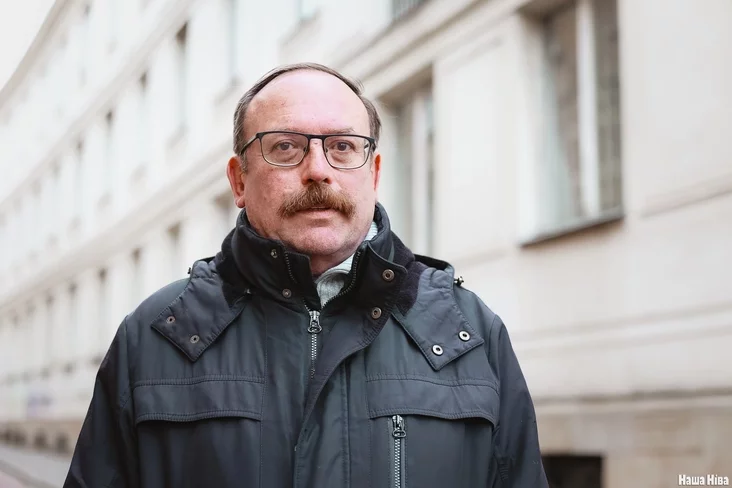
Viachaslau Siuchyk is one of the first political prisoners of Lukashenka's regime. Leader of the "Razam" solidarity movement, formerly Deputy Chairman of the BPF party.
Born into a family of scientists, he graduated from the Geography Faculty of BSU (Belarusian State University), worked at "Belarusgeology" and the Academy of Sciences, and studied the consequences of the Chernobyl catastrophe.
In 2006, he was one of the organizers of the tent camp on October Square. He organized dozens of protest actions, for which he was repeatedly beaten and convicted. In total, he spent more than a year behind bars.
"Nashaniva": You are now in exile, and it's not your first time: you were forced to leave Belarus after the 2006 elections, and after the events of the 2010 Square protests, you only returned home in 2015. How are these exiles similar and different?
Viachaslau Siuchyk: This is my first emigration now, that's how I perceive it. Before, I simply left Belarus temporarily to escape specific criminal cases. I deliberately did not seek asylum in 1996, although I was involved in the same criminal case that Zianon Paznyak and Siarhei Navumchyk fled under. I could have left Belarus even before the BPF, as I was a valuable enough specialist, and I was offered high-paying jobs abroad.
The last time I was forced to leave was in February 2011 for Kyiv, when I was completely accidentally not detained on the Square on December 19, 2010, but afterwards, on December 25, the KGB searched my apartment and my colleagues were interrogated about my role in the events on the Square.
I only returned in September 2015, when Mikalai Statkevich and all other political prisoners who refused to sign a petition to the dictator were released.
"NN": What do you do in Warsaw?
VS: I live just like the absolute majority of Belarusians abroad. I work various odd jobs just to have something to eat. I get by with casual earnings and part-time work. Some, Belarusians by the way, even mocked me for this reason. And if it weren't for Lukashenka, I should have retired at 55 for my work on Chernobyl.
(Viachaslau Siuchyk worked on environmental issues and the consequences of the Chernobyl catastrophe. — NN). When I was in pre-trial detention in 1996, two of my reports on Chernobyl were still being presented at a state conference. And until 1996, I was known primarily not as an activist, but as an environmental specialist. But my field of activity gradually narrowed, the KGB managed to get me dismissed from geology in 1997. I managed to stay in the Academy of Sciences a bit longer. But everything was finally cut off in 2004. Since then, I've just had odd jobs, especially during the struggle against "parasites."
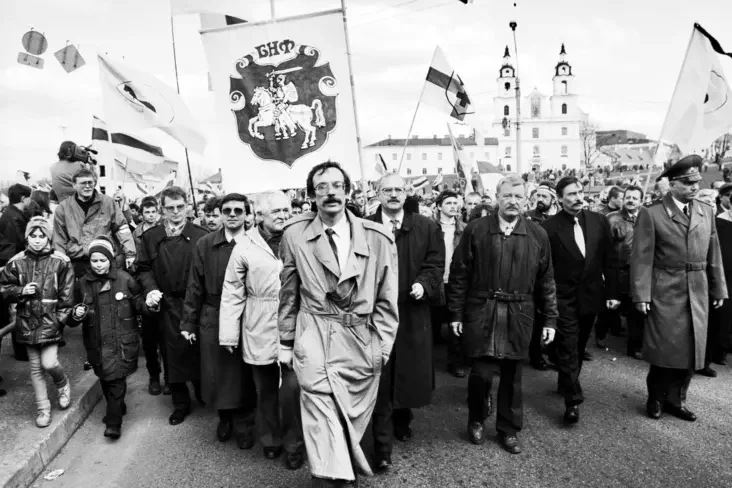
Overall, I never thought it would drag on like this. I entered the national liberation struggle in 1988. I was a nationalist even before the BPF, and I consciously joined the Front. I thought then that a "storming of the Bastille" would happen (that was my personal slogan at the time), we would drive out the communists, and we would live. That I would pursue my Ph.D. thesis, which was already prepared, publish an atlas on Minsk pollution... But a quick storming didn't happen...
Regarding my pension, nothing is looking good for me now. For my wife, yes, her biography is better. She worked all the time; I was forced to survive in Belarus through my activism. Despite this, the gang repeatedly offered me to simply stay silent, and they would arrange something for me. But I am probably the only Belarusian politician who consistently and harshly rejected the KGB for all these years. That's why they can't get rid of me even in Warsaw: there were provocations both with the conference and with the attack on me.
"NN": Are you in Warsaw with your family?
VS: My sons are in exile, and my wife, yes.
"My eldest son was severely beaten when I was performing the duties of technical head of Paznyak's election headquarters"
"NN": Back in Belarus, you said that attacks on family members were the most terrible events for you. Your youngest son, then seven-year-old Vitaut, was detained along with your wife to prevent you from holding another protest. And at seven months old, he found himself at his first picket while you were behind bars — many would have been stopped by such pressure.
VS: It was worse. My eldest son was severely beaten at a time when I was practically performing the duties of technical head of Paznyak's election headquarters.
When we were in Pinsk, my seven-year-old son was beaten in our Minsk yard so badly that he suffered a concussion. To this day, I cannot find out the name of the person who beat him; the only thing they said was that he was a KGB major.
I can't boast that my activity was always effective, but I am such a person: if I decide something, I do it. Nothing would stop me, only the destruction of this KGB gang.
When I was offered to become a member of the Sejm of the BPF "Adradzhenne" (Revival), still under the communists, I asked for a day to think. Then I decided the most important thing for myself: whether I would have the strength not to kneel if they tried to kill me. Only when I decided for myself that I would never, did I give my consent.
"NN": When thousands of people came out onto the streets with white-red-white flags in 2020, but you were not among them, wasn't it upsetting?
VS: My last actions in Belarus, together with my colleagues, were against the so-called deep integration with Russia. You know, Belarusians at that time mostly didn't believe there was a threat to independence. Some, by the way, even had hopes for Lukashenka as a guarantor of independence. Even the West then pursued an idiotic policy — that Lukashenka precisely was the guarantor of sovereignty, and they brought part of the opposition under this. And our actions in 2019 primarily took place thanks to activists from movements and parties that could be mobilized.
December 29, 2019, was the last metropolitan action against integration. We understood that I could be arrested, so I went to Warsaw to my youngest son. The events then took on an absolutely farcical character, as in the Partizansky district court of Minsk, different judges "tried" me five times a week, from Monday to Friday. The first court handed down 15 days, then a second time 15 days. Then there was a reaction in the media, and on Wednesday-Thursday, they canceled the trials, and on Friday, they held another one — in total, I was handed 45 days of arrest.
I was going to return to Belarus, but on May 15, 2020, in Kyiv, where I was, a quarantine was declared, an absolutely brutal one. It was the pandemic, strangely enough, that saved me, because I think I would not have survived in Belarus after 2020.
When we were able to hold street actions in Kyiv again, Mikalai Statkevich was already in prison. And the press was pushing everyone towards the Gazprom candidate, using a little-known regional blogger, because people needed to be driven to slaughter, and the invasion of Russian troops in 2022 needed to be prepared.
"The Belarusian opposition is in prisons, and it's certainly not Kalesnikava and Babaryka"
"NN": You often say in your videos that in 2020, the Belarusian opposition was replaced according to a Moscow scenario, but can we talk about the evidence you've gathered?
VS: I spoke a lot about this even before the elections. You can find all of this in "Voice of America," in the Ukrainian press.
"NN": To put it mildly, a small number of Belarusians consume information from there.
VS: All of this was prepared by the professional intelligence officer Mikhail Babich (former Russian ambassador to Minsk. — NN). Let me remind you that our "Razam" solidarity movement protested and adopted a special statement when Babich was appointed ambassador to Minsk.
Even after his resignation, Babich, already from Moscow, was involved in the scenario of the electoral farce. And naturally, he created infrastructure and selected personnel for the implementation of the scenario within the framework of the so-called deep integration. He specifically brought Russian agents to the embassy who were involved in the annexation of Crimea in 2014. They, naturally, were also involved in 2020. If someone thinks that Lubyanka went on vacation then, they are deeply mistaken.
Even before the bloody Sunday of August 9, I openly stated that Russia was not going to remove Lukashenka, but simply turn Lukashenka into a Belarusian Kadyrov. And this would have succeeded completely if Belarusians lived in the Caucasus. But thanks to the sacrifice of the Belarusian people, the Moscow scheme was broken. At the same time, the forces that prepared Babich's cadres are still afloat today — nothing in politics happens by chance, especially when it comes to a transit country where people have hated their government for decades.
"NN": Who exactly do you mean?
VS: The scheme was simple: to take away the opposition's electorate through Tsikhanouski. By the way, the only one who had a rating at that time was Mikalai Statkevich. And now no one knows what happened to him or if he's even alive. And Tsikhanouski was only one of Mikalai Statkevich's thirty protest candidates. Therefore, Tsikhanouski's small initiative group was mainly created by Statkevich and Seviarynets, and even theoretically could not collect one hundred thousand signatures. The initiative groups of the protest candidates were not massively registered, but Sviatlana Tsikhanouskaya's initiative group, which was created for her husband, was registered.
If someone believes that in our country, where the KGB is in power, something could have happened accidentally at such a level — he is a happy person.
And if everything is built on the lie that someone could have won the electoral farce, then it all crumbles. The entire opposition remained in Belarus. The Belarusian opposition is in prisons, and these are certainly not Kalesnikava and Babaryka. These are other people, and the absolute majority of them are ordinary citizens, from the regions. And many leaders who genuinely dedicated most of their lives to making Belarus a democratic country and giving Belarusians a choice — like Statkevich or Seviarynets.
"NN": Nothing is heard about Tsikhanouski either now. Why are he and all the other "pro-Russian," as you say, now in prison under such inhumane conditions, alongside other political prisoners?
VS: You know, one of the reasons the USSR collapsed was the Afghan adventure. And Hafizullah Amin, who ruled Afghanistan, was absolutely pro-Moscow, he himself asked for the introduction of Soviet troops. He was a person absolutely fixated on Moscow and experiments on people. And what did Moscow do? It simply sent special forces and shot Amin's supporters and Amin himself. That's Moscow.
Many people are imprisoned today. Another thing is that the absolute majority of political prisoners did not destroy Belarus. Did you like one of the slogans that was implanted to set up Belarusians: "an auto-zak is just a car"? I think hundreds of thousands of Belarusians have learned through their own experience that an auto-zak is an auto-zak. This is a crime against all those people who have gone through torture. But you see that those who propagated this are now receiving international awards, because this is the time when nations and individuals are being destroyed in the global world.
About Babaryka — that's an anecdote altogether. Let me remind you: the gas wars between Lukashenka's gang and the Kremlin began way back in 2004. It's clear that Moscow was preparing its candidate. Listen to his pre-election press conference. Neither he nor Maria Kalesnikava understood what was happening in Belarus.
In 2020, Moscow was solving the main political question — deep integration. And it was precisely through new actors, through their activities, that this was resolved.
What do we have today? The fact that Belarusians are outcasts in Ukraine, Lithuania, Latvia, Estonia — is that Tsikhanouskaya's achievement? Soon the same will happen in Poland. If you like this, I can't do anything.
"NN": How, in your opinion, could this have been avoided? What should the so-called old opposition, which criticizes Tsikhanouskaya and the new opposition, have done for this?
VS: It did. The white-red-white flags didn't just appear all over Belarus by themselves. Flags, not the white ribbons of the Russian opposition. People fought, there was an attempt at a revolution, and "headquarters" were completely absent. But the revolution was suppressed in a very simple way: by creating a Coordination Council to let off steam.
"Already from the early 2000s, there was no need to rely on the West"
"NN": What, in your opinion, are the main historical mistakes of the Belarusian opposition?
VS: The first and most important thing is that not only the opposition, but everyone slept through Lukashenka. Historical fact — before the first round in 1994, no one even stirred, they thought nothing would happen.
The second point is the underestimation of the consequences of the people's colonial status.
The third point is that the opposition constantly tried to seek allies in the West, which was pointless. New self-proclaimed leaders in the diaspora are also doing this now. And largely, there's more promotion of all sorts of gender issues here.
Already from the early 2000s, there was no need to rely on the West. It was clear that with Lukashenka, who had become a dictator, they couldn't cope. And they simply didn't need to.
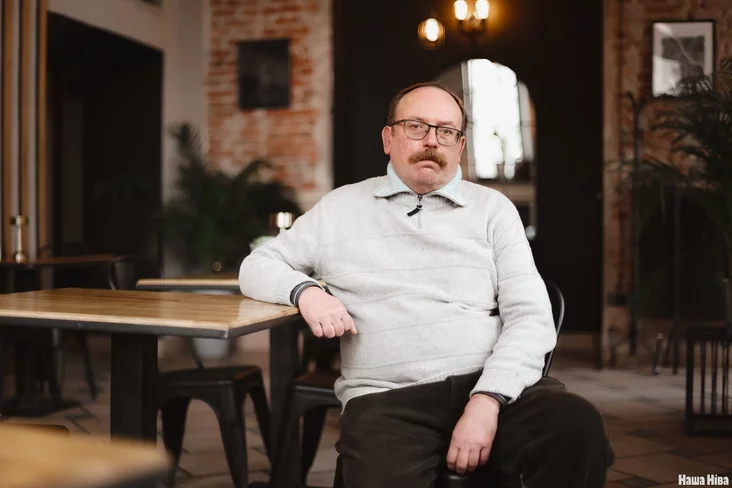
"For me, the BPF was simply a mechanism for defending the interests of the Belarusian people"
"NN": What about the eternal squabbles in the opposition? You yourself were expelled from the BPF with the formulation "for destructive activities."
VS: The squabbles in the opposition are not so eternal. Special services, the KGB, are also interested in these "squabbles."
Regarding my "expulsion": I was unconstitutionally expelled by a decision of the Sejm in 2003, but this decision was long ago overturned by the BPF Congress.
I will say, perhaps, the main thing: I never considered losing my party card a tragedy; for me, even the BPF was simply a mechanism for defending the interests of the Belarusian people, nothing more.
"A very big mistake is to separate Russian imperialism and Lukashenka"
"NN": What are your relations with Paznyak today?
VS: I define him as a Belarusian politician. And I have normal relations with all true politicians.
"NN": We cannot but ask about a line in a popular hip-hop track from its time about Zianon Paznyak, which was dedicated to you: "Why were you beaten by OMON, Siuchyk? Were you unbuttoning your girlfriend's bra in a tent? Nah, no question, no complaints to OMON here: 'Sex before marriage,' bastard, you disgraced Zianon!" What is this about?
VS: A normal person could not have written such a thing. I have no doubt where this was concocted. On what could it be based? Only perhaps on the fact that, contrary to West and East, we created Kastus Kalinouski Square in 2006 so that the Belarusian people would not be voiceless. It practically succeeded in bringing people and even moving them out; the authorities then were even afraid to initiate a criminal case.
I would like to remind you that there was a terrible frost then, I perfectly understood that as soon as I left the Square, I would be taken away, and I didn't even think I would survive. I spent three days on my feet there, and only twice was I put into a tourist tent for two hours because I simply passed out.
"NN": So, I understand that Statkevich is your ideal candidate?
VS: I would vote for any alternative to Lukashenka. I'm not even afraid of Babaryka. There are people in Belarus who can do something, even under him. This is not a sign of trouble.
It is a very big mistake to separate Russian imperialism and Lukashenka. The catastrophe that began in the world was laid, in part, by the 1994 elections, when former lower and middle ranks of the Soviet special services came to power through Lukashenka. And only our resistance restrained this KGB gang.
The absolute majority of all our mistakes were caused by external conditions, because the Belarusian people had no allies, have none, and, unfortunately, will not have any in the near future. Even bloodier events lie ahead. I believe that the electoral farce of 2025 is already preparation for World War III. But a situation is emerging where people will be massively given weapons and ammunition. And this is a bloody, but a chance for Belarus. Because the more fear, the more hatred. And at any moment, a Belarusian revolt can erupt.
"Globally, there is no difference between Paznyak, me, and Tsikhanouskaya"
"NN": Who, in your opinion, is the most influential politician in exile?
VS: Globally, there is no difference between Paznyak, me, and Tsikhanouskaya.
Another matter is that, unlike everyone else, I believe the main duty of people who find themselves abroad is to support the Belarusian people. But we in the diasporas haven't even sorted out elementary things — sanctions. For example, sanctions for Lukashenka providing Belarusian territory for the introduction of Russian troops, for the FSB-orchestrated landing of the plane with Pratasevich and Sapega. These should have long ago been reformatted under one demand: the release of political prisoners. This has not even come close to being done. Instead, it has happened more than once that Lukashenka was ultimately whitewashed and made into something human. That is why what happened before is repeating itself.

"I knew all the people who were killed before 2020 personally, and that compels me to do something"
"NN": You've spent most of your life in struggle, you've been beaten numerous times, spent a lot of time behind bars, in 1996 you ended up in intensive care after a 21-day hunger strike when your kidneys failed... Is there no resentment that, as a result, only a few dozen people attend the action with Paznyak, where you also speak?
VS: I spoke at both actions on January 26 in Warsaw. And I do not share Ihar Tur's opinions, nor the theses of the publication in "Nashaniva," because I see nothing wrong with that number of people. This is not only an objective indicator of the moods of Belarusians in Warsaw and the fear of repression; it is also the degree of informedness, motivation, and professional organization. Unfortunately, I cannot say that the actions were carried out with even minimal professionalism and common sense.
Personally, I regret nothing. To the question about my health, I have a simple answer from 1996. When the prosecutor asks if there are any complaints about my health, one should answer precisely: neither complaints nor health. No one will feel sorry anyway.
You see, I knew all the people who were killed before 2020 personally. Many of them very well. The first leader of Belarusian entrepreneurs, Arnold Pechersky, was actually my friend, a close colleague (According to one version, Arnold Vladimirovich was in an accident, and according to another, he was killed; his death coincided with the deaths of other opposition politicians — Karpenka, the disappearance of Hanchar and Zakharanka. — NN). I personally knew almost all political prisoners before 2020, and the fact that I knew these people compels me to do something, whatever is still realistically possible.
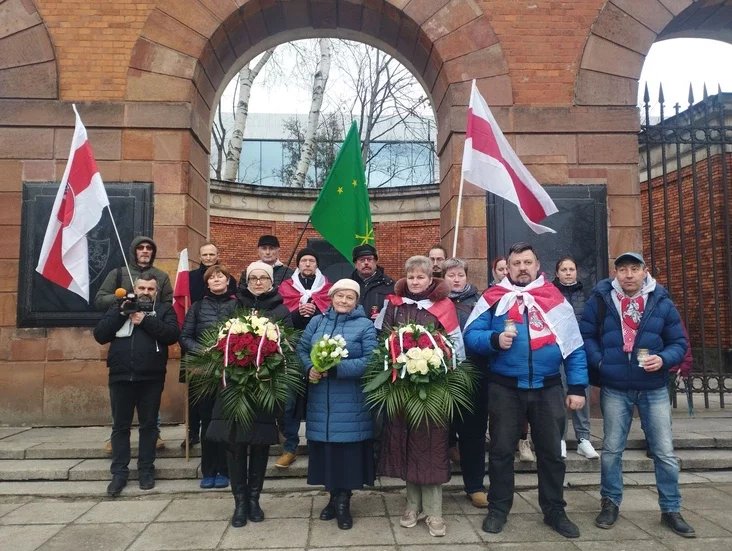
Overall, my entire biography is proof that if a person wants to live, they will cope with anything.
"NN": On your YouTube channel, there are quite pessimistic forecasts regarding the future of Belarus. In your opinion, is everything really so bleak, and is this, as you say, "the worst time for Belarus"?
VS: Unfortunately, as I entered my 63rd year, I very often started using the word "I'm afraid." I am genuinely afraid for Belarus. But there is a positive. In that the Belarusian people, though enslaved, are still alive.
However, only a revolution can change the Belarusian situation. Neither Ukraine nor negotiations regarding it will help us here. Currently, the entire Belarusian people are disenfranchised, whether you are a "yabatska" three times over or an "incredible one" four times over (both terms, I believe, were artificially created by Russian political technologists). Even the police today are put down by the KGB. The gang itself, through continuous madness and repression, is pushing everything to a point where an explosion could occur.


Comments