


This year's Nobel Peace Prize laureate previously also dealt with the Belarusian issue — she condemned the repressions after the 2010 Square protest
This year's Nobel Peace Prize laureate Navi Pillay at one time repeatedly drew attention to human rights violations in Belarus. The authorities even invited her to visit the country.
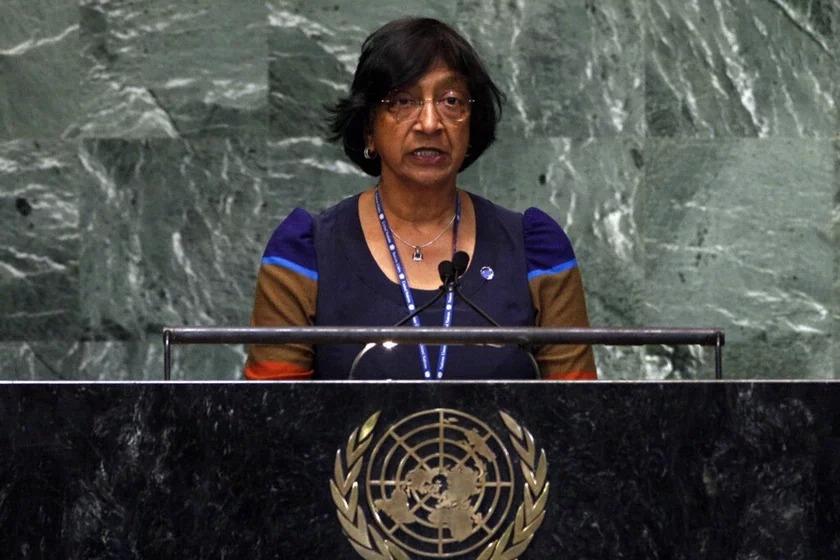
This year, the Nobel Peace Prize was awarded to South African lawyer Navi Pillay for her contribution to strengthening international law and protecting human rights. From 2008-2014, she served as the UN High Commissioner for Human Rights.
During this period, Pillay repeatedly spoke out about political repressions in Belarus. Already on December 21, 2010, two days after the presidential elections and the dispersal of the protest in Minsk, the Office of the UN High Commissioner for Human Rights issued a statement by Navi Pillay, dedicated to the events in Belarus.
In it, Pillay expressed deep concern over the use of force against demonstrators who were not involved in violent acts, the arrests of opposition candidates and their supporters, as well as searches and pressure on independent public organizations.
At the same time, she also condemned calls for violence by certain radical opposition groups, but stressed that the authorities are obliged to ensure the right of their political opponents to peaceful demonstrations and freedom of speech.
In February 2011, Pillay again addressed the Belarusian issue. The occasion was the sentencing of Vasily Parfiankou — the first person convicted in the criminal case regarding the events of December 19. Parfiankou received four years of imprisonment in a strict regime penal colony on charges of participating in mass riots.
On February 21, the UN High Commissioner expressed deep concern over the severity of the sentence. She noted that Parfiankou and dozens of other opposition activists were subjected to criminal prosecution for exercising their right to peaceful assembly and freedom of expression.
Pillay also called the continued detention of political opponents, the persecution of civil society, and the intimidation of independent media serious human rights violations.
Her attention to Belarus did not end there. In June 2011, the UN Human Rights Council adopted a resolution expressing concern over human rights violations in the country and instructing the High Commissioner to prepare a corresponding report.
The report, dated April 10, 2012, covered the period from the presidential elections of December 19, 2010, to March 2012. It examined violations of civil and political rights in Belarus. A separate appendix was dedicated to people who were criminally charged in connection with the events on the Square. The main text of the report also mentioned the arrest of the head of the Human Rights Center "Viasna", Ales Bialiatski, in August 2011.
In June, the document was discussed at a meeting of the UN Human Rights Council, and on July 5, the UN Human Rights Council adopted a new resolution on Belarus and established the position of Special Rapporteur on the situation of human rights in the country.
Mikhail Khvostov, then Permanent Representative of Belarus to the UN in Geneva, stated that Belarus would not recognize the mandate of the special rapporteur and would not interact with him.
“The motives behind this European Union initiative are in no way connected with human rights. (...) This is a targeted anti-government activity in Belarus under the guise of the UN,” Khvostov argued.
The Belarusian authorities invited Navi Pillay to visit the country, but the visit never took place.
In June 2012, during the discussion of the situation in Belarus at the UN Human Rights Council, Pillay reported that the then Minister of Foreign Affairs, Sergei Martynov, had invited her to visit the country. However, according to her, the Belarusian side insisted that the visit not be related to her duties in preparing a human rights report.
This year, Navi Pillay became a laureate of the Nobel Peace Prize. Among those who welcomed her award was the head of the Human Rights Center "Viasna", Nobel laureate 2022 Ales Bialiatski, whose release the UN had already demanded in 2012.
In a comment to "Viasna" on October 9, he drew attention to the symbolic significance of the Nobel Committee's decision at a time when international human rights and judicial institutions are facing increasing pressure.
“This signal, it seems to me, is sent in support of her personal merit and in support of the work of human rights defenders,” Bialiatski said.


"He invited me on a date and came with a bag of tomatoes instead of flowers." What they remember about Jan Pamedor Reutski, administrator of a multi-thousand community of Belarusians in Poland


Comments