


The impact should have created a crater.
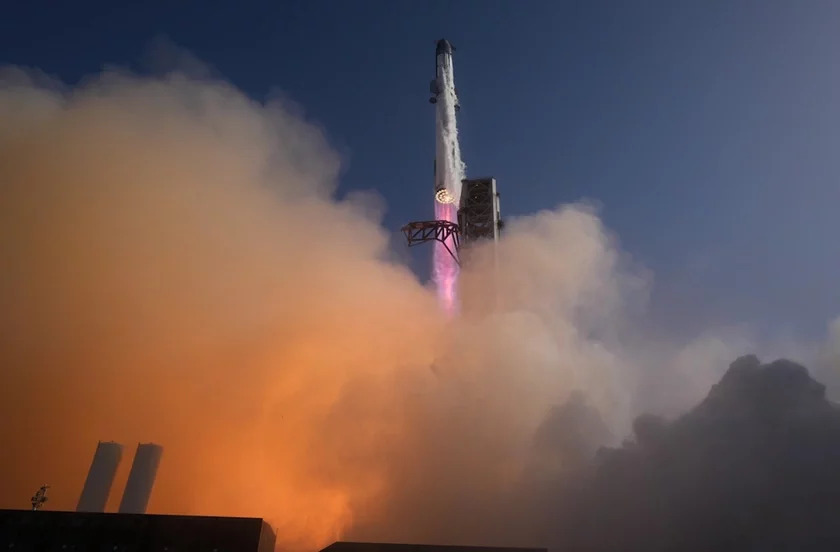
The upper stage of one of SpaceX's Falcon 9 rockets, which was moving towards Earth's satellite at a speed of about 9 thousand km/h, has likely already crashed onto the Moon's surface, scientists believe. The impact should create a crater, but it will take scientists some time to locate the impact site of the stage, writes the BBC.
None of the spacecraft orbiting the Moon were able to capture the moment of impact, as the impact site was not within their field of view. Scientists will need to analyze new images of the Moon's surface and compare them with those taken before the stage crashed. A trace of the collision with the Falcon 9 stage should be visible on the surface of Earth's satellite.
In addition, telescopes in North and South America may have recorded the moment of impact, but processing the received data will take at least several hours.
Over millions of years, the Moon has experienced countless collisions. Asteroids and meteorites have given Earth's satellite its characteristic scarred surface and covered it with numerous craters. In recent years, small probes and landers sent there by terrestrial space agencies have also started leaving their marks.
According to data from NASA's Center for Near-Earth Object Studies (CNEOS), the upper stage of one of SpaceX's Falcon 9 rockets, flying at a speed of about 2.43 kilometers per second, was supposed to crash into the Moon on the morning of August 5th.
The American space agency came to this conclusion, confirming the calculations of independent astronomers who, based on publicly available data, determined that a part of this rocket, launched in January 2025, accidentally ended up on a collision course with the Moon.
"There is no danger to Earth," assured spokesman Jimmy Russell. "NASA will continue to track the rocket stage for educational purposes and then will observe the impact site for scientific purposes."
SpaceX launched this Falcon 9 rocket as part of a joint US and Japanese mission to deliver two landers and scientific equipment to the Moon.
Part of the Falcon 9 rocket is reusable: it returns to Earth and is used again. However, some elements of the rocket separate in space and remain in orbit, unless they collide with another celestial body.
In this case, we are talking about the upper stage of the rocket, whose dimensions approximately correspond to a five-story building, and its mass on Earth is at least 4000 kilograms.
Astronomer Bill Gray, who first determined that it would fall on the Moon, reported that the stage was supposed to crash into the surface near the Einstein crater, which is on the side of the Moon visible from Earth.


Comments
Столкнулась.
Мусарню вызвали?
Американцы любят жеж на мусоров ломиться.