


Hebrew Script: It Turns Out Belarusian Was Also Written With a Fourth Alphabet, and Sorcerers Used It
It turns out that besides the familiar Cyrillic and Latin scripts, and also Arabic script, which our Tatars used to write in Belarusian, there existed another, completely unknown, but therefore even more interesting graphic variant — the Hebrew alphabet.
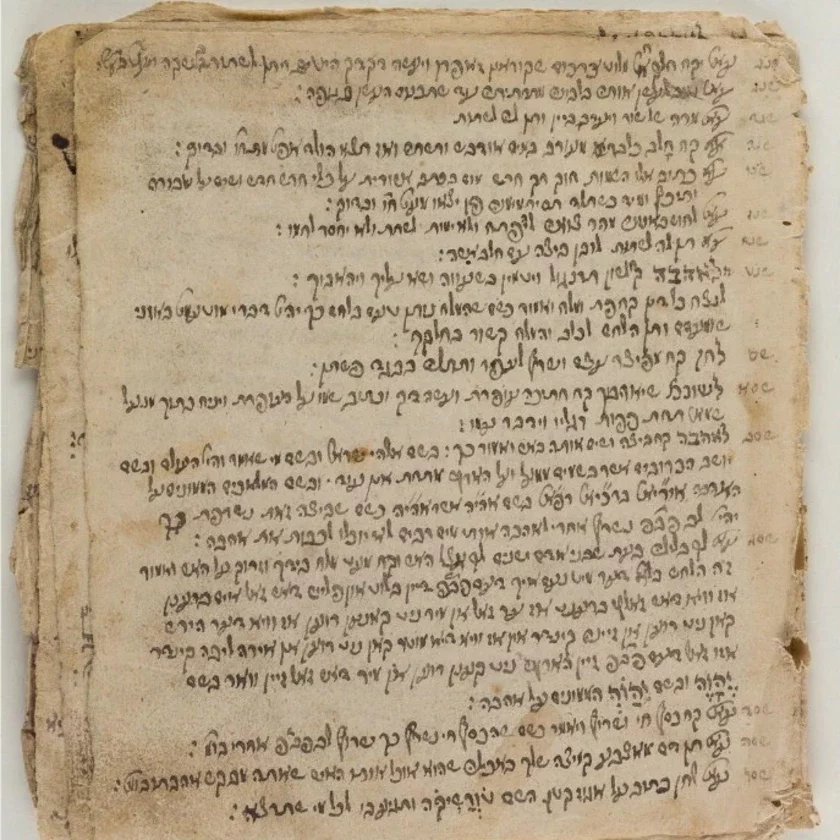
A sheet with Belarusian incantations, written in Hebrew script. Photo: nli.org.il
The tradition of writing Slavic words in Hebrew script dates back to ancient times. Already in the Middle Ages, Jewish scribes and editors of religious texts made notes (glosses) in local languages to explain certain unclear terms. These were the so-called "Canaanite" glosses, which reflected the spoken language of the Jewish population of Slavic lands at that time.
One of the most famous early examples of the use of Hebrew script in Rus' is the famous "Kyivan Letter" of the 10th century, found in the Cairo Genizah, where the name Kyiv is mentioned for the first time, though not in Slavic, but in Hebrew.
Canaanite glosses primarily refer to Czech and other West and South Slavic lands, while the use of Hebrew script for recording specifically Belarusian texts long remained an understudied topic.
As researchers of the Belarusian language noted, there is a scarcity of Jewish materials for its study, especially compared to the rich heritage of Belarusian Kitabs written in Arabic script.
Black Magic Discoveries in William Gross's Collection
Recent findings have shed new light on this problem.
Researcher and writer Yoel Matveev drew attention to interesting manuscripts from the private collection of William Gross (Tel Aviv), digital copies of which are available at the National Library of Israel.
These documents, tentatively dated to the 19th century, are collections of short magical texts, incantations, and conjuration formulas.
What makes these manuscripts unique? Among the texts written in Hebrew cursive, entire pages and extended fragments in Belarusian are found! The Belarusian translator Siarhej Shupa provides several such texts:
“In a clear field stands a golden pine, and on that pine a golden chair, on that chair sits a golden maiden, as the sun is dear and beloved to that maiden, and so when...”
“...one is golden, and the second is silver, and the third pulls out a tooth, and in a clear field stands a golden pear tree, on that pear tree a golden nest, in that nest a serpent-queen asks all of you: both field and marsh, and forest and swamp, and pine forest, and...”
This text, despite some phonetic and grammatical peculiarities (for example, confusion in cases), is undoubtedly a Belarusian incantation. Moreover, one can even find which specific incantations in folklore materials.
In the volume "Incantations" from the book series "Belarusian Folk Art," one can find incantations against snakes and their bites:
"In a golden field stood a golden pear tree, on the golden pear tree a golden nest, and in that nest a king and queen uttered words, enchanted swelling from all kinds of reptiles — from black, from mottled, from white."
"There is an island on the sea, on the ocean, on that island stands a mound-like, overgrown oak. In that oak is a golden nest; in that nest lies a serpent, queen of all serpents. I ask you, serpent-queen, queen of all serpents, restrain all your serpent-skins, and young serpents, and lizard-lizards — both swamp, and under-log, and forest, and marsh, and bush, and field, and border, and under-foot, and barn, and manure. Restrain them, and bring them to this brown wandering cow, and remove the sting from its two-haired wool, and remove the venom, and heal these wounds, and provide help. If I do not persuade you, if you do not restrain all your serpent-skins, and bring the young serpents to this cow, and remove the sting, and expel the venom, and heal the wounds, and give her help — I will persuade Saint Michael the Archangel. Saint Michael will descend from heaven to earth with his golden sword and you, serpent-queen, he will hack and cut with his sword, and give to Kuzma-Demyan in the golden smithy. Kuzma heats his rod and bakes your teeth, lips, and sting, forever and ever, amen."
The long list of snakes is not just an artistic device, but a strict formula, as it was believed that to neutralize the venom, it was necessary to name every single snake according to its habitat, otherwise the incantation would not work.
How Jews Used the Belarusian Language
The discovery of these texts sparked a discussion among researchers about the status of the Belarusian language in the Jewish environment of that time.
On the one hand, Siarhej Shupa notes that unlike the Kitabs of Belarusian Tatars, for whom Belarusian was the language of daily communication and religious literature, in these Jewish manuscripts it has a more functional character. It is the language of magic, of incantations, which were possibly borrowed from the local population along with the rituals themselves. The standard situation for Jews of that time was Yiddish-Hebrew diglossia, and Belarusian, though familiar, remained the language of the "surrounding" environment.
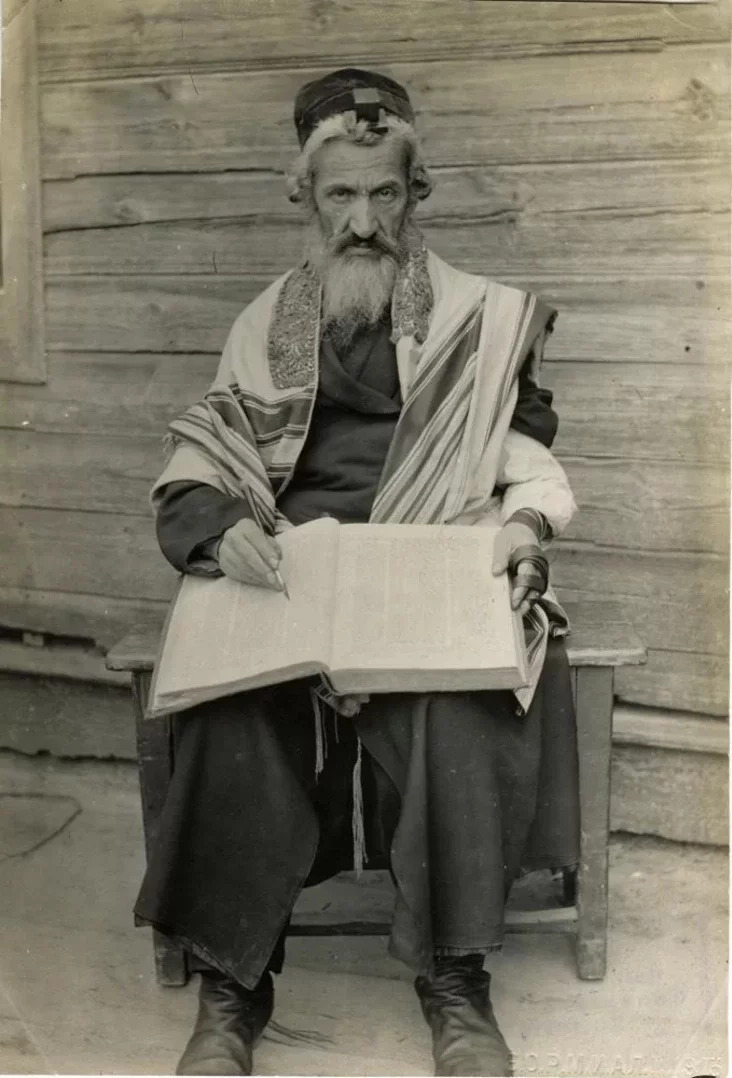
A rabbi from Mogilev province. Photo taken during Vyacheslav Kostka's expedition. 1903-1904. Photo: Wikimedia Commons
On the other hand, Yoel Matveev suggests that the situation could have been more complex and profound. He refers to the testimony of the Mogilev rabbi Meir Katz Ashkenazi (16th century), according to whom many Belarusian Jews at that time spoke Slavic, not Yiddish.
Matveev paints a picture of the complex internal multilingualism of the Jewish community: Aramaic was used for studying the Talmud and Kabbalah, Hebrew (lashon-kodesh) for prayers and serious books, Yiddish for everyday conversations in the family, and Slavic language ("raysish") for interactions with the "surrounding world."
According to Matveev, in small villages and hamlets, Jews might have possessed the local Slavic language even better than Yiddish. People who engaged in "Kabbalistic affairs" and magic were on the border between the written culture of the shtetl and the oral tradition of the Belarusian village.
Thus, the use of the Belarusian language in magical texts is not just a mechanical borrowing, but evidence of close interaction and belief in the special effectiveness of the local word in the sacred sphere, which is also confirmed by the presence of Slavic texts in Hasidic nigunim.
The manuscripts from the Gross collection are another proof of the multifaceted nature and interpenetration of cultures in Belarusian lands. They not only expand our knowledge of the history of the Belarusian language and its graphic variants but also open new pages in the study of the traditional culture and daily life of the Jewish population of Belarus. It remains to be hoped that further research into these and, perhaps, other as yet undiscovered manuscripts, will allow us to more precisely define the role and place of "Hebrew script" in the cultural landscape of our region.
«Nasha Niva» — the bastion of Belarus
SUPPORT US


Comments
З пачатку 1990-х гг. у незалежных медыя, якія спрабавалі перайсці на альтэрнатыўны правапіс, масава пачалі выкарыстоўвацца формы габрэ́й (таксама згадваецца ў праекце альтэнатыўнай правапіснай нормы), габрэ́йка, габрэ́йскі, габрай, габрайка, габрайскі, гэбра́й, гэбра́йка, гэбра́йскі. Некаторыя з гэтых варыянтаў укладзены ў аўтарскія ці, як варыянты перакладу, у перакладныя слоўнікі, адзін устояны варыянт дагэтуль адсутнічае. Форма гэбрэі і вытворныя не выкарыстоўваюцца зусім.
З'яўленне форм габрэй і габрай пры грэч. hebrajos не былі належным чынам вытлумачаны з фанетычнага пункту гледжання.