


Star and the Bull Luis Alberto: Belarusians Recall Cow Nicknames in Their Villages
The discussion about the nicknames given to cows turned into a vibrant panorama of Belarusian village life. It covered everything from childhood-familiar nicknames to unexpected references to characters from Latin American TV series.

«Belarusians, I suddenly became very curious: what names did the cows in your village have?» — Yauhen asked users on Threads.
The post gathered more than 400 comments.
At the beginning of the discussion, the «gold standard» of village nicknames was mentioned.
«Star. All cows were Stars,» — one of the women wrote.

Further, commentators began to list entire lists of names familiar from childhood:
«Rowan, Belka (Squirrel/Whitey), Galka (Jackdaw), Krasulya (Beauty), Malyuta (Small One), Zorka (Star), Malina (Raspberry), Tarpeda (Torpedo)».
«Zhuchka, Pyaresta (Spotted), Malina (Raspberry), Kalgasnitsa (Collective Farmer)».
«We first had Pchyolka (Little Bee), and then Mukha (Fly)».
«Lysukha (Blaze-faced), Vishnya (Cherry), Rabka (Dappled)».
«Lyalka (Doll), Chubenia, Pyarestka (Spotted), Lastawka (Swallow), Malva (Mallow) (Slonim district)».
«Lyuta (born in February), Nochka (Nighty), Zorka (Star), Belka (Squirrel/Whitey)».
«Kvyatukha (Flowery), Malva (Mallow)».
«My grandmother called the cow Kvetka (Flower)».
«Lastawka (Swallow), Belka (Squirrel/Whitey), Charaunitsa (Enchantress)».
One of the users shared memories not only about names but also about the system of assigning them on collective farm dairies:
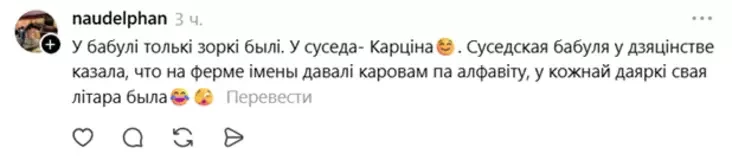
«My grandmother only had Stars. The neighbor had Kartina (Picture). The neighbor's grandmother said in childhood that on the farm, names were given to cows alphabetically; each milkmaid had her own letter.»
Alongside the usual names, quite exotic options for the village were also found:
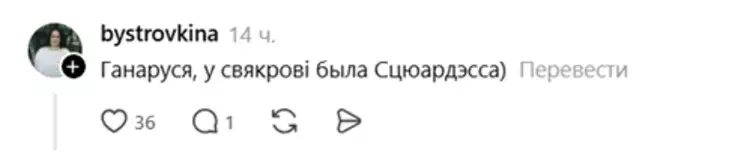
«Hanarusya, my mother-in-law had Stywardesa (Stewardess)».
«My grandmother had Matilda».
«Martsela».
«Kosmanautka (Cosmonaut)».
«Manida! That's what my grandmother's cow was called! She really loved black bread».
«Not ours, but there was a cow named Taiga in the village».
There were also humorous sketches about the contrast between the name and reality:
«Lyalka (Doll)! She was a very good cow, but the neighbor's cow was called Princess, she was very messy, but still Princess,» — writes a participant of the discussion.

A separate layer of nicknames reflects the era of popular Latin American TV series in the late 1980s — early 1990s:
«Hold my beer: Gaviota!» — one of the women boasted.
«Grafinya (Countess). We watched some movie with grandma about counts.»
«Roza (Rose) (influence of Mexican TV series, thank goodness it wasn't Isaura).»
«Raquel and Ruth. The series "The Secret of the Tropics" was on then. The names were from there.»
«My grandmother had a cow named Latifa (grandma said her eyes were like Latifa's from "The Clone").»
Series names were also given to young bulls:
«The neighbors had a bull named Luis Alberto (based on the TV series)».

«After watching a foreign TV series, our little bull was named Federico. He was the only one like that in the village.»
Sometimes global politics also influenced the choice of names for bulls:
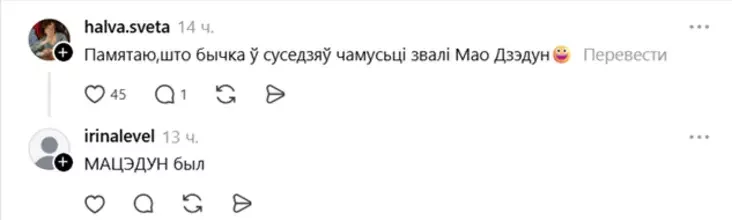
«I remember that the neighbors' bull was somehow called Mao Zedong».
Moreover, folk speech often adapted such names to its own way:
«It was Matsedun (Mao Zedong in folk pronunciation),» — adds another user.
But in the case of horses in the village, a harsh pragmatism with a taste of dark humor often prevailed:
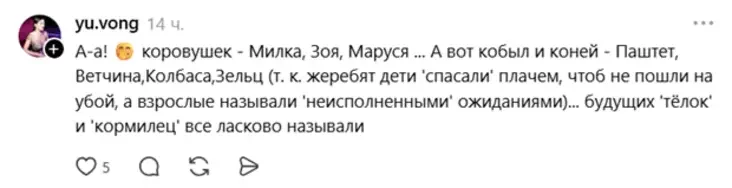
«For cows — Milka, Zoya, Marusya… But for mares and horses — Pashtet (Pâté), Shynka (Ham), Kaubasa (Sausage), Zelts (Headcheese) (because children "saved" foals with crying so they wouldn't go to slaughter, and adults called them "unfulfilled" expectations)… All future "heifers" and "nurturers" were affectionately named.»
Many comments are imbued with nostalgia for childhood and loved ones:
«My grandmother had Buronka (Brownie), Charnushka (Blackie), and Zorka (Star) — mother, daughter, and granddaughter, respectively, on the cow's family tree. I remember every cow. Unfortunately, no photos remain; in my childhood, it wasn't customary to photograph pets… But I remember each of them.»

«My grandmother had Praleska (Snowdrop). A red cow with the most beautiful blue eyes. More than 40 years have passed since then, and I remember what she was like.»
This historical excursion through barns and pastures concludes with small everyday sketches:
«My grandmother had a cow named Malinka (Little Raspberry), and my aunt had Zorka (Star), another aunt had Lyska (Blaze-faced). I didn't drink Lyska's milk — I didn't like the name, nor the cow's appearance (such a red one with a white face).»
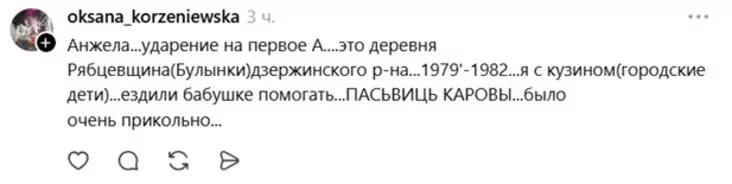
«Anzhela… accent on the first A… this is the village of Rabtsawshchyna (Bulynki), Dzyarzhynsk district… 1979-1982… my cousin and I (city kids)… went to help grandma… GRAZE COWS… it was a lot of fun…».
-
"I'm a true linguistic geek." A 16-year-old schoolboy from India is learning Belarusian
-
"Mulavin's Mustache" and "Euphrosyne's Cringe": Blogger ITBeard Created Alias in Belarusian
-
Belarusian digital voice will no longer grate on the ear with incorrect stresses. The neural network has finally been taught to distinguish "mUka" from "mukA"


Comments