


"In Ukraine, nobody believes what's happening there." Ukrainian, detained in Belarus two days before the war, tells of his suffering behind bars
Political prisoner Mikhail Staliarchuk from Ukraine is one of 31 released Ukrainians at the end of last November. He and his nephew Dzmitry were detained two days before the start of the full-scale war. Of the six years he was sentenced to, the Ukrainian served almost half under harsh conditions in the Brest pre-trial detention center and Vitsebsk colony. On the anniversary of the start of the full-scale war, Mikhail told "Viasna" about torture during detention, fabricated charges, the death of Vadzim Khraśko, which he witnessed, hope for quick release during imprisonment, and difficult adaptation to freedom.
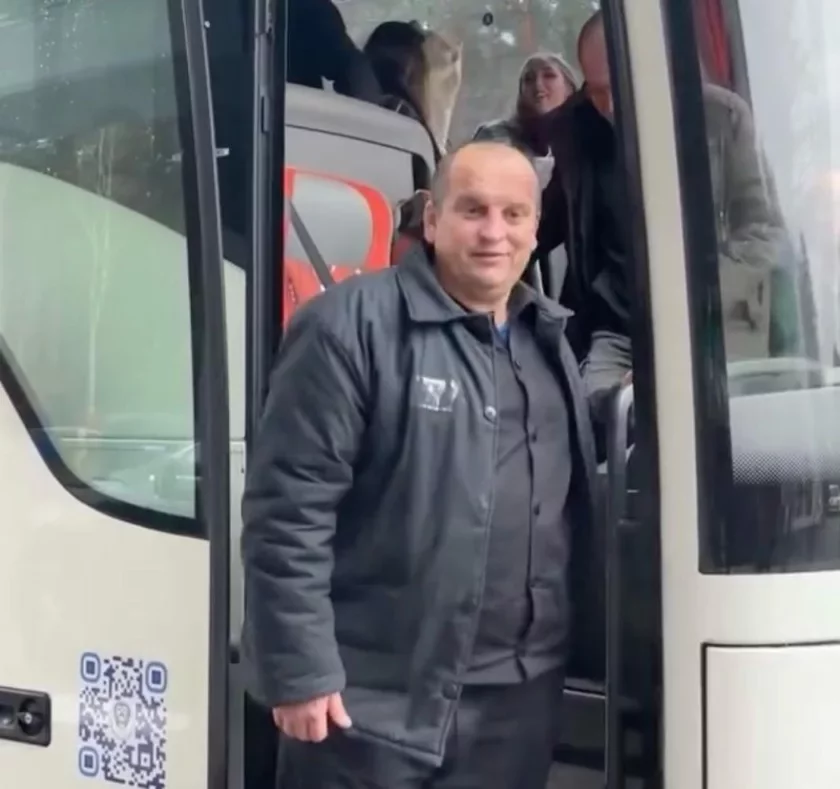
Mikhail Staliarchuk during his release. November 22, 2025
"Bags put on our heads and driven away from the border"
Mikhail Staliarchuk is from Kovel, Volyn region; he lives there now with his family. Previously, he worked as a bus driver for a regular route. From 2018 until his detention, the man made trips on the Kovel – Brest route. He could travel to Belarus four or five times a week. This lasted for almost four years, but on February 22, 2022, after returning on the Brest – Kovel route, Mikhail was detained.
"I was returning from Brest home to Ukraine. My nephew, Dzmitry Hudzik, who worked as a conductor on the route, was with me. At the Makrany border crossing point, KGB officers (I realized this later) in border guard uniforms immediately sent me for a check, claiming I was carrying drugs. They supposedly had information about this – whether they searched or not afterwards, I don't know.
They took our phones and the video recorder from the bus, my nephew's and mine. Then they put bags over our heads and drove us away from the border. They drove us for about four hours, and eventually brought us to the KGB department in Brest.
When I was driving to Brest for the last time, on February 22, a column of military equipment — Russian and Belarusian — was moving towards the border. This was captured by the video recorder. The KGB questioned us about this. They beat us. They asked why there were cameras in the bus. We said that video recorders are installed all over the country, and furthermore, the company installed it in our bus. We were held for three days in the border temporary detention facility – all this time they interrogated us, asking who we worked for."
"Beaten with hands, a bottle of water on the kidneys, electroshocker"
As the man recalls, on the fourth day, he and his nephew were taken to the Leninsky District Department of Internal Affairs in Brest. There, they were told they would be held in the detention center for a month in preparation for deportation.
"My nephew and I were held in different cells for about 28 days. Then we were put in one cell – we thought we would finally go home. But two days later, a criminal charge of "agent activity" was brought – as if we were cooperating with the special services of Ukraine.
I was shocked by this criminal case. I said that the company installed the video recorder for us – regardless of whether we were going to Poland, Ukraine, or Belarus. We have nothing to do with it.
To make us sign the charges, they beat us. The torture lasted two days. They beat us with their hands, with a bottle of water on the kidneys, with an electroshocker. On the third or fourth day, I was brought to the investigator, who started threatening that if I didn't sign, he would call my wife and tell her that I was being released and she should come and pick me up. And he added: "But don't be surprised if they find drugs on her at the border and she gets 13 years – so, think about it."
At that point, I confessed – I recorded a "repentant video" where I publicly apologized to the president and the Belarusian people for my actions. I agreed to this. After that, they stopped mocking and beating me."
"Lawyer said to sign all papers"
Mikhail only learned about the start of the full-scale war in Ukraine a month and a half later:
"It was hard. Because they were saying that the war was going on throughout the country, and I have relatives and family in Ukraine. I was worried."
The man recalls that after his detention, a lawyer was appointed for him:
"Initially, I wasn't called for interrogations much. Then an investigator came and asked who hired a lawyer for me. Because right away, there was a lawyer from them who told me to sign all the papers. I realized she wouldn't help me, and I refused her. Then my relatives hired a lawyer for me. The investigator asked who did it, and if I agreed.
After some time, I was brought from the KGB for interrogation with a new lawyer. I managed to talk to her for two minutes before the investigator arrived. We agreed that I would think before answering, and if something was wrong, she would correct me. During the interrogation, she tried to help me answer, to which the investigator told her: 'Shut your mouth, because tomorrow you'll be sitting in the cell next to him. From today, we know what underwear you wear.' That's when I understood what was happening."
Mikhail was made to sign a non-disclosure agreement regarding the criminal case data:
"When I asked why, the investigator said that if anyone came to me and asked about anything, I should only state the article and that's it."
"Almost all the time I was without parcels"
The man was transferred to the Brest pre-trial detention center a month after his detention, and soon he was placed on a preventative register as "prone to extremist and other destructive activities":
"After I was transferred from the solitary cell to a general cell, I was immediately called and told that I would be put on a preventative register. They told me I needed to sign papers. I replied that I would not sign anything. Then the head of the pre-trial detention center said that they didn't need my signature; they would put me on the register themselves."
For two weeks after the temporary detention facility, Mikhail was held in a solitary cell, and then transferred to a general cell, periodically being sent to the punishment cell. In total, he spent 11 months in the pre-trial detention center before being transferred to a penal colony:
"In solitary confinement, I was held without a mattress or belongings. A two-by-two meter cell. All day, you either sit or pace back and forth. In the general cell, violations were written up for any trifle. I was sent to the punishment cell about 10 times — sometimes for 10 days, sometimes for five.
Almost all the time I was without parcels, because I had no relatives in Belarus. Parcels from strangers were forbidden to me even in the pre-trial detention center, because I was a political prisoner. One time, my wife came from Ukraine via Poland and brought a parcel. As soon as she crossed the border, she was called for interrogation. Then she was called to the KGB – there they interrogated her for four or five hours, intimidating her. Later, she wanted to come again, but they didn't let her cross the border.
She was told that her "relatives committed a crime on the territory of Belarus, and their visit is not a reason for entry into Belarus." They put a stamp in her passport prohibiting entry. She told me she would try to come again, but I already asked her not to go, because she would be imprisoned."
"Six years based only on assumption — how is that possible?!"
The trial of Mikhail and his nephew Dzmitry took place behind closed doors. There were a total of six hearings. Judge Andrei Liashchanka sentenced Mikhail to six years in a penal colony, and Dzmitry to five. There was also an appeal in the Supreme Court, but the verdict remained unchanged – by this time, Mikhail had already been sent to the penal colony.
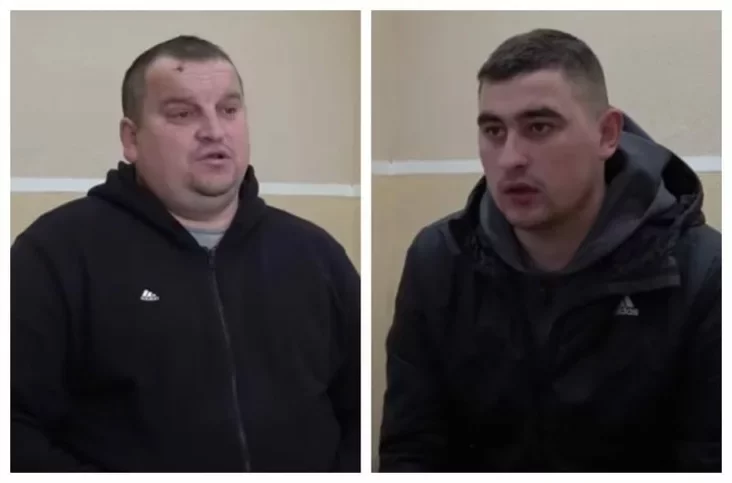
Mikhail Staliarchuk and Dzmitry Hudzik
"In the case materials, everything was based on the prosecution's assumptions that Dzmitry and I "could have cooperated with various special services." When the prosecutor requested six years, I asked her: "I assume you are betraying your husband, that you are taking bribes, but that's my assumption, I have no proof. And you are asking for six years for me based only on assumption – how is that possible?!" She replied: "Sit down, it will be seven now."
I wasn't even surprised by the sentence anymore... In a year in the pre-trial detention center, I saw how many people were imprisoned and for what – I already understood everything. I was shocked that people are jailed for likes, for comments! Such sentences are given for nothing! Now in Ukraine, I tell people what's happening there – everyone is shocked! Nobody believes that such things are happening there and that people are imprisoned for such reasons."
The outcome of the trial and the essence of the charges against Mikhail and Dzmitry became known from the ATN propaganda film "Counterintelligence. Operations of the Belarusian KGB against Western and Ukrainian special services." The man himself saw the report after he was already free:
"I found it funny. Not only are they turning their own people against themselves, but also the Ukrainian people."
"At the moment of my release, I had already been in the punishment cell for more than 30 days"
Mikhail was sent to penal colony No. 3 "Vitsba" to serve his sentence. The journey there took about a day.
"They took me to the colony in handcuffs — hands behind my back. My belongings, carry them however you want. On the train, my hands were also in handcuffs – they didn't even switch them to the front. For a day, I was left in the Vitebsk pre-trial detention center.
On the first day at "Vitsba," they immediately started threatening to take me to a "high-security prison" [крытая, literally "covered," implies a more severe regime]. The first three days passed calmly, and then it was inspection after inspection. For "discrepancy of items in the inventory," I was given 10 days in the punishment cell (SHIZO).
When I got out of the punishment cell, I was sent to a squad. There, violation after violation was issued. For any trifle, for example, for an unbuttoned button, violations were recorded and I was sent to the punishment cell. For the first year, I was often sent to the punishment cell. For a month, they could write violations every two days. If you didn't go to work or refused, it was immediately 90 days in the punishment cell or directly to the "covered" [high-security prison].
I tried to spend more time at work, because if you stayed in the squad, violations were immediately issued one after another. For some time they didn't bother me, and then again constant violations and the SHIZO. At the moment of my release, I had already been in the punishment cell for more than 30 days. The head of the colony came and added another 15 days, saying that I might be taken to Mahilioŭ to a "covered" [high-security] prison as a "malicious violator."
Mikhail notes the low level of medical care in the colony:
"I tried not to go there myself, because the help was useless. An acquaintance once went to have a tooth pulled, and the medical worker knocked out a healthy tooth with a hammer. Without an injection – without anything. She didn't even pull it! You walk into the medical unit, and there's a hammer and chisel lying there. She says if it's not the right tooth, she'll knock out another one.
If you're sick, there's one pill for everything. I'm hypertensive, so it was hard for me there. During detention and torture, my tooth was damaged. Now I had an MRI, and the bone is already gone. During this time in captivity, four teeth fell out."
"He felt so bad that he collapsed in the barracks"
The former political prisoner told about the circumstances of the death of Vadzim Khraśko, who was convicted for donations — he witnessed it:
"He already had health problems. In January 2024, he had a fever and went to the medical unit, but they didn't admit him there. Then he felt so bad that he collapsed in the barracks. The staff themselves got scared. They called a controller and a medic. He was carried on a stretcher to the medical unit, where he immediately died. An ambulance arrived and took him away. As the controllers later said, "he burned out in three days" — he died of inflammation, as the autopsy showed. If they had done an X-ray in the medical unit and helped him in some way, this wouldn't have happened."
The man notes that he faced biased treatment not only because of his political charge but also because of his nationality:
"The squad leader told me directly: 'I hate you Khokhols [derogatory term for Ukrainians].' At every turn, they tried to suppress and insult us.
However, there were Ukrainians in the colony who were not imprisoned for political articles – their treatment was better. They immediately told me: you understand, you're a political prisoner with a yellow tag.
Some treated me normally, but directly told me that I should understand that if they didn't issue violations to me, they would punish them. They said they had an unwritten order – to issue more violations and send political prisoners to punishment cells, to deprive them of parcels, calls, and meetings. To deprive them of everything they have.
Everything is forbidden for a political prisoner in Belarus. Rapists and murderers were treated better than political prisoners. It's very hard for political prisoners there."
"You must understand that I am their hostage"
The former political prisoner says that thoughts of release helped him cope psychologically:
"It was hard at first. In 2023, Belarusians started to be released on pardons. There was hope that it would reach me someday too. I also hoped that I would be exchanged. I lived on that hope.
The KGB investigator told me that I should understand that I am their hostage. When it's necessary, then they will release you. You can sit until the end of your term, or you can sit for a year. Nothing depends on you."
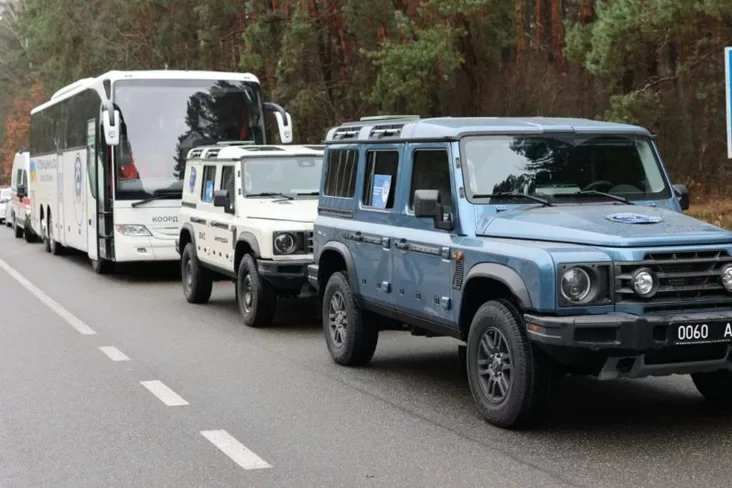
Ukraine's release of a group of prisoners from Belarus, among whom was Mikhail. November 22, 2025
Mikhail was released on November 22, 2025 – Ukraine then returned 31 citizens of its country. The political prisoner was released from the SHIZO, where he had been held for more than 30 days:
"Around 4 PM on November 21, controllers came to me and told me to gather my belongings and follow them. I asked where, but they told me not to ask unnecessary questions. Then they told me to go to the barracks, gather all my belongings, and not talk to anyone. I did so. I was taken to a point, like for a transfer stage, where I was thoroughly searched. They took all my tags and all my notes. No one said anything about where we were going, only that it would be a special transfer.
At that moment, I didn't even hope I was going home, because there were three other people with me – they were not on political charges (fraud and drugs). If there had been other political prisoners with me, then maybe I would have understood that we were being released. I already thought they might be taking me to Russia.
At one in the morning, a senior operative came and said that a special transfer had arrived. They told us to lower our heads, not to turn anywhere, put handcuffs behind our hands and a bag over our heads. They put us in a minibus. I heard that others were released like this, but those were political prisoners. With me, everyone was non-political, so I had doubts about where I was going. They drove us like this all night, no one spoke to us. Someone tried to adjust the bag on their head, and they were beaten along the way.
In some forest, they took us to a toilet – still in bags, but with our hands cuffed in front. We drove like this for about half a day. Then they transferred us to another bus, where there were more people. We drove a bit further, and they told us they were taking us to the border, that they would remove the bags now and hand us over to the Ukrainian side.
When we arrived, still on the Belarusian side, they removed the bags, gave us packages with sandwiches and water — all this show was filmed. Then they transferred us to a bus and we went to Ukraine."
"You fall asleep for a couple of minutes and wake up"
Mikhail says that before his detention, he was unaware of the political situation in Belarus and the mass repressions that have been happening since 2020:
"I knew nothing about it. I heard about the 2020 protests, but it didn't particularly interest me at the time. I don't know how true it is, but they say that not even all Belarusians know and understand what's happening in their country. Until it affects someone personally, no one fully understands.
I wouldn't advise anyone to go to Belarus. In the place of Belarusians who left due to repression, I wouldn't even think about returning."
The former political prisoner is now home with his family, but he still continues to follow the situation of political prisoners in Belarus:
"I have many friends who remained in captivity – all of them are political prisoners. So it's important for me to know if any of them have been released or not. I maintain contact with the relatives of some of them."
The man has been free for almost three months, but he admits that adaptation is difficult:
"Psychologically, it's difficult. I can't readjust... There's no sleep: you're more awake than asleep. You fall asleep for a couple of minutes and wake up. Different thoughts flood in."

Syrskyi: The operation of one of the repeaters was recorded again in Belarus. They will not turn them on again, they will realize that it is not necessary

Syrskyi: The operation of one of the repeaters was recorded again in Belarus. They will not turn them on again, they will realize that it is not necessary


"Karotkevich's name is a tool in dirty hands, a club in political fights." What propaganda responded regarding the neglected home of the classic's family


Comments
Конечно не верят. Если по телемарафону пять лет говорят не об этом, а про босиком на скамейке, то чему удивляться.