


Psychology of a Super-Agent: How one of the most successful KGB operations ended in its biggest failure
It was crucial for the KGB that Bandera be killed by a Ukrainian. But this very desire would lead the Soviet special service to a blunder. The blow to their reputation was such that the USSR launched a special disinformation operation. But even it was exposed. The declassification of Soviet-era archives by the Security Service of Ukraine made thousands of new documents available about Bohdan Stashynsky, his handlers, and his family. Thanks to these archives, it was possible to see those events through the eyes of the authorities and through the eyes of Stashynsky's fellow villagers, who were carefully monitored by secret agents. Ukrainian historian Dmytro Lukin writes about the killer's recruitment and repentance. This article was originally commissioned by the magazine "Nasha Historyja" (Our History). Since 2022, for five years now, Dmytro Lukin has been fighting in the Ukrainian army.
Bohdan Stashynsky was considered one of the most talented agents in Moscow — despite living for many years in the GDR and FRG, he never learned to speak fluent German.
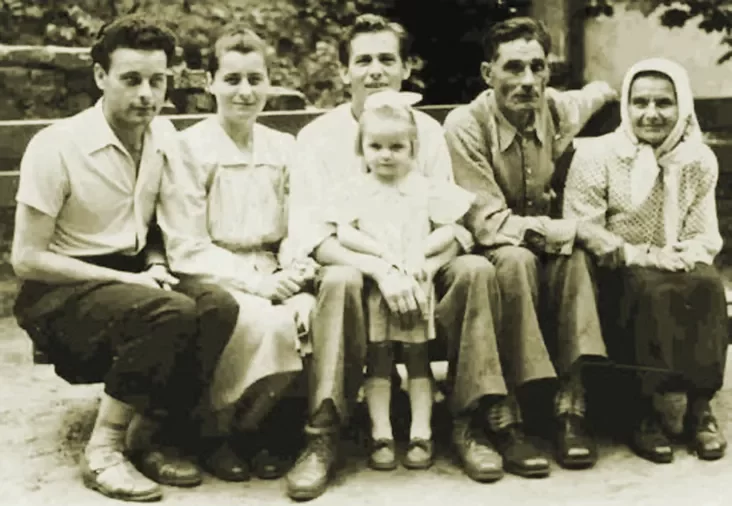
When Stashynsky's family found out that their son was working for the "Muscovites," they boycotted him for several years until he wrote his father a sharp "final letter."
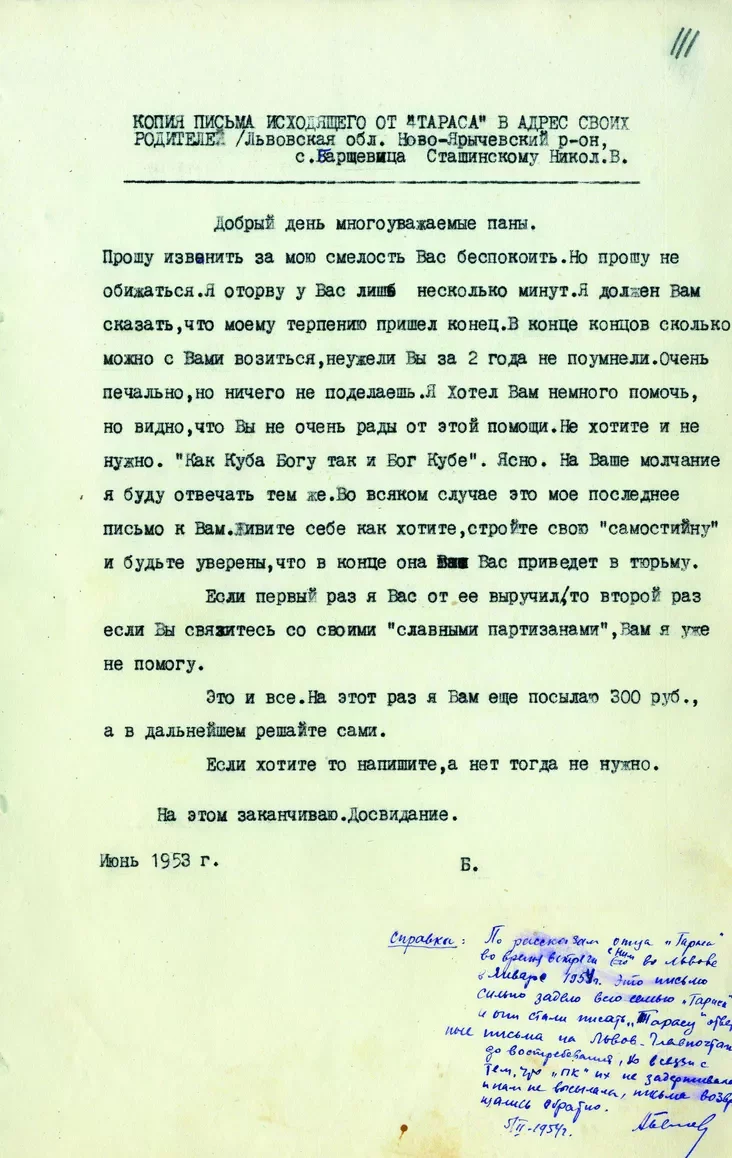
And after the Stashynskys reconciled with their son and started receiving money from the KGB, it was their fellow villagers who began to ignore them. And when it became known from radio broadcasts that Bohdan had killed Bandera, agents in the kolkhoz were tasked with finding out if anyone intended to kill the elder Stashynskys in retaliation.
A Stranger Among His Own
Stashynsky was recruited classically — by surprise.
The Stashynsky family lived in the village of Barszczowicze near Lviv. They lived terribly poor, owning less than a hectare of land — practically nothing in those days. But, like many peasants of that time, they yearned for education, seizing the opportunity to help their children get ahead in life. They hated the Soviets: the NKVD arrested their grandfather and shot him in June 1941.
Even as a schoolboy, Bohdan helped the Bandera partisans. Although it was already the late 40s, they still held strong in the forests of Lviv Oblast.
Stashynsky attracted the attention of the MGB — as the KGB was called until 1953 — because two of his sisters helped the UPA, and one was even engaged to Ivan (Karmeliuk) Lob, a leader of one of the Ukrainian Insurgent Army detachments.
At that time, Stashynsky had entered a pedagogical institute in Lviv.
Stashynsky was monitored and detained for fare evasion on a suburban diesel train. The Chekists knew that he, a half-starved young man, rode home "like a hare," and they seized upon this. It was important for the special services that no one, not even accidental train companions, suspect that the 18-year-old youth was being targeted for recruitment.
After the first conversation, there was a second, again about the illegality and futility of the struggle "for an independent Ukraine." And about the fact that his parents and sisters would be arrested as accomplices of bandits if he did not start helping the Soviet authorities. And an example was before his eyes: his sister Maria was mercilessly beaten during an NKVD interrogation (as a result, she would suffer from illnesses her whole life).
On an April night in 1950, a thin, dark-haired young man with delicate facial features accepted the "organs'" offer.
The MGB ordered Bohdan to infiltrate a partisan detachment. A few months later, his sister's fiancé would be killed in an ambush based on Bohdan's tip-off.
Sending agents into partisan detachments was a common MGB practice in those years. Stashynsky impressed his handlers with his natural intelligence and his ability to present information accurately and without distortion.
Secrets don't stay hidden for long, and it quickly became known in the village that Bohdan was working for security. In 1951, the Stashynskys completely severed ties with their son and brother. Bohdan sent them letter after letter and money — without a response. Nevertheless, in gratitude for his service, the MGB completely stopped its surveillance of his relatives.
Meanwhile, he, rejected by his family, was offered permanent work in a special unit of the Lviv MGB Directorate. His tasks included organizing provocations, creating a negative image of the UPA, and liquidating insurgent commanders.
The underground was running out of steam; leaders were being shot or arrested one after another. By 1952, UPA forces had completely ceased combat activity. Moscow then wanted to neutralize foreign Ukrainian centers. The KGB understood that it would be easier for a Ukrainian, who knew both the language and the national psychology, to get close to the OUN leadership. In the same year, Stashynsky was sent to the Kyiv special school of state security under the name Hryhoriy Moroz. He was being prepared for work abroad. He would have to approach the leaders of the Ukrainian emigration just as he had approached partisan commanders in Western Ukraine.
In 1953, 21-year-old cadet Bohdan wrote another letter to his parents — the most poignant and at the same time imperiously contemptuous. It's hard to say if he already understood then that all his letters were being censored, and their typewritten copies were filed in a strictly secret case — no longer for Hryhoriy Moroz, but for "Agent Taras."
Either this letter worked, or the KGB's efforts to mend the son's relationship with his family, but after this letter, correspondence resumed. The underground was defeated, and the son was on the side of the victors.
And Bohdan arranged with his superiors for the KGB to pay his father 400 rubles monthly. This was roughly equivalent to the average monthly salary of a kolkhoz worker at the time and was 2 times less than the average worker's salary. Monthly receipts have been preserved in the archive. But the father's letters to his son remained cold and formal.
Stashynsky told his relatives that he worked at a secret radio station. But his relatives were still very afraid. Agent Olga recorded that Bohdan's sister threatened a neighbor with whom they were feuding: "If you give us up, we'll drag the whole village down with us!"
His Path to Europe
After completing an express German language course and mastering the basics of intelligence, Agent Taras — now Bronislav Kachar (for Poles) or Josef Lehmann (for East Germans) — was sent to the KGB residency in Karlshorst, Germany. More training, more checks — in 1955, he was "released into the natural environment" to live for a while as a German, a translator from Polish.
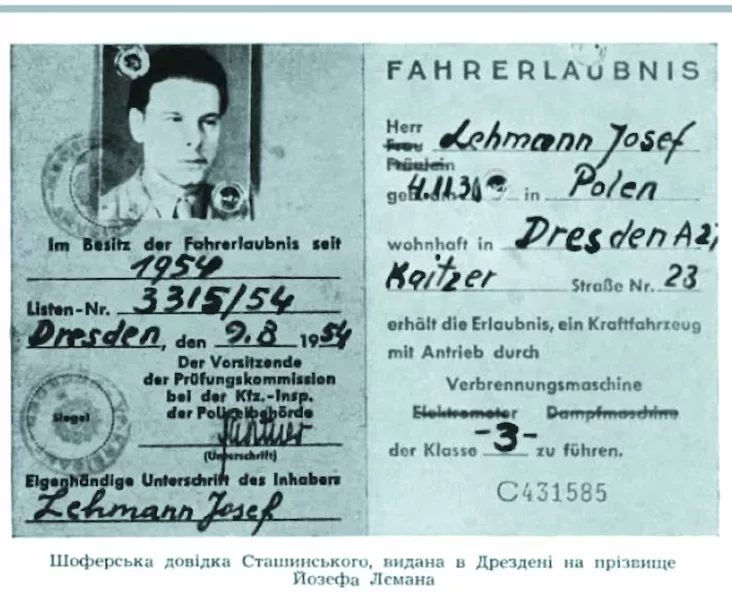
His legend: he is German, grew up in Galicia, and has only now repatriated, which is why he speaks German very poorly and with a Ukrainian accent.
Taras's reports from Zwickau were also accurate and concise. "East Germans hate the Soviets, consider them the cause of all their troubles," he reported, "and they trust me, since they don't hide such sentiments from me." In his reports, he also described daily realities and national character. Germans are stingy, he wrote, in cafes everyone pays for themselves, they drink vodka in tiny shot glasses, and give the waitress a couple of pfennigs for a tip. Germans recognize Russians by the fact that they order a whole bottle at once and give the waitress several marks for a tip.
A year later, "Josef Lehmann" went behind the "Iron Curtain" for the first time, to Munich. The purpose of the trip was to establish contact with agent Ivan Bysaha-Nadeychyn, close to Lev Rebet, an ideologue of the OUN faction opposed to Bandera. The double life affected the mental state of the Munich "mole." Bysaha had to be transported to the USSR. He would leave his affairs to Stashynsky. And the main task among those was the assassination of Rebet.
Meanwhile, in the USSR after the 20th Congress, prisoners were released from the camps. In church, Stashynsky's sister met her former underground friend, who had returned from Vorkuta, and was afraid to show that they knew each other. "Are you pretending not to recognize me?" she sharply asked. "But I didn't betray you then, though I could have." "It would have been better if you had betrayed me!" Stashynsky's sister flared up. "Then I wouldn't have sent Bohdan into the forest, and my Ivan would have stayed alive!"
Josef Lehmann transformed into Siegfried Dräger and began surveillance of the target.
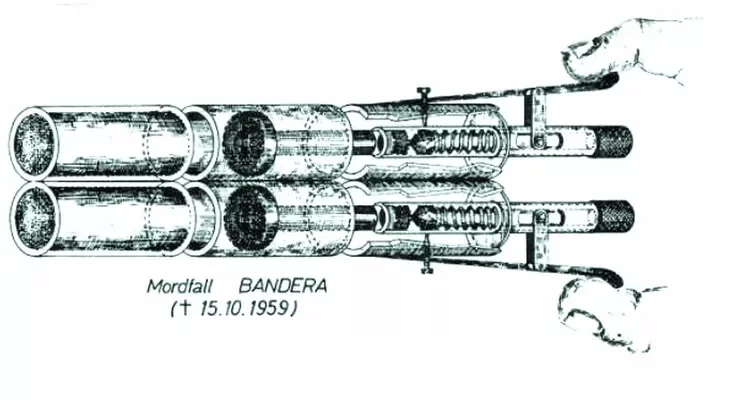
In September 1957, Stashynsky was given the latest sample of spy weapon — a cylindrical gas pistol that could be hidden in a newspaper.
Pressing the trigger released a lethal dose of hydrocyanic acid into the victim's face, which yielded an immediate result and then quickly evaporated, leaving no trace.
As a result, the victim's death appeared completely natural. However, there was also a danger of the agent himself being affected, so he took an antidote before and after the operation.
First Assassination
"Dräger" trained on dogs and in October 1957 again went to Munich. In his luggage were two cans with tasty sausages. In one of them, in a dense casing, instead of food, lay a gas pistol.
On the morning of October 12, having taken up position beforehand, Stashynsky met Lev Rebet near the publishing house where he worked, in the city center, at Karlsplatz, 8. They entered together, the shot was successful, and the assassin left the scene of the operation unnoticed. Newspapers would soon report Rebet's sudden death from a heart attack; no one suspected murder.
Agent Taras returned to the GDR and received a prize — a Contax camera, a medal, and money. As well as a new assignment — the assassination of Stepan Bandera himself.
Hunting Bandera
The 50-year-old Bandera was a legend for Western Ukrainians. A strong-willed and charismatic son of a priest, he made the Organization of Ukrainian Nationalists (OUN) powerful and widespread.
Ukraine was divided between the Soviets and the Poles, and the OUN saw its task as fighting both the former and the latter. The OUN acted harshly, using terrorist methods. In response to intensified Polonization, they killed the Minister of Internal Affairs of Poland. In retaliation for the Holodomor, they attacked the USSR consulate in Lviv. Bandera himself participated in these operations.
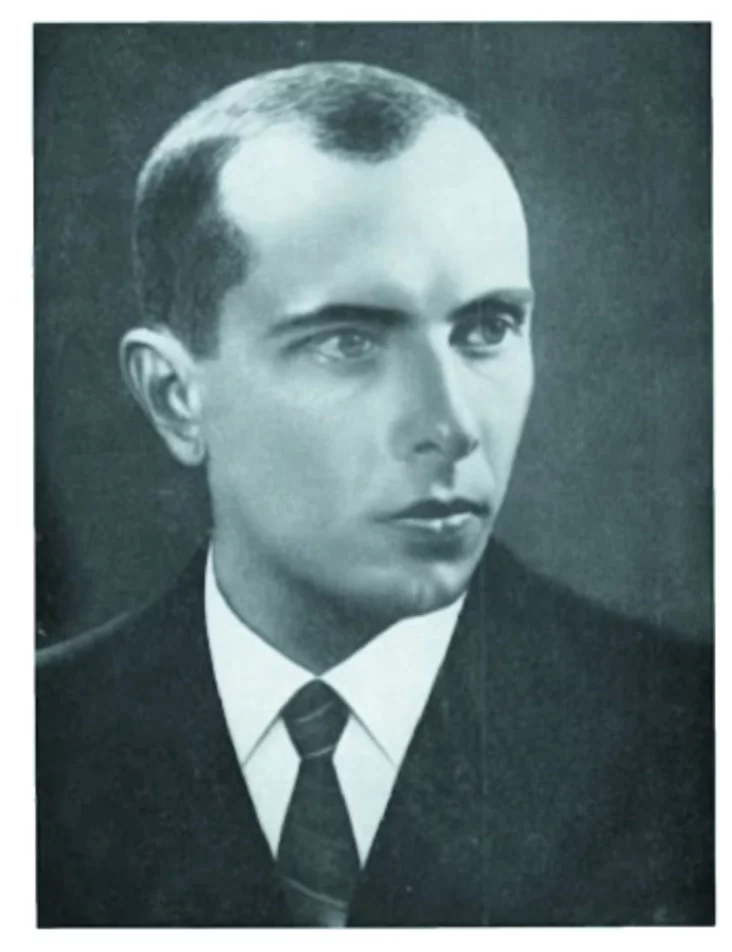
He was sentenced to death, but it was commuted to life imprisonment. September 1939 found Bandera in a Brest prison. The guards fled, and the prisoners were freed.
To fight the Poles, the OUN relied on the Germans. The Germans had their own plans. As soon as the Soviets retreated from Lviv in 1941, Ukrainians declared independence. Enraged Germans arrested Bandera and placed him in a concentration camp. He could not influence events in Ukraine during the war. Part of the OUN worked for the Germans, the other (Bandera's followers) formed the partisan Ukrainian Insurgent Army.
After the war, Bandera sought support from the British and Americans. Under an assumed name, Bandera lived with his family in Munich. During the post-war period, attempts were made to kill him five times, but he was lucky.
His children only learned their real surname and who their father truly was after his death.
For the new task, the weapon was modified — the pistol was now double-barreled so that not only Bandera but also his bodyguard could be instantly eliminated.
The clandestine Bandera still needed to be identified; the special services knew his pseudonym — Stefan Popel. Stashynsky found Bandera-Popel's place of residence using the Munich address book, after which he shadowed him for nine months.

The OUN leader lived on a quiet street, Kreittmayrstrasse 7. It's not the city center, nor a suburb, a typical five-story building in a residential area. Now it's brick-red, but then it was unpainted, gray.
Bandera drove his favorite "Opel-Kapitän." It was in this blue car that Popel first caught Stashynsky's eye when he arrived in Rotterdam for the twentieth anniversary of the assassination of Yevhen Konovalets, Bandera's predecessor as head of the OUN, by a Soviet agent. Stashynsky then clearly remembered a short man with not at all heroic facial features, with already graying hair and receding hairline, who spoke strongly and confidently. Photos of Bandera's speech at that rally are online. Stashynsky did not make it into the frame.
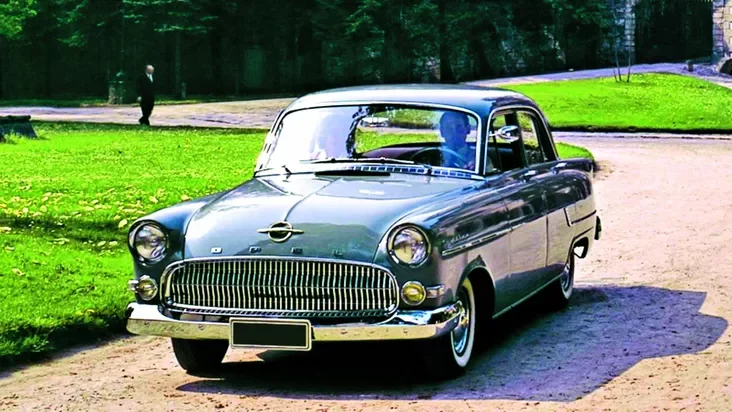
Death of Bandera
The first assassination attempt in May 1959 was unsuccessful: the killer could not get into Bandera's building entrance. The residency insisted on a repeat visit to Munich. The second time, on October 15, Stashynsky managed to enter the building, but the operation almost failed again: one of the neighbors was going down to the shop at that very moment. At the same time, the assassin was helped by the absence of a bodyguard — Bandera had given him the day off.
Bandera entered the building alone, carrying a bag of vegetables in his hand. Stashynsky descended the stairs to meet the victim, shot Bandera with both barrels, and then left the entrance.
Bandera cried out and instantly lost consciousness and fell. Neighbors ran out at the sound and found the body — Bandera had fractured his skull on the concrete steps when he fell. Only at the hospital would doctors see that the deceased had a pistol on his belt and call the police.

For the successful "special event," the agent received one of the highest state awards of the USSR — the Order of the Red Banner. However, the shot with a double dose of poison revealed that the OUN leader did not die a natural death. During the autopsy, cyanide was found in his stomach. But the circumstances of the murder (or suicide, as there was such a version too) remained a mystery for another two years.

Unexpected Turn
On the evening of August 12, 1961, a few hours before the start of the construction of the famous Berlin Wall, Josef and Inge Lehmann, a married couple, crossed the border into West Berlin. The next day, they were to bury their five-month-old son. It was only because the boy had died that Lehmann-Stashynsky was allowed to come to Berlin to see his German wife. When the Soviet special services raised the alarm, it was already too late.
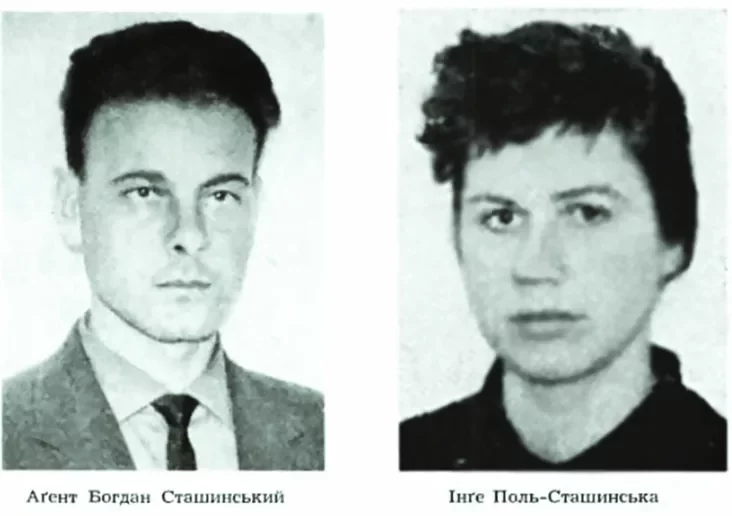
When there was no longer any doubt that Stashynsky had fled to the West, Agent Taras was renamed "Object Scorpion," and Soviet special services began a preemptive game. In October 1961, in the midst of the Berlin Crisis, East German politicians held a press conference, blaming the assassinations of Ukrainian emigrants on West German intelligence and on members of the OUN themselves. But here too was a blunder: the person designated by the KGB and "Stasi" as the "scapegoat" had an ironclad alibi — on the day of Bandera's assassination, he was in Rome.
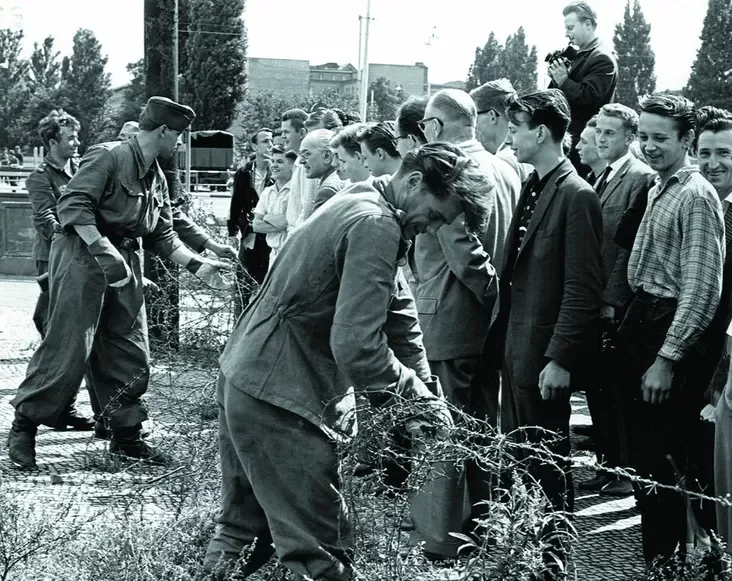
On November 17, West German Chancellor Konrad Adenauer publicly mentioned the Stashynsky case for the first time. By that point, the Soviet killer had already been cooperating with the investigation for two and a half months.
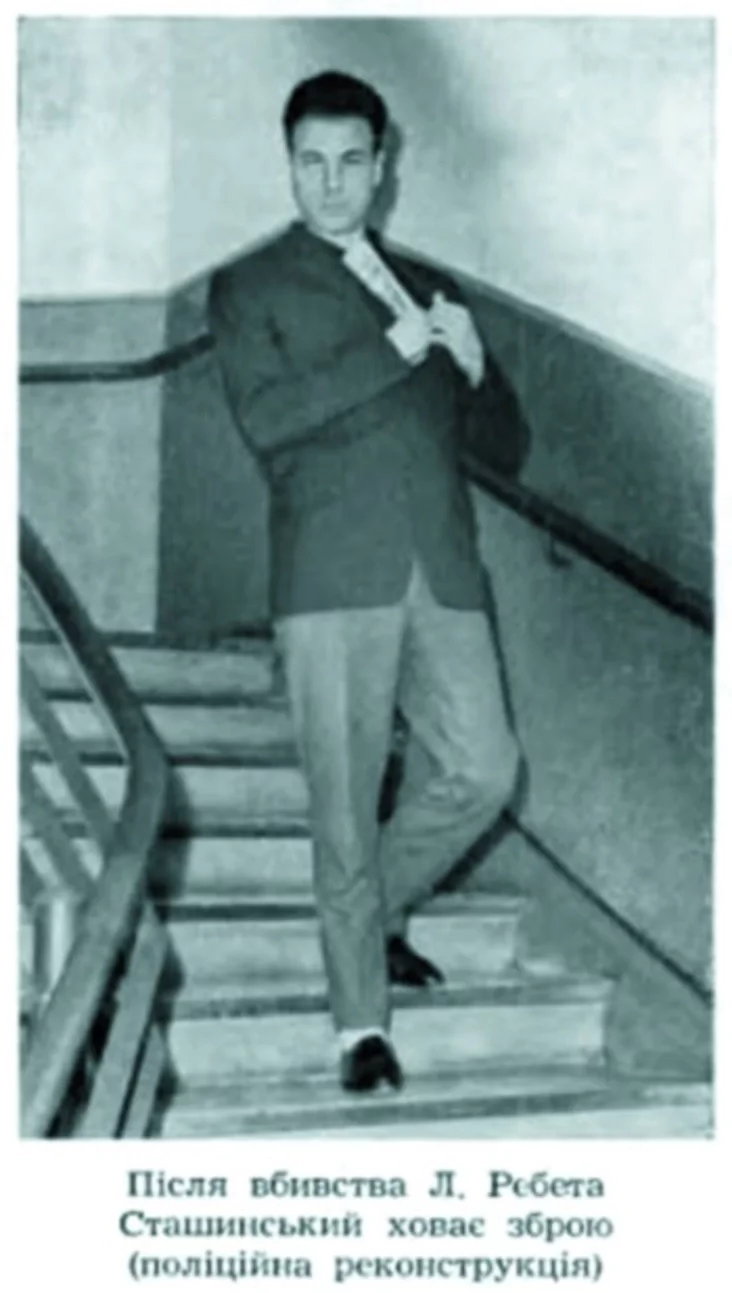
The open trial took place in October 1962, becoming an important part of the backdrop against which the famous Cuban Missile Crisis unfolded.
The Stashynsky Trial
The Stashynsky case, in its time, had as strong an impact on Western public opinion as the recent Skripal poisoning. The Western community did not suspect how extensive the activities of Soviet special services were within their countries. Initially, Americans and Germans did not even believe Stashynsky's story about a special silent pistol. They assumed that Bandera could have been eliminated through an agent in his entourage, by slipping poison into his tea. But poison from a pistol?
The investigation not only revealed the inner workings of secret KGB operations to the world but also unveiled the killer's typology. Stashynsky's psychological portrait turned out to be far from the image of a ruthless killing machine. The author of the best book about Bandera's assassination, Harvard professor Serhii Plokhy, even compares Stashynsky to Raskolnikov. The Ukrainian-language edition of Plokhy's book was published in 2017 in Kyiv under the title "Murder in Munich. On the Red Trail."
In court, Stashynsky stated that he agreed to cooperate with the KGB to save his family from arrest for collaborating with the Ukrainian Insurgent Army. Perhaps it was his Christian family upbringing and pre-Soviet notions of good and evil that pushed Stashynsky towards self-exposure, suggests Plokhy.
And then there was love — Inge Pohl, an East German citizen, permission to marry whom Bohdan obtained from the KGB with great difficulty in 1960. Inge was shocked that Soviet special services kept all aspects of the Lehmann-Stashynsky family life under control.
And then there was the family's earlier distrust. Soon after the wedding, he and Inge visited his parents, and he was still met as a stranger.
In court, Stashynsky would recount that even while preparing the assassination of Rebet, he felt uneasy, and the psychological turning point occurred during the viewing of footage of Bandera's funeral in October 1959, which thousands of people attended. The callous reaction of his Moscow handlers to the death of his infant son put an end to his ties with the KGB. He would never see him alive — only in his coffin. And even at that moment, agents would be watching the Stashynskys.
Bohdan and Inge seized the first opportunity to escape. If they had delayed even until morning, due to a desire to throw a handful of earth onto their son's grave, they would not have been able to carry out those plans.
The Tracks are Lost
The investigation was based almost exclusively on Stashynsky's detailed testimony. Where it could be verified, it was confirmed down to the smallest detail.
Bandera's associates considered the sentence too lenient — only 8 years in prison for two premeditated murders. The court justified its leniency by stating that the accused was a puppet in the hands of the real criminal — the Soviet regime. Even Rebet's widow stated in court that she forgave Stashynsky.
In Moscow, there was a major debriefing. Heads rolled; some even ended up in pre-trial detention centers.
Stashynsky's parents and sisters again came under close surveillance by the authorities: the KGB hoped that Scorpion would try to contact them, but he did not. Bohdan's father used the authorities' attention to obtain financial assistance for buying an apartment in Lviv for his daughter Iryna. Iryna would later name her daughter Bohdana.
Stashynsky, having served the requisite two-thirds of his sentence, was released and secretly transferred to the USA. Information about this would only appear in the press three years later. The subsequent tracks of the former Agent Taras are lost. It was written that he and Inge moved to the Republic of South Africa. But is this fact not also a smokescreen?
Perhaps Bohdan Stashynsky is still alive? There is no information.
-
Ice Mummies and the Viking Pass. How Mysteries Emerge from the Ice, Changing Perceptions of the World
-
"About 70% of Russian visitors turned out to be vatniks." An ex-guide from the WWII museum, detained by his own tour group, is now popular in Warsaw — we spoke with him
-
Collection of Publicist Works by Albin Stapovič Published in Poland
Now reading


Belarusian woman from the USA with an expired passport was taken to the basement at the border and had her phone checked. She compared Belarusian border guards to angels


Comments