


«My life is also full of compromises». Kanstantsin Kaveryn – on helplessness, BATE, and his way to avoid depression
Former radio host Kanstantsin Kaveryn has been living in Warsaw for over half a year, where he hosts the YouTube show «Ordinary Morning» with his colleague Liudmila Milaslauskaya. Kaveryn spoke to Nasha Niva about his new city, life amidst Belarusian events, and the meaning of his work.
«To say that someone is outside of politics is the same as calling them a person outside of hygiene»
Nasha Niva: What does your life consist of now?
Kanstantsin Kaveryn: Morning broadcast, lunch, an afternoon nap for 40-60 minutes. Then a cup of coffee and work – a daily immersion into the Belarusian agenda. After work, I have chess and sleep.
NN: Are you satisfied with what you are doing now?
KK: I think so. Of course, given the conditions we work in, and how frightening it is for people in Belarus to watch what we do. Nevertheless, they watch, our views, subscribers, and likes are growing, which means we are needed and doing the right thing – at least, I want to believe that. But it seems that for a channel less than a year old, 20 thousand subscribers and two thousand daily online viewers are good indicators.
NN: Why has a political agenda appeared in your life? Previously, as far as I know, you didn't work with it so closely.
KK: Because the war started, and a full-blown dictatorship rose in the country, and I see no reason now not to be part of the political agenda. Politics is something we live with every day, and to say that someone is outside of politics is the same as calling them a person outside of hygiene. Like, I won't brush my teeth or wash myself because I'm outside of hygiene, why bother? But then, sooner or later, people will start turning away from you, and eventually, you'll rot.
Now they say, supposedly, theater, sports, painting – are outside of politics, but all this is an attempt to justify oneself, self-deception. I couldn't help but find myself in the political agenda, because ultimately, this is my life and my vested interest, the main thing that affects me. I want, for example, to play football or write songs, but I can simply be put in prison for not playing football correctly or writing the wrong songs. If someone still manages to be outside of politics, I'm happy for such people, but I think that sooner or later politics will come to them; it's already quietly arriving.
NN: What about non-political things, the simple joys of life? Do they have a right to exist?
KK: It's harder with that, but of course! It's always pleasant to drink a cup of coffee in a cafe, listen to music, watch a movie that is not directly related to political technologies. But
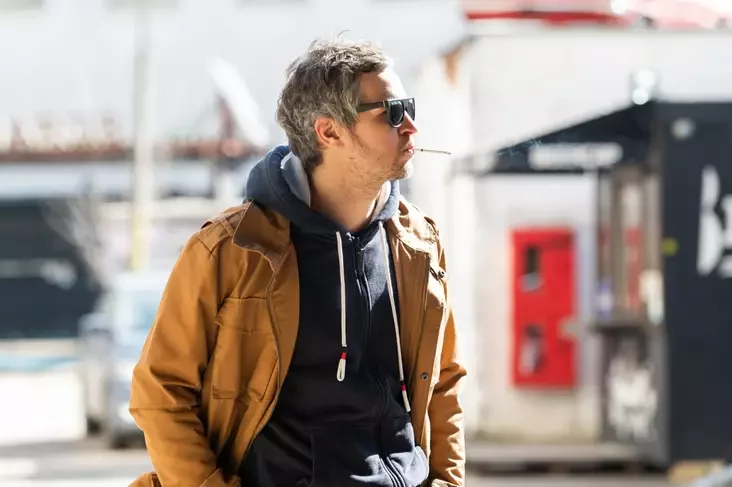
while the war is ongoing, while what is known is happening in Belarus, I drink coffee with a cigarette in sunny Warsaw with the thought that I am probably still an asshole, and I cannot be completely happy. This is an internal feeling that cannot be overcome.
Intellectually, I realize that I fully have the right to this small daily happiness, but my heart doesn't leave me in peace. Simply because there are people who speak the same language as me and share the same origin, but now they are suffering terribly, and I can't do anything about it, and I am also to blame for it.
NN: But one can, for example, transfer money for the benefit of political prisoners or do something else for them.
KK: I believe that informational warfare is no less important than simple volunteering and other aid. Sometimes I dream of becoming an IT specialist, disconnecting from the agenda, and living my life like most people on planet Earth, without daily immersions into this hell and while preserving my mental health. But I still do what I do, and in this case, I do what I can. And, since this is my profession, I do what would be useful to people who share Western values in this fight against obscurantism.
NN: Is this the principle of "do what you can, and let come what may"?
KK: Of course, cultivate your own plot. One wants to help everyone at once, stop everything and punish the guilty, and do it without leaving one's apartment, but that's impossible. So, little by little, we contribute to the common cause.
There's nothing else you can do. You can, of course, take a rifle and go to Bakhmut. But, first, I am very afraid of death and war, and second, it seems to me that I am more useful on the information front than on the front with a rifle.
«Sometimes you want to say that you're hurting, and millions of indifferent people oppose you, but rationally you realize that's not the case»
NN: How do you feel about those who live as if there are no political prisoners?
KK: And how should they live? Every person has their own story. For example, an IT specialist left Belarus. He happily travels the world, writes his code, and earns a salary. Everything is good for him, and it seems to us that for him, neither political prisoners nor war exist. But in reality, they do, and we will never know how much he hurts or what they talk about over dinner with his wife, how many thousands of dollars or euros he donated to the Armed Forces of Ukraine or the Bysol foundation. However, there are also those who went to Lep's concert in Minsk in the midst of the war, and about them, I can say that they are moral degenerates.

Sometimes you want to say that you're hurting, and millions of indifferent people oppose you, and sometimes I break down. But rationally, you realize that's not the case, and generalizing someone to the concept of 'them' is simply unreasonable.
NN: Do stories about how Lep's and Minsk's hockey Dynamo fill "Minsk Arena" frighten you?
KK: They deeply sadden me. In Minsk, I lived near "Minsk Arena". Sometime in 2020-2021, in a local pub, we met a group of guys who were coming from a match, they still had their hockey scarves. We asked them, like, why do you go there, you understand it's a pro-government story. We heard in response: well, what about us, we were given tickets at work, we're doing it for the kids, the season ticket is bought, we have to use it... When you talk to a specific person, you see that he simply really likes hockey and he has stepped over himself. He understands what's happening. If we want people not to go to hockey, we measure by the highest standards of conscience, but everything is much more complicated.
I'm sure that many people who do not support the war, who dislike the policies of Russia and Lukashenka, also went to Lep's concert. But it saddens me.
NN: What do you do to abstract yourself from the difficult informational agenda?
KK: Chess helps me, I can read a book. But it's difficult for me because I love Russian literature and can't read it now. Thoughts constantly creep in: how could they have written so well, and yet the country ended up like this?
And so – like everyone else: watch a series, go to the park. There's less alcohol in my life, because I understand it's a path to nowhere. No, I haven't given it up completely; I can drink once a week, and that's enough for me. I want to tell those who are in a depressive state and try to drown it out with alcohol: the less you drink, the happier your life.
A healthy lifestyle? No, I move little, although I love cycling, but here you have to force yourself. Although, when you do something like that, you always feel good afterwards.
NN: Is Warsaw, where you live, suitable for bike rides?
KK: Yes, there's much more barrier-free space here than in Minsk. Compared to it, Warsaw is a paradise for cyclists, but they say it's even better in Amsterdam.
It was very difficult for me to accept Warsaw; during the first months of emigration, I howled at night, I dreamed of Minsk. But now Warsaw is gradually growing on me. Poles are very sociable, responsive, kind, and that's captivating. I like the city, I love walking through these old streets. Of course, Warsaw was destroyed during the war and rebuilt, but it was done beautifully, and when it's spring and the sun is shining, all this is very soothing.
I like Warsaw's public transport. I very rarely drive here, although in Minsk, that's the only way I traveled.
«Europe is on our side»
NN: How do you envision your return to Belarus?
KK: Triumphant. We all meet in the center of Minsk, stroll around, give concerts. Everything around is white-red-white, champagne flows like a river, we celebrate for a week without sleep or rest, everyone is joyful and happy. In the following months, we try to reinstate each other in positions so that we can begin building a new, happy Belarus. In parallel, the lustration process is underway.
Metaphorically speaking, I imagine my return to Belarus like August 16, 2020, throughout Minsk. Balloons, flowers, happy children, car horns, and people forming their fingers into a 'victory' sign.
NN: Do you admit the possibility that you might not return to Belarus?
KK: Of course. My daughter, for example, doesn't want to return; she likes it here. But it would be much easier for me if I could just go there for some time. Many people tell me that nostalgia is not a problem, two weeks in Belarus – and next year it will be gone like magic. I reply that this is very good, but I cannot go to Belarus for two weeks; I will stay there much longer against my will.
Before talking about a total return, one should at least try to visit. I'll come, we'll celebrate, and then we'll see what's next. It doesn't necessarily have to be black and white, either I'm only here or I'm only there. As soon as it becomes safe to come to Belarus, I will take advantage of it, and then we'll see.
NN: Don't you feel helpless now?
KK: Sometimes – yes, it seems that all is lost, and sometimes, on the contrary, I want to live and work, because I understand that it's not all in vain.
NN: What helps you realize this?
KK: NATO, Ukrainian troops, Western countries. Sometimes I think that when Belarusians say that we are the majority, it's not so unfair, because
almost 750 million people live in Europe. And all these people, with few exceptions, are on our side – the side of European values and common sense, human rights and freedom.
Many people write to me on social networks: yes, we are hiding, we don't like or comment on anything, and in general, I will delete this message as soon as you read it. They write from different regions and sectors: from factory workers to security forces.
They tell simple life stories, and it's inspiring. They send various photos: look, they've pasted "Pahonia" here, and here they've written "Long Live Belarus". It's as if a person in a concentration camp lies on a bunk and carves anti-fascist slogans on the wall for themselves; it's the same here.
NN: So, do you feel that Belarusians have not resigned themselves?
KK: I don't want to turn into Vladimir Putin, who decided for 9 million Belarusians that there should be nuclear weapons in the country; I don't want to decide for them. Has Maria Kalesnikava resigned herself? And Ales Bialiatski? And I, you? If a doctor performs an operation and doesn't take a rifle, has he resigned himself?
It seems to me that no. To 'resign oneself' means a person who has convinced himself that Lukashenka's regime is better for him than any other political structure of the country. In 2020, he thought that it was necessary to fight this, and now he thinks, well, it's good that that revolution didn't win. But I know literally two or three such examples, and those are commentators from my social networks.
«When we are forcibly placed in certain conditions, morality inevitably stretches»
NN: I imagine you've heard about the 'blacklist' in Belarusian football, which also affected BATE, the club where you worked. Under all these circumstances, does the club still exist for you?
KK: I don't follow BATE; it's not interesting to me today. For me, this club doesn't exist.
NN: From what moment did it cease to exist for you?
KK: Probably from the moment we talked with Andrei Anatolievich Kapski and decided to end the relationship. Everything was gradual; I still followed the guys, I just needed to arrange my life somehow. From my life, BATE left as a work project, and then disappeared altogether.
I was no longer at the club, the guys continued to be silent, and the club continues to cooperate with the regime. Some things, of course, can be understood, like Kapski's visit to the All-Belarusian People's Assembly. I don't presume to judge; it's just how things gradually developed with the club for me. I miss those times, and one of the reasons why I want to come to Belarus is I really want to visit the grave of Anatol Anatolievich Kapski.
NN: BATE went from playing group stage matches in the Champions League to a club that lost its hegemonic status even in the Belarusian championship and is embroiled in scandals due to supporting the regime. What does this story mean to you?
KK: These are all parts of the same story, just as fascism is part of Germany's history, and the Gulag is part of the Soviet Union's history. Somewhere it was beautiful and inspiring, and somewhere – disgraceful. What is it about? About the natural processes of unfreedom. People agreed to live in a certain way, and there are examples of societies where human rights are observed. And when rights and freedoms are not observed, when people are ready to kill for an idea, then we have what we have. How a particular structure, country, or club degrades in the process is already a detail.
Such things have always been, are, and will be; we are not unique. Recently was the anniversary of the death of Yuri Trifonov, one of my favorite writers. His prose is entirely universal, tied to such everyday situations.
A small compromise with oneself, a small betrayal, a small feat – people lived, live, and will live with all of this.
Perhaps, sometimes there are more such compromises. Where laws are violated more fiercely, there are more compromises. I really like the expression 'elasticity of morality'. We all know perfectly well that one must not kill, betray, lie. Hrysha Azaronak knows this, and Aliaksandr Ryhoravich knows this, Valeria Novodvorskaya knew this – these are basic postulates. But when we are forcibly placed in certain conditions, morality inevitably stretches.
To survive in a concentration camp, you, for example, have to compliment the guard so that he gives you an extra portion of gruel. Someone can overcome themselves and do this, someone cannot, but I will not judge people for any of this. Everyone has their own story.
My life is also full of compromises. Sometimes people challenge me, asking why I was silent until 2020. I was comfortable, I made compromises somewhere. Yes, there's my fault in that, but what can you do about it?
Artist performing in the 'DPR' sold out 'Minsk-Arena'
Sokolov-Vojush unrecognizable. What happened to the famous bard of the 1980s?
-
"I want to dispel the myth that I am a very strong person, just a tank, because many know me from 2020." A Conversation with Halina Kazimierskaya about Overcoming a Difficult Diagnosis
-
Czech Citizen Who Came to Sick Mother in Belarus Sentenced to Six Years
-
Unique Telescope Returned to the Upper Platform of the Minsk Planetarium Observatory
Now reading


Adviser to the President of Poland commented on the appeal of Kolesnikova and Zolotova: Lukashenka releases several dozen prisoners, and detains new ones the next day


Comments