


Just three decades ago, China had no aircraft carriers. Now the balance of power has shifted. The Wall Street Journal traced how this happened.
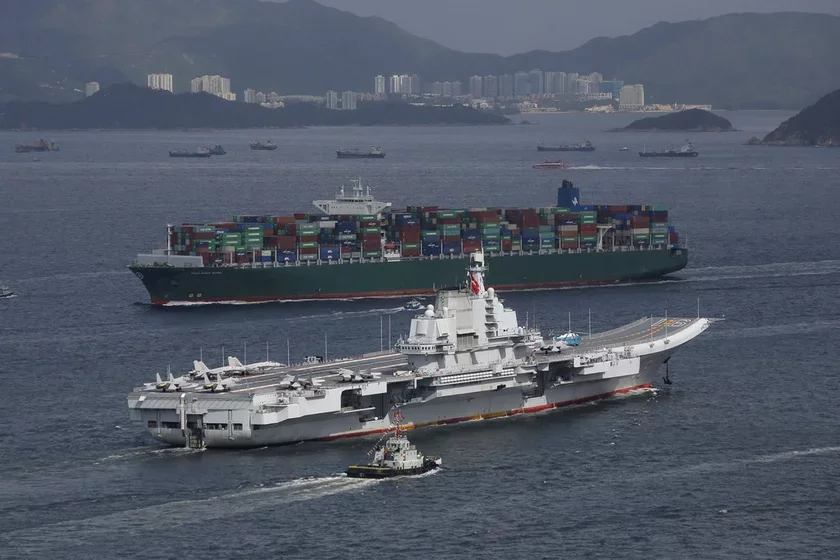
As of the end of the 20th century, China had neither its own aircraft carriers nor experience in building and operating them. The first step towards change seemed like an adventure.
In 1998, a little-known company from Macau bought the unfinished Soviet aircraft carrier "Varyag," which was rusting in a Ukrainian shipyard. They paid a meager 20 million dollars for it and claimed they intended to turn the ship into a floating casino.
However, this was just a cover-up. The aircraft carrier was delivered to China, where it was decided to use it as a basis for creating their own aircraft carrier. It took about 15 years to restore the ship, equip it, and learn how to launch planes from its deck. In 2012, the "Liaoning" became the first aircraft carrier in China's arsenal.
Under Xi Jinping, the development of the navy became one of the main state priorities. He linked the development of maritime trade with the strengthening of military power. China began financing the construction of ports in various parts of the world, from Sri Lanka to Israel and Peru. Its research vessels explore the ocean from the Mariana Trench to the Arctic, and powerful shipyards use civilian shipbuilding capabilities to rapidly build warships.
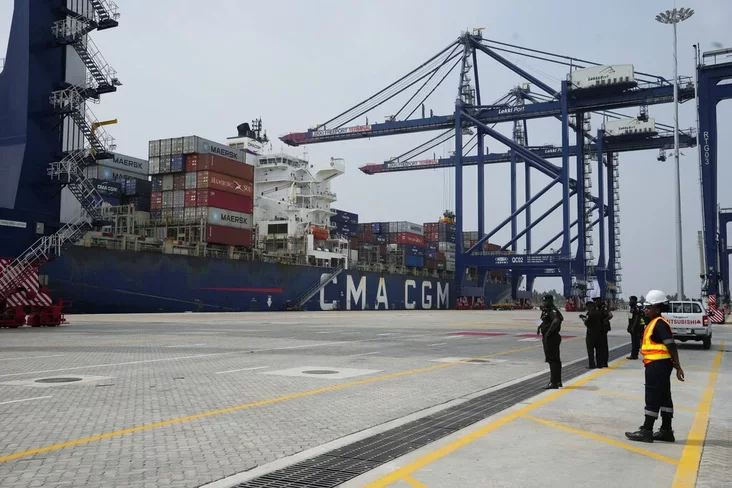
At the same time, money also went directly to military projects. Since around 2014, China has transformed reefs in the South China Sea into artificial islands, and then into bases, thereby changing the balance of power in the region. A few years later, the first overseas base appeared in Djibouti, and a secret agreement was made for access to a base in Cambodia. Along its own coast, piers, docks, and weapons depots were expanded.
In 2020, the Chinese fleet received its first Type 055 destroyer. Now there are already ten such ships. In China, they are classified as destroyers, but due to their large size and powerful armament, the USA classifies them as guided-missile cruisers.
One of them, the "Zunyi," with a displacement of 13,000 tons, shows how far the fleet now sails. In early 2025, it circumnavigated Australia and conducted live-fire exercises approximately 8,000 kilometers from China, which required rerouting passenger flights. Afterwards, it trained as part of an aircraft carrier group, covering 50,000 nautical miles in 200 days.
Changxing Island near Shanghai has become the center of new shipbuilding. Where there were fields five years ago, neighboring shipyards now build gas tankers and container ships for clients worldwide, and nearby — warships. Satellite images from May simultaneously show two amphibious ships, two cruisers, three destroyers, and two frigates.
In 2023, the construction of the "Sichuan" began here — a colossal vessel with a displacement of 40,000 tons, dubbed the "drone carrier." Its size surprised analysts. In June 2026, a new class of submarine, likely nuclear-powered, appeared at the Jiangnan shipyard, which was not known for such work.
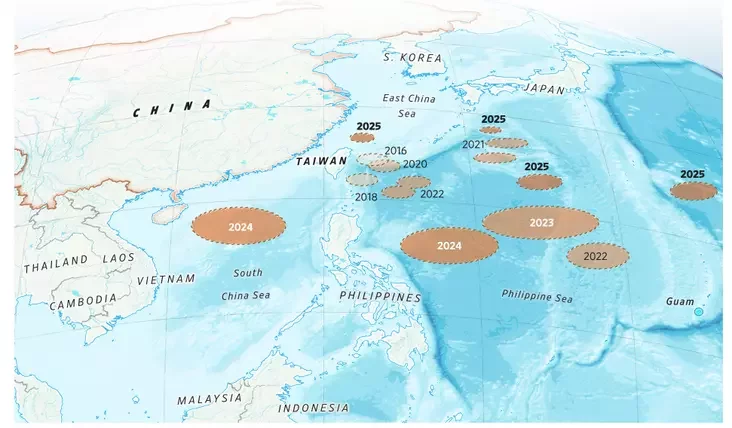
In June 2025, China for the first time sent two aircraft carrier groups simultaneously to the Western Pacific. In the same year, one of the Chinese aircraft carriers for the first time ventured beyond the island chain, which includes Guam, where an important American military base is located. And in November, the Chinese Navy received the "Fujian" with electromagnetic catapults, which until then were only available in the USA. Trump, by the way, conversely ordered a return to steam catapults on future American aircraft carriers, a move the fleet had long resisted.
Ambitious Plans of China in the Oceans
The Chinese fleet now comprises over 400 combat units compared to approximately 290 in the USA. By tonnage, the Americans are still ahead, but since 2020, China has added 71 large ships and submarines, 19 of which were last year. It already has three aircraft carriers. A fourth, according to Western experts, will be nuclear-powered, and by 2035, the Pentagon expects nine of them against 11 American ones. By 2040, Chinese submarines may regularly operate in the Indian Ocean, near the Arctic and possibly in the Atlantic.

In civilian shipbuilding, the gap is even larger. Chinese shipyards annually build more than half of the world's commercial vessels, while the USA produces only a small fraction of them.
The massive expansion of the Chinese fleet is primarily driven by Beijing's strategic interests. Its main goal is to achieve dominance in the seas near the Chinese coast, where rivalry with the USA is increasingly escalating.
The main zone of confrontation stretches from the Yellow Sea to the South China Sea. From the Pacific Ocean side, it is bounded by the so-called first island chain, which passes through Japan, Taiwan, and the Philippines. It is here that China seeks dominance, calculating that in the event of a conflict, it can establish control over Taiwan and prevent US intervention.
Up to 100 Chinese Navy ships are at sea daily. About half a dozen are constantly operating around Taiwan, approximately three times more in the South China Sea. Their presence is supplemented by coast guard vessels, which sometimes ram ships of neighboring countries and use water cannons against them, as well as thousands of fishing boats, some of which are dual-purpose, capable of performing military tasks.
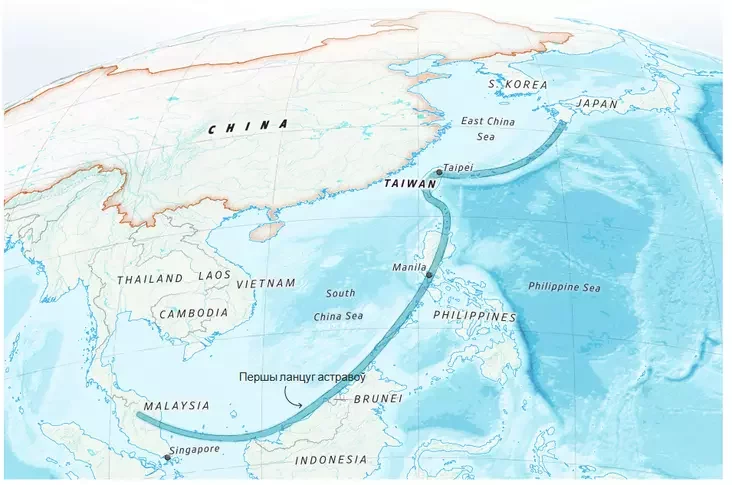
Experts warn that in the event of war, China is capable of defeating a significant portion of traditional American forces. Beijing, meanwhile, is pushing the line of potential confrontation as far east as possible. The US State Department expresses concern, and the White House promises to restore American maritime dominance. But the pace at which China is building naval ships has already become a serious challenge for Washington.
Now reading


It's incredible, but a truckload of cucumbers was brought from Moscow to Olshany — the cucumber capital of Belarus. It was not allowed into the country

It's incredible, but a truckload of cucumbers was brought from Moscow to Olshany — the cucumber capital of Belarus. It was not allowed into the country


"Dima, my half-million-euro microscope is in your clinic. You stole the equipment." The founder of "Novy Zrok" spoke about his relationship with the Abelsky family


Comments
І дарэчы, як там карабель Авраам Лінкальн пры вахце трампа? Ці гэта зноў іншыя вінаватыя?
але нешта пайшло не так))