


Once millions lived here. Laser technologies reveal the scale of a lost Amazonian civilization
Under the canopy of the Amazonian rainforests, far from major rivers, hundreds of geoglyphs—enormous patterns carved into the earth—have been found in Brazil. They are thousands of years old. These are traces of an ancient civilization whose population possibly numbered around three million people, writes the BBC.

"These people were creating monumental geometry in the Amazon at the same time Pythagoras was formulating his theorem in Greece," says paleontologist Alceu Ranzi, president of the Amazonian Geoglyph Institute and a member of the research team.
Scanning the Past
The study, recently published in the journal Nature, was conducted by a group of scientists from universities and institutes in Spain, Finland, Brazil, and Denmark.
They scanned the dense forest canopy using LiDAR (Light Detection and Ranging) technology, which uses laser pulses to measure distances and create complex three-dimensional maps. This allows for the analysis of large areas without clearing vegetation or physically visiting each site.

"This was the first truly large-scale study using LiDAR technology in the Amazon," says archaeologist, anthropologist, and co-author Martti Pärssinen from the University of Helsinki.
The team studied an area of 4400 sq. km and found 432 geoglyphs—the vast majority of which had not been previously recorded. They were created between 600 BC and 850 AD.
The Acre civilization, to which these geoglyphs belong, occupied an area of about 183,000 square kilometers, according to scientists' estimates—roughly the size of modern-day Cambodia or Syria. During its heyday (100–300 AD), the population could have reached three million people.
According to Alceu Ranzi, researchers found ditches up to 15 m wide and 5 m deep. Such grandiose structures indicate that they were created by large communities working together.
"There is no stone in this region. They probably used wooden tools and baskets to move the earth," he suggests.
However, due to the humid climate of the Amazon, organic materials decompose quickly, making it quite difficult to draw definitive conclusions.
Researchers believe that the construction of such objects required not only enormous labor costs and division of labor but also deep knowledge in mathematics and geometry.
What could they have been created for?
It was once believed that geoglyphs served as fortresses or defensive structures, protecting the population from invasions.
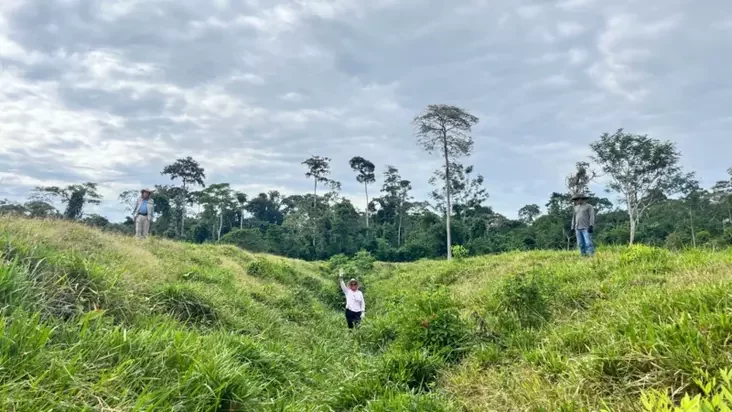
However, today experts believe that these structures most likely performed ceremonial and political functions—and served as gathering places, rather than permanent residences for people.
"If this is confirmed… it means these people lived in peace. The fact that they spent so much effort and labor on creating [the geoglyphs] suggests that they had no serious enemies to worry about," says Ranzi.
According to Pärssinen, the Acre culture was characterized by a deep respect for nature.
"They never turned the rainforest into a savanna," he says. "Forest clearing and tree felling were done only to the extent necessary to support their way of life—cultivating corn, pumpkins, and cassava—and no more."
Excavation results indicate that the structures were carefully maintained.
"It wasn't just about construction, but about preserving these objects for centuries, which undoubtedly required extensive accumulated knowledge," notes another co-author of the study, archaeologist and anthropologist Rhuan Carlos Lopes from the Federal University of Pará (Brazil).
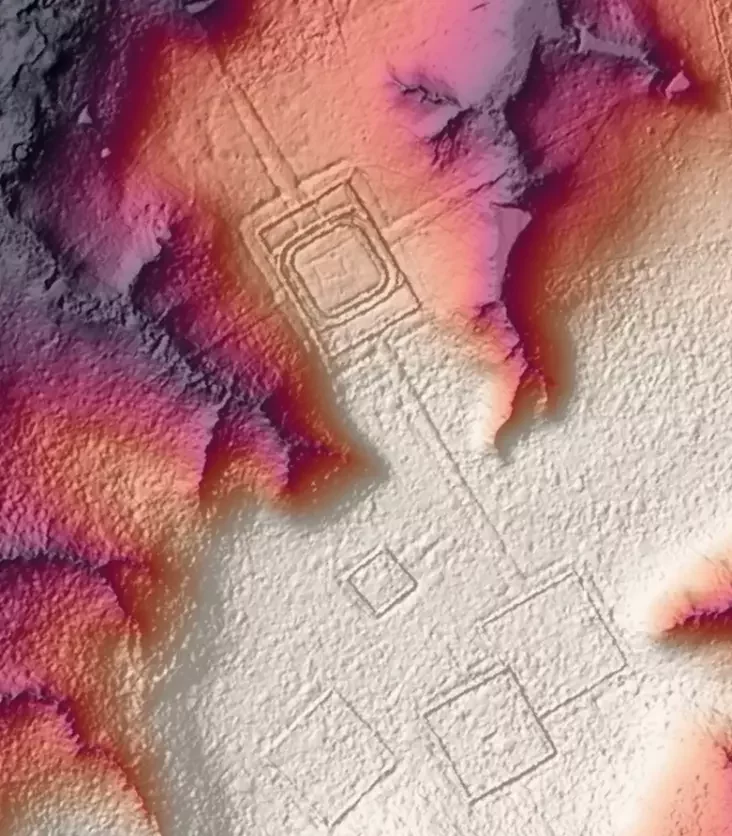
According to Ranzi, the geoglyphs were not isolated and hidden in the forest; they were interconnected.
"We mapped 350 kilometers of roads connecting the geoglyphs," he explains. "These paths led to them, and the roads became wider as they approached the structures."
The End of the Acre Civilization
The creation of geoglyphs apparently ceased around 850 AD. The reason for this remains unclear.
Ranzi draws a parallel with the Maya civilization: major centers of this culture in Mexico and Central America were abandoned around the same time.
"The Maya stopped building and using palaces. The pyramids of Yucatán were swallowed by the forest," he notes. "Something similar happened in the Amazon. Perhaps the 9th century was a period of a large-scale natural crisis."
New research, including this study, challenges the entrenched notion that the Amazon rainforests were "wild nature" that had never known human presence.

Over the past decades, interdisciplinary research has shown that long before the arrival of Europeans, millions of people lived here, leaving a significant mark and altering the landscape of the world's largest rainforest.
"What we see in the Amazon is not a vast natural forest, but rather a huge historical garden, shaped by human activity," asserts Lopes.
Estimates of the region's population in the pre-colonial era are constantly being revised upwards. While early studies suggested that 1-2.5 million people lived across the entire Amazon, later estimates raise this figure to 5-10 million.
Now, given that up to three million people could have lived in a relatively small area, these figures may need to be revised once again.
Furthermore, it was previously thought that the region's inhabitants primarily settled along large rivers, where food was easier to obtain.
However, geoglyphs are found mainly on elevated areas located between rivers. The new research indicates that a large number of people also lived in these areas, cultivating crops and altering the forest landscape.
"These people were not limited to the banks of large rivers, rich in fish and convenient for canoe travel," says Ranzi. "They had an excellent understanding of the landscape, settled away from rivers, and moved across land using a network of roads. And this completely changes our understanding of how the Amazon was settled."
-
Kreva Castle revealed its main secret: the entrance to the dungeon where Kęstutis was strangled was found
-
Ice Mummies and the Viking Pass. How Mysteries Emerge from the Ice, Changing Perceptions of the World
-
"About 70% of Russian visitors turned out to be vatniks." An ex-guide from the WWII museum, detained by his own tour group, is now popular in Warsaw — we spoke with him


Comments